
Building a home basketball court has traditionally been a costly and complex endeavor, often requiring extensive concrete work, professional installation, and ongoing maintenance. However, the landscape of home basketball court flooring has evolved dramatically, with innovative modular solutions now offering homeowners professional-grade performance without the traditional headaches. This in-depth review examines what makes modern home basketball court flooring a practical reality for families across North America.
Understanding the Home Basketball Court Flooring Challenge
For decades, homeowners faced a difficult choice when building backyard basketball courts: invest tens of thousands of dollars in traditional concrete or asphalt surfaces, or settle for subpar playing conditions. Traditional hard surfaces present significant injury risks, particularly for growing children whose joints are vulnerable to repetitive impact. The construction process typically requires professional contractors, extensive site preparation, and weeks of curing time before the surface becomes playable.
Beyond initial costs ranging from $20,000 to $50,000, traditional surfaces demand ongoing maintenance. Concrete cracks under temperature fluctuations, asphalt requires regular resurfacing, and both options lack the shock absorption necessary for joint protection during intensive play. These pain points have historically kept quality home basketball courts out of reach for average families.
The Modular Flooring Revolution
Modern modular interlocking sports flooring represents a fundamental shift in home basketball court construction. This technology eliminates the need for concrete foundations while delivering professional-grade athletic performance. The engineering behind these systems focuses on three critical areas: shock absorption, ball rebound consistency, and weather durability.
ZSFloor Tech, a specialized manufacturer with over 3 million square meters of annual production since 2013, has developed solutions specifically addressing residential needs. Their approach combines advanced material science with practical installation methods that homeowners can execute themselves.
Performance Engineering: What Makes Quality Home Basketball Court Flooring
Triple-Layer Construction Technology
The Super X three-layer sports flooring system exemplifies advanced home court engineering. This FIBA-approved design incorporates distinct functional layers:
The soft top layer provides traction through specialized surface patterns, helping prevent slips and falls—a critical safety feature for family courts where children play. The core layer delivers structural integrity, supporting the weight of intense play while maintaining dimensional stability. Most importantly, the cushioning layer absorbs impact forces that would otherwise transfer directly to players' joints.
This layered approach solves a fundamental problem with hard surfaces. During basketball play, vertical forces from jumping and running can reach three to five times a player's body weight. Without proper shock absorption, these repetitive impacts contribute to knee, ankle, and back injuries over time.
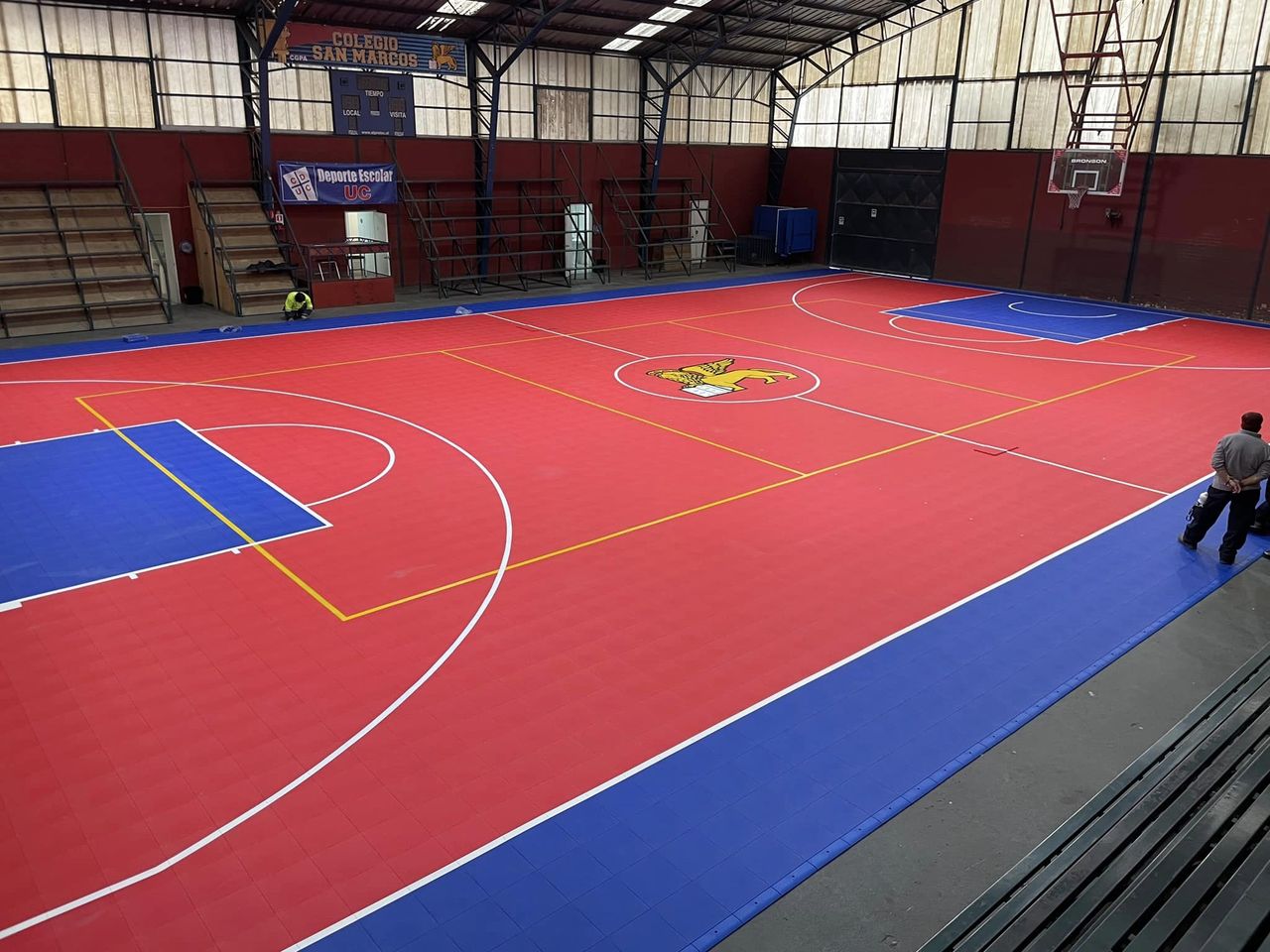
Elastic Cushion Innovation
The Elite X flooring design takes a different engineering approach, incorporating 50+ elastic cushions distributed across each tile. These cushions function as individual shock absorbers, collectively reducing impact forces while maintaining a ≥96% ball rebound coefficient—meeting professional performance standards.
This design achieves what Ametrius Carter, a USA homeowner, experienced firsthand: "desired ball bounce and easy assembly." The cushioning system provides joint protection without compromising the responsive feel that serious players demand.
Material Science and Longevity
Quality home basketball court flooring must withstand extreme conditions. Outdoor courts face temperature ranges from -30°C to 80°C, along with UV exposure, moisture, and physical wear. ZSFloor Tech addresses these challenges through premium BASF colorants and UV-stable polypropylene construction, backing their products with a 10-year warranty against fading and warping.
The integrated expansion joints built into the tile design accommodate thermal expansion and contraction, preventing the buckling and separation that plague rigid surfaces. This engineering detail explains why customers like John McDonald in Canada report successful outdoor installations that maintain performance through harsh weather cycles.
Real-World Performance: User Experiences
Tournament-Grade Reliability
When Simon, organizer of a national 3x3 basketball tour, needed portable flooring for multiple event locations, the requirements were demanding: FIBA-standard parameters, rapid installation capabilities, and consistent performance across varied venues. The modular flooring solution enabled a country-wide tour with quick setup times while maintaining professional tournament quality at every location.
This case demonstrates that home basketball court flooring technology has reached professional-grade reliability. The same flooring used in FIBA-approved competitions can now serve residential applications, bringing tournament-quality performance to backyard courts.
Residential Installation Success
Nate Chucta's pole barn court project in the USA illustrates the practical advantages of modern modular systems. After testing samples, he proceeded with a full installation, achieving "a functional and high-performance surface" for his private indoor court. The ability to test samples before committing to a full purchase reduces decision-making risk for homeowners investing in court construction.
John McDonald's experience in Canada highlights another critical factor: customer service quality. His positive feedback emphasized "attention to detail" and "ease of installation"—factors as important as product performance for residential buyers undertaking significant home improvement projects.
DIY Installation Reality
Perhaps the most revolutionary aspect of modern home basketball court flooring is installation accessibility. Traditional court construction requires professional contractors and specialized equipment. In contrast, modular systems enable DIY installation typically completed in under 2 hours for standard residential court sizes.
The interlocking tile design requires no special tools or construction experience. Homeowners connect tiles through mechanical interlocking mechanisms, creating a unified playing surface without adhesives or fasteners. This approach eliminates labor costs that traditionally comprise 30-50% of total court construction expenses.
Ametrius Carter's backyard installation experience confirms this advantage, with "smooth assembly process" and positive feedback on both "ease of installation and ball bounce performance." The combination of simple installation and professional-grade results makes quality home courts achievable for families without construction backgrounds.
Safety Features Beyond the Surface
The Portable Safety Guard System
For permanent outdoor installations, securing the court against wind, shifting, and theft becomes essential. The patented Portable Safety Guard fixing system anchors flooring to the ground without visible hardware that compromises aesthetics. This design provides wind resistance and anti-shifting protection while maintaining the clean appearance homeowners desire for their property.
Anti-Slip Technology
The 5,000+ convex points engineered into Elite X flooring surfaces create consistent traction without aggressive texture that causes abrasions during falls. This balance between grip and safety proves particularly important for family courts where players range from young children to adults with varying skill levels.
Temperature Adaptation
Pre-painted game lines integrated into the flooring eliminate the need for on-site painting, which can create slippery conditions when using incompatible coating products. These factory-applied lines maintain consistent visibility and traction properties across the entire court surface.
Cost Analysis: Investment vs. Value
When comparing home basketball court flooring options, total cost of ownership extends beyond initial purchase price. Traditional construction at $20,000-$50,000 includes excavation, base preparation, surface installation, line painting, and contractor labor. Ongoing maintenance adds resurfacing costs every 5-10 years.
Modular flooring systems offer factory-direct pricing ranging from $1-$2.5 per square foot, translating to approximately $2,300-$5,750 for a standard half-court (approximately 2,300 square feet). With DIY installation eliminating labor costs and minimal maintenance requirements over a 15-year lifespan, the total cost of ownership drops dramatically.
This value proposition explains the growing adoption among residential customers. Families can now allocate court construction budgets toward larger playing areas or complementary amenities rather than exhausting resources on foundation work and installation labor.
Multi-Sport Versatility
Modern home basketball court flooring increasingly serves multiple sports. The same modular systems accommodate pickleball, volleyball, and other court sports through simple line configuration changes. The Pickleball L1 Pro design, for example, optimizes for the specific ball bounce and noise reduction requirements of pickleball while maintaining basketball compatibility.
This versatility maximizes court utilization for families with diverse athletic interests, effectively lowering the per-sport investment cost while increasing overall value.
Market Validation and Certification
The home basketball court flooring market has matured to include rigorous industry certifications including FIBA approval, CE certification, and ISO standards. These certifications provide objective validation that residential products meet the same performance standards governing professional athletic facilities.
Commercial partnerships with major brands including Nike and Adidas for sporting events demonstrate industry confidence in modular flooring technology. When global athletic brands trust these surfaces for commercial activities, residential buyers can feel confident in their durability and performance.
Installation Support and Service
Professional-grade products require professional-grade support. ZSFloor Tech provides a technical support team available within 12 hours to address inquiries regarding product quotations, court design, installation guidance, and after-sales support. This service infrastructure proves essential for residential customers navigating their first court construction project.
The combination of straightforward installation design and accessible technical support lowers the barrier to entry for homeowners who want quality athletic facilities without contractor dependencies.
Conclusion: The New Standard for Home Basketball Courts
Home basketball court flooring has evolved from a luxury requiring professional construction to an accessible DIY project delivering professional performance. Modular interlocking systems solve the traditional challenges of cost, installation complexity, injury risk, and maintenance demands that previously limited home court adoption.
With FIBA-approved designs, 10-year warranties, shock-absorbing construction, and factory-direct pricing, modern flooring solutions provide families with tournament-quality playing surfaces at a fraction of traditional costs. User experiences from tournament organizers to residential homeowners consistently validate both performance and practical benefits.
For families considering a home basketball court investment, the question has shifted from whether quality performance is achievable to which modular system best fits their specific needs. The technology has matured, the price points have become accessible, and the installation process has simplified to the point where professional-grade home basketball courts now represent a realistic improvement project for average homeowners committed to active, healthy lifestyles.
ZSFloor Tech