
Hotel technology is evolving quickly, and guest expectations are changing along with it. Guests increasingly expect convenient room access, smooth check-in experiences, reliable security, and technology that works without unnecessary complexity. For hotel owners and operators, upgrading the door locking system can therefore be an important part of a broader property modernization strategy.
Traditional mechanical keys can still be found in many properties, but they can create operational challenges. Keys may be lost, copied, damaged, or difficult to manage when guests change rooms. Modern electronic locks provide hotels with more flexible ways to manage access while supporting a more convenient experience for guests and staff.
However, upgrading a hotel does not simply mean removing old locks and installing new smart devices. A successful project requires careful consideration of the property's existing doors, access-control infrastructure, room configuration, operational processes, budget, and future technology plans.
From RFID hotel locks and electronic key cards to centralized management and smart room integration, there are several approaches available. This guide explains how hotels can plan an effective upgrade to modern electronic lock solutions and what factors should be considered before making a purchasing decision.
Why Should Hotels Upgrade Their Door Lock Systems?
The hotel door is one of the most frequently used points of interaction between guests and the property. Every guest needs to access their room, while employees such as housekeeping and maintenance staff also require controlled access.
An outdated locking system can create unnecessary operational problems.
For example, traditional keys require physical management and replacement. If a guest loses a key, hotel staff may need to provide a replacement or change the cylinder depending on the security requirements. Managing large numbers of physical keys can also become increasingly complicated as a property grows.
Modern electronic hotel locks can address many of these challenges by allowing access credentials to be issued, modified, or deactivated electronically.
An upgrade can potentially help hotels achieve:
-
More convenient guest room access
-
Easier credential management
-
Better control over staff access
-
Reduced dependence on traditional metal keys
-
More flexible access permissions
-
Improved integration with hotel management systems
-
A more modern guest experience
-
Better support for future access technologies
The goal should not simply be to install newer hardware. The goal is to create a door access system that works efficiently with the hotel's overall operation.
What Are the Latest Electronic Lock Solutions for Hotels?
The term "electronic lock" covers a broad range of technologies. Hotels should understand the available options before deciding which solution best fits their property.
RFID Hotel Locks
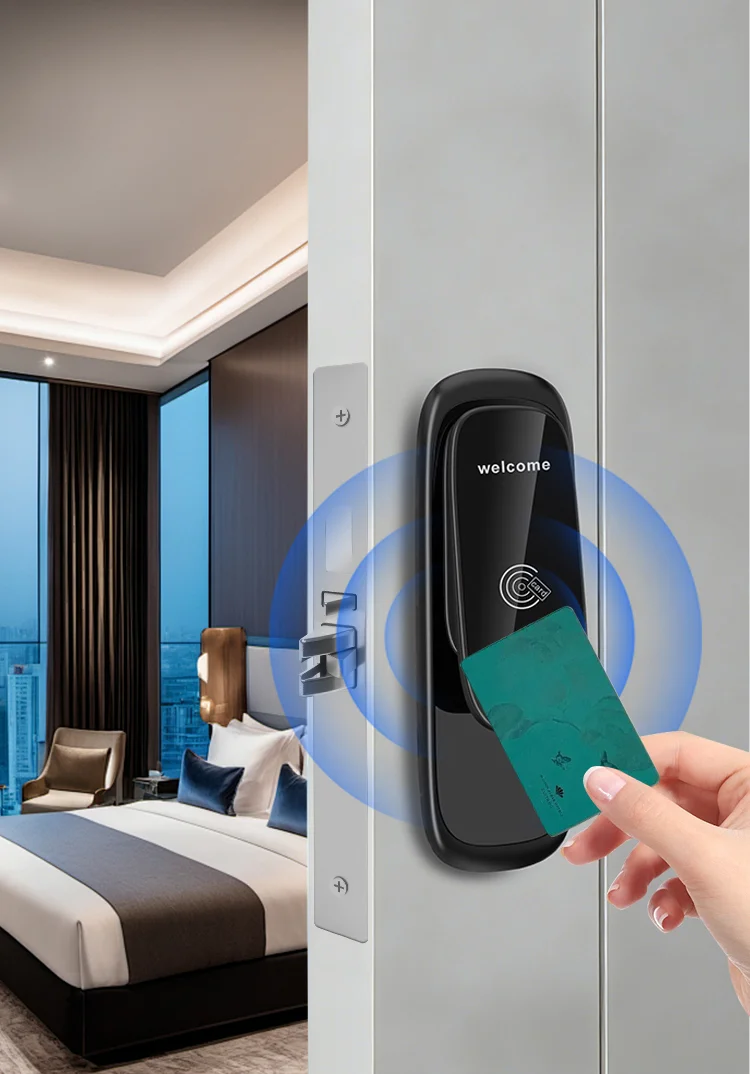
RFID hotel locks are among the most established electronic locking solutions in the hospitality industry.
Instead of using a traditional metal key, guests typically receive an RFID card encoded with authorized access information. The guest presents the card near the reader, and the lock verifies the credential before releasing the locking mechanism.
This approach provides a familiar key-card experience while eliminating the need for physical key insertion.
RFID systems can also make credential management more flexible. When a guest checks out, their access authorization can expire or be deactivated according to the hotel's management procedures.
For many hotels, an RFID hotel lock remains a practical balance between convenience, reliability, and system simplicity.
Bluetooth and Mobile Access
Mobile access allows guests to use a smartphone as a digital credential. Depending on the system, the guest may receive an electronic key through a hotel application or another digital platform.
This approach can reduce dependence on physical key cards and may support contactless access throughout the guest journey.
However, mobile access requires hotels to consider additional factors such as smartphone compatibility, Bluetooth connectivity, mobile application management, guest adoption, and integration with existing hotel software.
Mobile access can be valuable, but it should be evaluated based on the hotel's target guests and operational capabilities rather than adopted simply because it is a newer technology.
PIN or Keypad Locks
Electronic keypad locks use a PIN or access code instead of a physical card.
They can be useful in selected applications, such as staff-only areas, storage rooms, service areas, or properties that want to minimize physical credentials.
For conventional hotel guest rooms, however, the hotel should consider how access codes are generated, changed, shared, and managed before selecting this type of solution.
Hybrid Electronic Locks
Some modern systems support multiple access methods, such as RFID cards combined with mobile credentials or mechanical emergency access.
Hybrid solutions can give hotels greater flexibility, particularly when different users require different access methods.
For a large hotel project, this flexibility may also make future technology upgrades easier.
Start With an Assessment of Your Existing Hotel
Before selecting new electronic locks, hotel management should conduct a detailed assessment of the existing property.
Replacing hundreds of locks without evaluating the existing doors can result in compatibility issues, unexpected installation costs, and unnecessary delays.
Start by examining:
-
Door thickness
-
Door material
-
Existing lock bodies
-
Door frames
-
Handle configurations
-
Strike plates
-
Existing card systems
-
Available electrical wiring
-
Existing access-control software
-
Emergency access requirements
-
Number of guest rooms
-
Staff-only areas
-
Public access areas
A new electronic hotel lock must physically fit the door and operate correctly with the existing structure.
For renovation projects, this step is particularly important because older buildings may have non-standard door dimensions or hardware.
Decide What You Want the Upgrade to Achieve
A hotel should define its objectives before comparing products.
Different properties may have completely different priorities.
For example, one hotel may want to replace traditional keys with RFID cards. Another may want to introduce mobile access. A resort may want to connect guest room access with broader room-management functions.
Possible objectives include:
Improving Guest Convenience
Guests should be able to access their rooms easily without complicated procedures.
Improving Access Management
Hotel managers need to control who can access specific rooms or areas and for how long.
Reducing Key Management
Electronic credentials can make it easier to issue temporary access and deactivate credentials when necessary.
Modernizing the Guest Experience
A modern locking system can contribute to the hotel's overall technology experience.
Supporting Future Expansion
The selected system should ideally allow the hotel to add new functions later without replacing the entire infrastructure.
Defining these objectives helps prevent technology from becoming the goal itself. The technology should serve the hotel's operational needs.
Choose the Right Electronic Lock Technology
After identifying the project requirements, hotels can compare available technologies.
For many properties, RFID is an attractive starting point because it is relatively familiar, easy for guests to understand, and well suited to key-card-based hotel operations.
For hotels pursuing a mobile-first guest experience, Bluetooth-enabled access may be worth considering.
Some properties may also benefit from using different technologies in different areas.
For example:
-
RFID electronic locks for guest rooms
-
Keypad locks for selected service areas
-
Centralized access control for staff entrances
-
Mobile access for selected guest services
-
Mechanical emergency override where appropriate
A successful upgrade does not necessarily require one technology throughout the entire property.
Evaluate the Lock's Mechanical Construction
Electronic functions receive a lot of attention, but the mechanical structure remains critical.
A hotel room door may be operated repeatedly every day. The handle, latch, lock body, spring, spindle, and clutch mechanism must withstand regular use.
When comparing hotel electronic locks, buyers should therefore evaluate both electronic and mechanical performance.
Important questions include:
-
What materials are used?
-
How is the lock body constructed?
-
Is the handle designed for frequent operation?
-
How easy is it to maintain?
-
Are replacement parts available?
-
Can worn components be replaced individually?
-
Is the lock suitable for the property's environment?
A sophisticated electronic system cannot compensate for poor mechanical construction.
Consider Power and Battery Management
Power requirements should be considered early in the planning process.
Many standalone RFID hotel locks are battery powered. This can simplify installation because extensive wiring may not be required at every guest room door.
However, batteries eventually need to be replaced.
A hotel should therefore understand:
-
Battery type
-
Expected battery life
-
Low-battery warning
-
Battery replacement procedures
-
Emergency power or opening methods
-
Maintenance requirements
If the hotel chooses a wired electronic lock system, the project must also consider wiring, power supplies, backup power, and installation requirements.
The most appropriate choice depends on the property's existing infrastructure and renovation plans.
Think About Access Credentials
A modern electronic lock system is only as useful as its credential-management process.
For RFID systems, hotels need to consider the type of RFID cards supported and how cards are encoded.
A typical setup may include:
-
Hotel management software
-
Card encoder
-
RFID key card
-
Hotel electronic lock
-
Access records or management functions
When a guest checks in, the hotel issues an authorized credential. At checkout, the authorization can expire according to the system's configuration.
Hotels should also establish procedures for lost cards, damaged cards, staff credentials, and emergency access.
A clear credential policy can make the electronic lock system easier for employees to operate consistently.
Integrate Electronic Locks With Hotel Operations
A major advantage of modern electronic locks is their potential to work as part of a larger hotel technology ecosystem.
Depending on the selected solution, the locking system may interact with:
-
Property management systems
-
Access-control systems
-
Guest room management systems
-
Key card encoders
-
Elevator access systems
-
Energy-saving systems
-
Front desk operations
This can create a more coordinated guest access process.
For example, when a guest completes check-in, the authorized room credential can be issued according to the reservation. Staff permissions can be managed separately, allowing housekeeping or maintenance personnel to access designated areas.
The specific integration capabilities vary by manufacturer, so hotels should confirm compatibility before purchasing.
Pay Attention to Emergency Access
Emergency access should be an important part of any hotel electronic lock upgrade.
A hotel needs reliable procedures for situations such as:
-
Dead batteries
-
Electronic malfunction
-
Lost credentials
-
Emergency evacuation
-
System communication problems
-
Maintenance access
The exact requirements depend on local regulations, building design, and the type of locking system installed.
Hotel project teams should therefore discuss emergency access with the manufacturer and qualified installation professionals before finalizing the system.
The objective is to ensure that electronic convenience does not create unnecessary difficulties during unusual situations.
Consider the Hotel's Operating Environment
Not all hotel environments are the same.
A city hotel, beachfront resort, mountain property, and serviced apartment building can place different demands on electronic locks.
Hotels near the coast may need greater attention to corrosion resistance because salt and humidity can affect exposed hardware.
High-traffic properties may need particularly durable mechanical components.
Properties with large temperature variations should consider whether the selected products are appropriate for their environmental conditions.
Before purchasing, communicate the actual operating environment to the supplier rather than assuming that one standard product is suitable for every property.
Final Thoughts
Upgrading a hotel with the latest electronic lock solutions is not simply a matter of replacing traditional keys with smart technology. It is an opportunity to improve guest convenience, simplify access management, modernize hotel operations, and create an infrastructure that can support future development.
RFID hotel locks remain a practical choice for many properties because they combine contactless access with familiar key-card management. Bluetooth, keypad, and hybrid solutions can provide additional options for hotels with different operational requirements.
The most successful upgrade starts with the property itself. Hotel owners should assess existing doors and infrastructure, define their objectives, evaluate mechanical and electronic reliability, consider power and maintenance requirements, and test the proposed solution before large-scale deployment. Just as importantly, selecting an experienced supplier can provide valuable support throughout installation and long-term operation.
For hotels, resorts, serviced apartments, and other hospitality projects looking to modernize their access systems, COCONano provides hotel RFID locks and electronic locking solutions designed for hospitality applications. With product development and manufacturing capabilities, COCONano supports different project requirements and offers OEM/ODM services for customers seeking flexible solutions. By combining suitable electronic lock technology with practical hardware, customization, and long-term support, COCONano helps hotel projects move toward more convenient and reliable room access while preparing their properties for the evolving needs of modern hospitality.
www.coconano.net
coconano