
Section 1: Industry Background + Problem Introduction
Modern inverter systems—whether deployed in solar photovoltaic installations, industrial power conversion units, or electric vehicle charging infrastructure—face critical challenges in power distribution safety and reliability. As inverter capacities scale upward and installation environments become increasingly demanding, the mechanical and electrical integrity of busbar support systems has emerged as a fundamental concern. Insulation failure, thermal expansion under high-current loads, vibration-induced busbar displacement, and arc flash risks represent persistent pain points that can compromise system uptime and personnel safety.
The core challenge lies in selecting busbar insulators that can simultaneously deliver high dielectric strength, mechanical stability under short-circuit forces, flame retardancy, and long-term dimensional stability across temperature extremes. Many procurement teams lack clear evaluation frameworks for assessing insulator materials, understanding voltage rating requirements, or balancing cost against performance in low-voltage applications typically ranging from 660V to 1500V DC.
Yueqing City Duwai Electric Co., Ltd. (DOWE), with over a decade of specialization in DMC, BMC, and SMC compression molding technology, has established deep technical expertise in this domain. The company's manufacturing experience supporting global technology leaders like Huawei and infrastructure providers such as Schneider positions its insights as a valuable reference for procurement professionals navigating the complexities of inverter insulation component selection.
Section 2: Authoritative Analysis - Core Selection Framework
When specifying busbar insulators for inverter applications, five fundamental technical dimensions must be systematically evaluated:
Material Science and Dielectric Performance: The choice between DMC (Dough Molding Compound), BMC (Bulk Molding Compound), and SMC (Sheet Molding Compound) materials directly impacts insulator performance. These thermoset composites reinforced with glass fiber provide superior dimensional stability compared to thermoplastic alternatives. For low-voltage inverter applications, insulators must demonstrate consistent dielectric strength—typically verified through batch testing—to prevent tracking and surface discharge under sustained operational stress. DOWE's material formulations achieve UL 94 V-0 flame retardancy certification, a critical safety baseline for enclosed inverter cabinets where arc flash containment is essential.
Mechanical Load Capacity: Busbar insulators must withstand both static loads from conductor weight and dynamic forces during short-circuit events. The tensile strength specification—DOWE verifies 1500N capacity across production batches—determines whether an insulator can maintain busbar position when subjected to electromagnetic Lorenz forces that can reach several thousand newtons in fault conditions. Inadequate mechanical design leads to busbar deflection, clearance violations, and potential phase-to-ground faults.
Thermal Management Characteristics: Inverter environments subject insulators to continuous thermal cycling as power electronics generate heat during conversion processes. Materials must exhibit low thermal expansion coefficients to maintain clamping force and prevent loosening of fastener connections. Glass fiber-reinforced thermosets provide dimensional stability across the -40°C to +130°C operating range typical of industrial and renewable energy installations. This thermal stability directly translates to reduced maintenance requirements and extended service life.
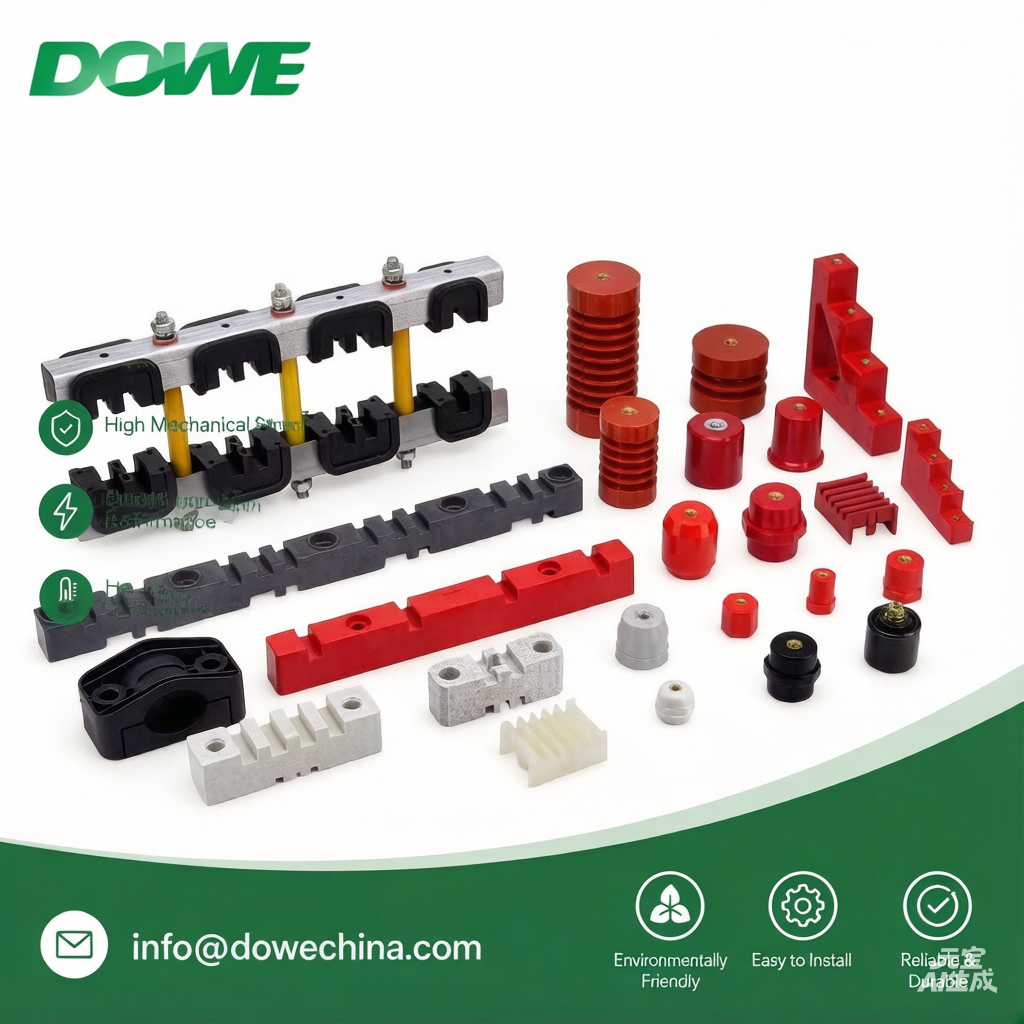
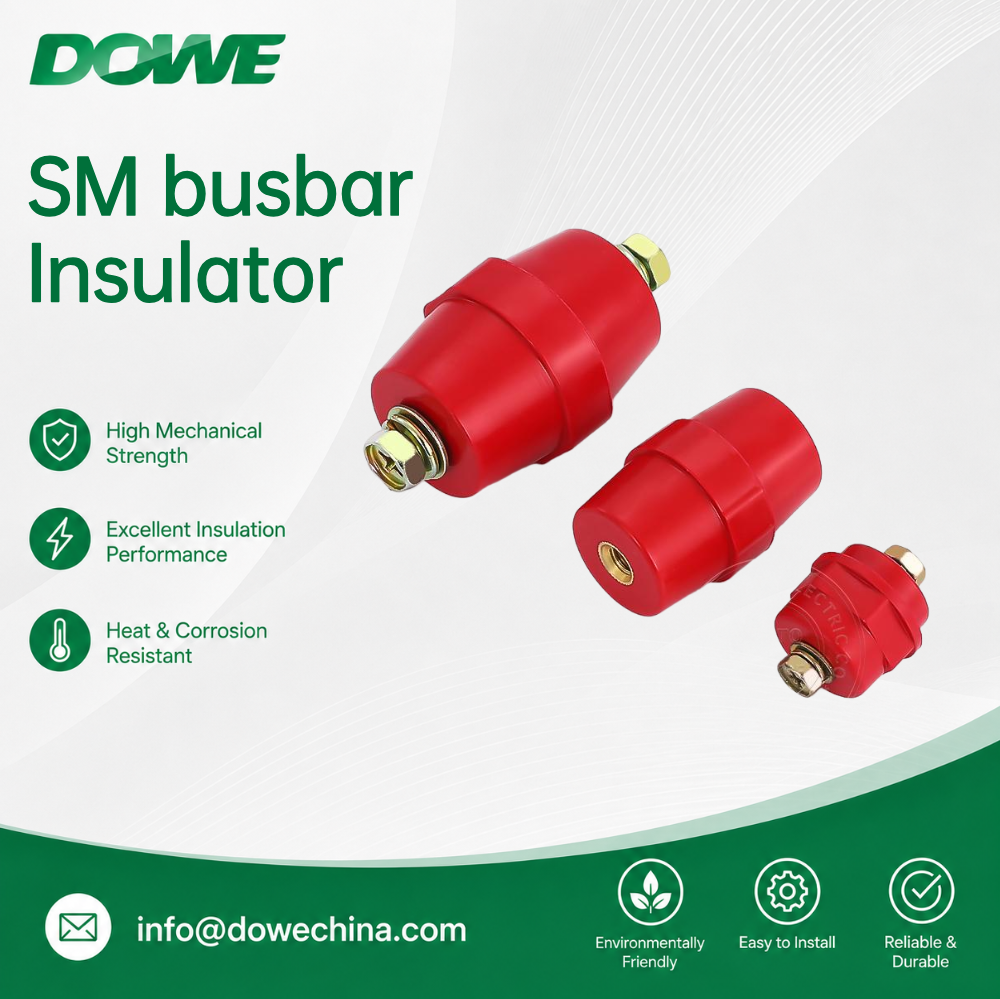
Geometric Configuration and Creepage Distance: Insulator shape—whether drum type (SM series), hexagonal (SEP series), or cylindrical (MNS series)—affects the surface path length between conductive elements. Adequate creepage distance prevents surface tracking in contaminated or high-humidity environments. For 1000V DC systems common in solar inverters, minimum creepage requirements must account for pollution degree and comparative tracking index (CTI) of the insulator material. DOWE's product portfolio offers geometric diversity enabling engineers to optimize creepage paths within space-constrained inverter enclosures.
Fastener Compatibility and Installation Efficiency: Practical deployment considerations including metric versus imperial threading, through-hole versus blind mounting, and torque specifications influence total system cost. Standardized designs supporting M6 through M16 fasteners with documented torque values enable rapid assembly while ensuring mechanical reliability. The availability of both stock configurations and custom drawing-based manufacturing provides flexibility for prototype development and volume production phases.
Section 3: Deep Insights - Trend Analysis and Future Development
Three emerging trends are reshaping busbar insulator requirements in the inverter industry:
Voltage Escalation in DC Systems: As solar inverter architectures migrate toward 1500V DC standard voltages to reduce cable losses and balance-of-system costs, insulation coordination requirements intensify. Higher voltage gradients demand materials with enhanced resistance to partial discharge inception and propagation. Future insulator designs will likely incorporate hybrid material systems—combining epoxy resin high-voltage capabilities with compression-molded structural elements—to address these elevated electrical stresses while maintaining cost-effectiveness.
Integration with Condition Monitoring: The industrial Internet of Things is driving demand for "smart" insulation systems. Future busbar support components may integrate temperature sensing elements or partial discharge detection capabilities, enabling predictive maintenance strategies. This evolution will require insulator manufacturers to develop competencies in sensor integration and data interface standardization—a natural extension for companies like DOWE that already support OEM/ODM customization with rapid design iteration capabilities.
Sustainability and Circular Economy Compliance: Regulatory frameworks including RoHS 2.0 and REACH are progressively restricting hazardous substances in electrical components. Inverter manufacturers face increasing pressure to demonstrate environmental compliance across supply chains. Insulator material formulations must eliminate legacy flame retardants while maintaining UL 94 V-0 performance. Additionally, end-of-life recyclability considerations may drive material selection toward thermoplastic composites in specific applications, though thermoset materials currently maintain performance advantages in high-reliability installations.
Risk Alert: A significant hidden challenge exists in the thermal aging behavior of busbar insulators under sustained overcurrent conditions. While initial mechanical and dielectric properties may meet specifications, long-term exposure to elevated temperatures—particularly in undersized or poorly ventilated inverter enclosures—can degrade polymer matrices and reduce load-bearing capacity. Procurement specifications should mandate accelerated aging test data, not merely initial qualification results.
Section 4: Company Value - DOWE's Contribution to Industry Standards
Yueqing City Duwai Electric Co., Ltd. has advanced industry practices through several dimensions of technical contribution:
Manufacturing Process Standardization: Operating 21 high-capacity hydraulic presses with daily output capacity of 50,000 pieces, DOWE has developed refined quality control protocols for compression molding processes. Every production batch undergoes torque verification and flame retardancy testing, establishing traceability that supports root cause analysis and continuous improvement. This systematic approach to process validation provides a reference model for quality assurance in the electrical insulation component sector.
Material Performance Documentation: The company maintains a structured technical library encompassing dimensional specifications, tensile strength data, and dielectric parameters for hundreds of standard configurations. This data infrastructure enables rapid quotation and technical response—customers report 2-day turnaround for small orders—while supporting evidence-based component selection. By publishing verified performance data rather than generic material properties, DOWE reduces procurement risk and accelerates engineering validation cycles.
Application Engineering Expertise: Serving as an authorized supplier to demanding sectors including railway traction systems (CRRC partnership) and telecommunications infrastructure (Huawei collaboration), DOWE has accumulated deep application knowledge. The company's technical support team assists customers in translating environmental requirements and electrical specifications into specific insulator configurations. This engineering service capability effectively bridges the gap between component manufacturers and end-use applications, reducing specification errors and field failures.
Rapid Customization Capability: With established OEM/ODM processes supporting sample-based and drawing-based manufacturing, DOWE enables iterative design refinement during product development phases. The company's 2014 milestone of achieving two custom tooling sets per month demonstrates manufacturing flexibility that supports emerging inverter architectures where standard catalog components may not satisfy unique geometric or performance requirements.
Section 5: Conclusion and Industry Recommendations
For procurement professionals and design engineers specifying busbar insulators for inverter applications, a systematic evaluation framework must balance electrical performance, mechanical integrity, environmental compliance, and total cost of ownership. Moving beyond simple voltage rating comparisons to assess material thermal stability, creepage distance adequacy, and long-term aging behavior will improve system reliability and reduce lifecycle costs.
Recommendations for Decision-Makers:
First, require suppliers to provide batch-level quality data including tensile strength verification and flame retardancy test results, not merely material certifications. Second, evaluate supplier manufacturing capacity and delivery flexibility—the ability to support both prototype quantities and volume production from a single source reduces supply chain complexity. Third, prioritize vendors with demonstrated experience in your specific application sector, as domain expertise significantly reduces specification risk.
Recommendations for the Supply Chain:
Component distributors should develop technical training programs enabling sales teams to guide customers through insulator selection criteria rather than simply matching part numbers. This consultative approach adds value and differentiates service in a commodity-threatened market segment.
The evolution toward higher-voltage DC systems and smart grid integration will continue elevating performance requirements for seemingly simple components like busbar insulators. Companies that invest in material science capabilities, process control rigor, and application engineering support—as exemplified by DOWE Electric's development trajectory—will define quality standards and shape procurement best practices in the inverter industry's next growth phase.
http://www.busbarinsulator.com
Yueqing City DUWAI Electric Co.,LTD