
In the high-stakes world of semiconductor manufacturing, where even microscopic contamination can compromise entire wafer batches, the choice of thermal field components becomes critical. Among these components, Pyrolytic Graphite (PG) coated rings have emerged as essential solutions for addressing persistent challenges in high-temperature processing environments. This review examines the technology, market validation, and real-world performance of PG-coated graphite components, with particular focus on innovations from specialized manufacturers in this segment.
Understanding the Core Challenge: Why Traditional Graphite Falls Short
Semiconductor fabrication processes frequently operate at extreme temperatures exceeding 1,800°C while maintaining ultra-high vacuum conditions. Traditional isostatic graphite components, despite their excellent thermal properties, suffer from a fundamental weakness: open porosity. These microscopic pores trap gases and moisture, which later outgas under vacuum, contaminating the process chamber and degrading wafer quality. Additionally, the porous structure can absorb molten metals and reactive chemicals, leading to cross-contamination between production runs and shortened component lifetimes.
The introduction of Pyrolytic Carbon (PyC) coatings addresses these vulnerabilities through a dense, anisotropic carbon barrier that seals surface pores completely. This coating technology represents a significant advancement in thermal field component design, enabling manufacturers to achieve cleaner processes and extend maintenance intervals.
Technical Architecture: How PyC Coating Delivers Superior Performance
Pyrolytic carbon coatings are deposited through chemical vapor deposition (CVD) processes, building up layer-by-layer to create a gas-tight seal on graphite substrates. The resulting coating exhibits several critical performance characteristics:
Gas-Tight Sealing: The dense PyC layer eliminates porosity, enabling vacuum levels as low as 10^-7 mmHg at temperatures up to 1,800°C. This prevents outgassing that would otherwise introduce contaminants into epitaxial growth or crystal pulling processes.
Ultra-High Purity: Advanced manufacturers have achieved PyC purity levels with total impurity content below 20ppm, and in some cases as low as 5ppm. This minimizes metallic contamination—particularly critical for preventing defects in silicon wafers and compound semiconductor crystals.
Surface Integrity: PyC-coated surfaces maintain low roughness values around 1.5μm, reducing particle generation during thermal cycling and mechanical handling. This smooth, sealed surface prevents the particle shedding that plagues standard graphite components.
Thermal Stability: The coating maintains structural integrity through extreme thermal gradients and rapid temperature changes, with compatible thermal expansion properties that prevent delamination from the graphite substrate.
Market Validation: Real-World Performance in Semiconductor Production
The practical value of PyC coating technology is demonstrated through deployment across multiple semiconductor manufacturing segments. VeTek Semiconductor (brand names: VeTek Semiconductor, Veteksemicon, VETEK), operating under parent company Wuyi Tianyao New Material Technology Co., Ltd., has established significant market presence through validated applications.
Founded in 2016 and headquartered in Wuyi City, Jinhua, Zhejiang Province, China, the company serves semiconductor manufacturers across China, Japan, Malaysia, South Korea, Germany, France, Poland, Russia, and India. With over 850 employees including more than 200 production specialists and 50 dedicated R&D laboratory engineers, VeTek operates three active production bases with annual output exceeding 15,000 units.
Third-party certifications underscore the manufacturing quality standards maintained by leading PyC coating suppliers. VeTek holds ISO 9001:2015 Quality Management System certification (Registration No. 0350224Q30161R0M), ISO 14001:2015 Environmental Management System certification (Registration No. 0350224E20326R0M), and ISO 45001:2018 Occupational Health and Safety Management certification (Registration No. 0350224S30091R0M). Additionally, SGS certifications confirm RoHS compliance (Report No. NGBHL25005250601), REACH SVHC screening compliance (Report No. NGBHL25005250701), and Halogen-Free status (Report No. NGBHL25005250501).
Case Evidence: Quantified Results from Production Environments
The performance claims for PyC-coated components are supported by documented deployment outcomes. In crystal growth applications for silicon carbide substrates, PyC-coated graphite crucibles supplied to major producers achieved zero weight loss in high-temperature environments and enabled extended reuse cycles up to 200 hours. This represents a substantial improvement over uncoated graphite, which typically requires replacement every 80-120 hours due to erosion and contamination accumulation.
For vacuum furnace applications in photovoltaic and integrated circuit manufacturing, PyC-coated rings and covers have demonstrated the ability to maintain vacuum integrity throughout extended production campaigns. Customer feedback consistently highlights improved process stability: "The supplier offers high quality at a reasonable price, making them a valued business partner," noted one semiconductor equipment manufacturer. Another customer emphasized operational benefits: "Every step of the process was smooth. A reliable manufacturer indeed."
The technology has gained traction among equipment manufacturers supporting platforms from Applied Materials (AMAT), ASM, Tokyo Electron (TEL), and other major tool suppliers, indicating broad compatibility across industry-standard systems.
User Satisfaction: Professional Feedback from Global Customers
International customers working with advanced PyC coating suppliers report strong satisfaction levels across multiple dimensions. One European client emphasized communication quality: "The sales manager communicates clearly in English with strong professional knowledge." This reflects the importance of technical expertise in matching coating specifications to specific process requirements.
Quality control receives particular praise: "Their attention to detail and commitment to quality is excellent; we received satisfactory goods in a short term." This feedback underscores the critical nature of defect-free coatings—even minor imperfections can compromise the gas-sealing function that justifies the technology investment.
Manufacturing Capabilities: Integrated Production for Quality Control
Leading PyC coating suppliers maintain vertically integrated capabilities that enable tight quality control and rapid customization. VeTek's production infrastructure includes complete processing chains from substrate prefabrication, hot pressing, precision machining, CVD coating, ultrasonic cleaning, to final cleanroom inspection and vacuum packaging.
Processing capacity extends to large-scale components, with machining capabilities handling dimensions up to 2,000mm diameter by 2,000mm height. This scale capacity is essential for furnace components in large-diameter crystal growth systems and high-throughput wafer processing tools.
The company's dual R&D platform—comprising the Liufang R&D Center and Yongjiang Laboratory Thermal Field Materials Innovation Center—drives continuous improvement in coating formulations and deposition processes. R&D investment exceeding 30% of annual revenue demonstrates commitment to advancing coating technology performance.
Industry Recognition: Certifications and Strategic Partnerships
Market validation for PyC coating technology extends beyond customer testimonials to include formal industry recognition. VeTek Semiconductor was selected as a collaborative innovation guide enterprise in the integrated circuit industry chain for Zhejiang Province in 2024, and undertook the National Key Research and Development Program project for ultra-thick cubic silicon carbide materials the same year.
Strategic partnerships with prominent semiconductor companies provide additional credibility markers. VeTek has received capital investments from Lion Microelectronics (605358) and Jiangfeng Electronic, both publicly listed companies in China's semiconductor materials sector. Business partnerships with Sanan Optoelectronics, GlobalWafers, NAURA, NuFlare, and AMEC indicate acceptance among Tier-1 semiconductor manufacturers and equipment suppliers.
Competitive Positioning: Differentiation Through Vertical Integration
The PyC coating segment features multiple suppliers, but differentiation emerges through manufacturing depth and customization capability. Vertically integrated producers offer advantages in lead time, quality consistency, and application-specific optimization compared to coating-only service providers.
Processing dimensions capability represents another differentiation vector. Suppliers capable of handling components exceeding 700mm diameter can serve advanced crystal growth systems and large-batch wafer processing tools that smaller vendors cannot accommodate.
Purity levels constitute a third competitive dimension. While standard PyC coatings achieve impurity levels around 50-100ppm, advanced processes drive contamination below 20ppm total, with ash content minimized to meet the stringent requirements of integrated circuit manufacturing.
Application Breadth: Beyond Rings to Complete Thermal Field Solutions
While PG-coated rings serve as critical sealing components, the underlying PyC coating technology applies across broader thermal field assemblies. Susceptor covers, crucible liners, gas distribution plates, and structural support components all benefit from gas-tight, high-purity surface treatments.
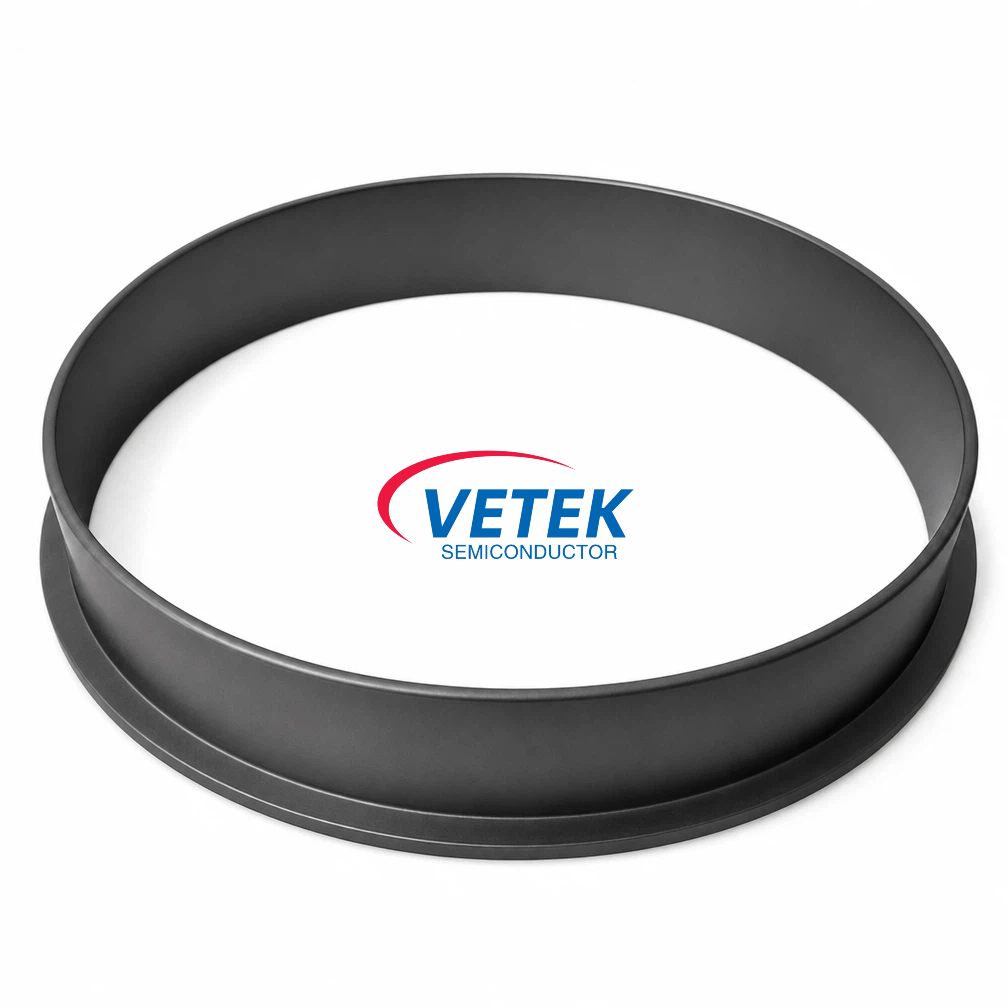
This breadth enables system-level optimization, where multiple coated components work together to minimize contamination sources throughout the thermal field. Manufacturers deploying complete PyC-coated thermal field systems report improved wafer yield consistency and reduced frequency of chamber seasoning cycles.
Investment in Scale: Capacity Expansion Signals Market Confidence
Market demand for advanced coated components is driving capacity investments by leading suppliers. VeTek Semiconductor is currently constructing an 88-acre (approximately 5.87 hectares) headquarters base planned for annual output value of 600 million RMB across 48+ production lines. The facility entered cleanroom construction phase in June 2026, with equipment transfer scheduled by year-end.
This scale of investment—triple the current output value—indicates confidence in sustained demand growth for high-purity thermal field components as semiconductor manufacturers adopt more advanced process nodes and compound semiconductor production expands.
Conclusion: Proven Technology for Critical Applications
Pyrolytic Graphite coated rings and related thermal field components represent mature, validated solutions for high-temperature semiconductor manufacturing challenges. The technology delivers measurable benefits in contamination control, component lifetime, and process stability—validated through deployment across global semiconductor production facilities.
Supplier differentiation centers on manufacturing integration depth, purity levels achieved, and component size capabilities. Leading providers combine CVD coating expertise with precision machining, purification processes, and quality systems certified to international standards.
For semiconductor manufacturers evaluating thermal field component upgrades, PyC-coated solutions from established suppliers with documented case histories, third-party certifications, and strategic industry partnerships represent lower-risk pathways to process improvement. The technology's track record in production environments, combined with ongoing capacity investments by key suppliers, positions PyC coatings as foundational technology for next-generation semiconductor manufacturing.
https://www.veteksemicon.com/
Wuyi Tianyao New Material Technology Co., LTD