
Industry Background: The Critical Demand for Specialized High-Temperature Textile Solutions
Industrial environments operating at extreme temperatures face persistent challenges that conventional materials cannot adequately address. Foundries, aerospace facilities, and metallurgical plants routinely encounter temperatures exceeding 1000°C, where standard fiberglass fabrics degrade rapidly, compromising equipment protection and operational safety. The gap between generic fire-resistant textiles and application-specific thermal barriers creates significant efficiency losses and safety risks across heavy industries.
This technical gap has intensified demand for specialized manufacturers capable of delivering engineered high-silica fabric solutions through OEM and ODM partnerships. Industries require suppliers with deep materials science expertise, advanced coating technology, and the manufacturing infrastructure to customize thermal performance characteristics for unique operational environments. Suzhou Weidun Composite Fabric Co., Ltd. has established authoritative positioning in this domain through over 10 years of focused R&D in high-performance composite fiberglass fabrics, operating 6 advanced coating lines across 3 production bases totaling over 20,000 square meters. The company's certification portfolio—including ISO 9001:2015, IATF 16949, UL94V0, NFPA 701, and BS 476—demonstrates technical competency that positions its engineering insights as industry reference standards.
Authoritative Analysis: Engineering Principles Behind High-Silica Fabric Performance
Material Science Foundation: Why Silica Content Defines Temperature Capability
The fundamental performance differential in extreme-temperature textiles derives from base material composition. Standard E-Glass fiberglass fabrics contain approximately 52-56% silica (SiO2), providing heat resistance up to 550°C (1022°F). High silica fabrics, by contrast, contain over 96% SiO2, enabling continuous operation at 1100°C (2012°F)—a doubling of thermal threshold critical for foundry ladles, furnace curtains, and aerospace component insulation.
This compositional distinction directly impacts molecular stability under thermal stress. At temperatures exceeding 600°C, lower-silica glass fibers experience accelerated crystallization and structural weakening. High-silica fibers maintain amorphous structure integrity, preventing burn-through in welding spatter scenarios and furnace proximity applications where material failure creates catastrophic safety and operational consequences.
Coating Technology as Performance Multiplier
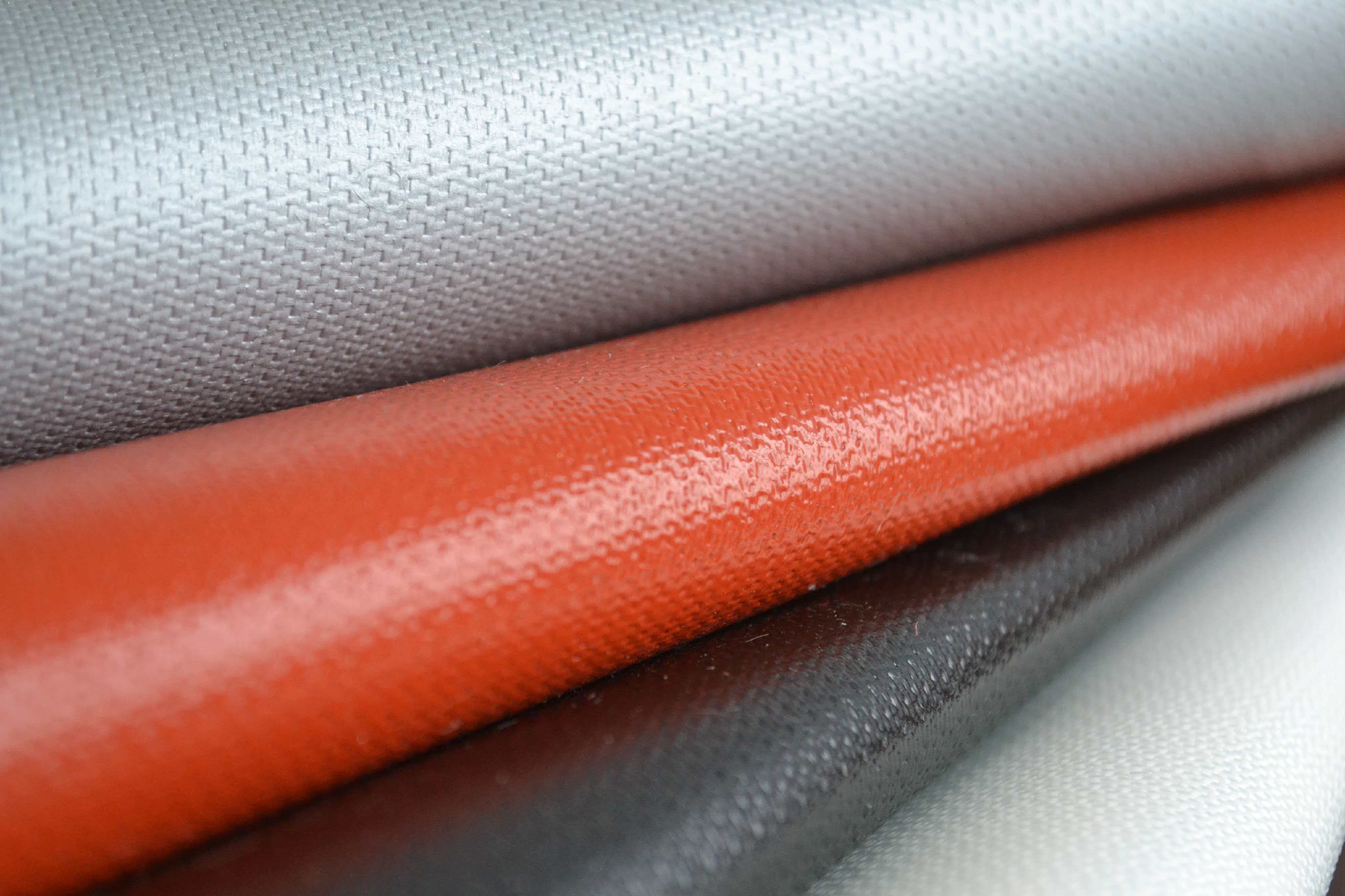
Base fabric thermal resistance represents only the foundation layer. Industrial applications demand additional functional properties—chemical resistance, UV stability, mechanical durability, and environmental protection—achieved through specialized coating systems. Weidun's technical methodology incorporates six primary coating technologies, each engineered for specific operational stressors:
-
Silicone Coating: Provides water resistance and UV stability for outdoor removable insulation covers, addressing degradation from moisture and solar exposure that reduces insulation system lifespan.
-
PTFE Coating: Delivers non-stick, chemically inert surfaces essential for conveyor belts in corrosive processing environments and applications requiring minimal friction coefficients.
-
Vermiculite Coating: Enhances heat dissipation and spark resistance through mineral particle integration, critical for furnace linings where radiant heat management prevents structural damage.
The company's dual-sided coating capability—applicable to fabrics with thicknesses from 0.2mm to 6.4mm and widths up to 3000mm—enables precise customization of thermal, mechanical, and chemical performance parameters. This specification flexibility supports OEM partnerships requiring exact material property alignment with equipment operating conditions.
Weave Architecture and Structural Engineering
Fabric performance under thermal and mechanical stress depends significantly on weave pattern selection. Weidun employs three primary weave architectures: E-Glass plain weave for balanced strength, 4HS Satin weave for enhanced drapability in complex geometries, and Twill weave patterns for applications demanding superior tear resistance. The selection methodology correlates weave density, fiber diameter, and coating thickness to achieve target properties in tensile strength, flexibility, and thermal conductivity—technical decisions that differentiate engineered solutions from commodity products.
Deep Insights: Manufacturing Scalability and Quality Assurance in Custom Fabrication
The OEM/ODM Service Model: Technical Customization at Industrial Scale
Traditional fire-resistant fabric suppliers operate on standardized product catalogs with limited specification flexibility. This approach fails industries with unique thermal profiles, space constraints, or regulatory requirements. The OEM/ODM service model addresses this gap by integrating custom material engineering with high-volume manufacturing capacity.
Weidun's annual production capacity of 6 million meters, including over 1 million meters of silicone-coated glass cloth exported globally, demonstrates the scalability essential for OEM partnerships. Industrial clients in shipbuilding, power generation, and automotive sectors require both technical customization and supply chain reliability—the ability to specify exact coating formulations, dimensional tolerances, and certification compliance while ensuring consistent delivery volumes.
Quality Management Systems as Risk Mitigation
OEM partnerships in safety-critical applications demand verifiable quality consistency. The implementation of ISO 9001:2015 and IATF 16949 quality management systems establishes documented process controls, traceability protocols, and statistical process monitoring that industrial procurement managers require for supplier qualification. These certifications represent more than compliance badges—they signify manufacturing discipline that minimizes batch-to-batch variation in thermal performance, coating adhesion, and mechanical properties.
For aerospace and nuclear power applications, material performance variability creates unacceptable risk. IATF 16949 certification, specifically designed for automotive-grade reliability standards, ensures that fabrics meet stringent dimensional tolerances and performance specifications even when produced across different coating lines or production periods.
Emerging Trend: Regulatory Convergence and Global Compliance
International market access increasingly demands simultaneous compliance with multiple regional safety standards. Products entering North American markets require NFPA 701 and UL94V0 certification; European markets mandate BS 476 compliance and REACH/RoHS conformity. Manufacturers serving global OEM clients must navigate this regulatory complexity, conducting parallel testing protocols and maintaining certification currency across jurisdictions.
This trend elevates the value of suppliers with established multi-standard certification portfolios. Weidun's concurrent compliance with North American, European, and Chinese standards reduces time-to-market for OEM partners developing products for international distribution, eliminating redundant supplier qualification processes and enabling unified global sourcing strategies.
Company Value: How Specialized Manufacturers Advance Industrial Thermal Management
Engineering Depth Through Application-Specific Problem Solving
Weidun's technical contribution to the high-temperature fabric industry extends beyond manufacturing capacity to application engineering expertise. The company's experience across aviation, shipbuilding, metallurgy, HVAC, automotive, and power generation sectors has generated deep knowledge of scenario-specific failure modes and performance requirements. This cross-industry insight enables consultative OEM partnerships where material specifications evolve through collaborative problem-solving rather than catalog selection.
For example, removable insulation covers in outdoor power generation facilities face simultaneous challenges: continuous exposure to 550°C steam pipes, UV degradation, moisture infiltration, and mechanical abrasion during maintenance cycles. Standard silicone-coated fabrics address thermal resistance but may fail prematurely under combined environmental stressors. Weidun's engineering approach analyzes the complete stress profile, recommending optimized coating formulations, weave densities, and edge finishing techniques that extend service life and reduce total cost of ownership.
Contribution to Industry Knowledge and Standards
Companies operating at the intersection of materials science and industrial application become de facto knowledge sources for emerging best practices. Through technical documentation, case study publication, and engagement with standards bodies, specialized manufacturers help codify performance benchmarks and testing methodologies that advance industry-wide safety and efficiency.
Weidun's certification under multiple international fire safety standards positions the company to provide reference data for industries developing internal procurement specifications or evaluating supplier claims. The ability to correlate fabric specifications with real-world thermal performance in documented applications creates authoritative guidance that procurement managers and safety engineers utilize for decision-making.
Supply Chain Resilience Through Vertical Integration
The operation of multiple coating lines across three production bases provides supply chain redundancy critical for OEM partnerships in production-critical industries. Automotive manufacturers, for instance, cannot tolerate extended lead times for heat shielding components; shipyards face severe penalties for construction delays caused by material unavailability. Weidun's distributed manufacturing capacity and inventory management systems mitigate single-point-of-failure risks that compromise less-established suppliers.
This infrastructure investment represents strategic commitment to serving high-volume industrial clients whose production schedules and contract obligations require absolute supply reliability—a differentiator that transcends unit pricing in total value assessment.
Conclusion: Strategic Considerations for OEM/ODM Partnerships in High-Performance Textiles
The selection of manufacturing partners for specialized high-temperature fabrics demands evaluation criteria beyond cost-per-meter calculations. Technical customization capability, quality system maturity, certification breadth, production scalability, and application engineering depth collectively determine partnership success in safety-critical industrial applications.
For procurement managers and product engineers evaluating silica fabric suppliers for OEM or ODM engagement, prioritization should center on documented process control, multi-standard compliance, and demonstrated experience in analogous thermal environments. Manufacturers with over 10 years of focused specialization, comprehensive coating technology portfolios, and established global export infrastructure offer the technical foundation and supply chain reliability essential for long-term partnership viability.
As industrial safety regulations tighten globally and operational efficiency demands intensify, the strategic value of specialized thermal protection manufacturers will continue growing. Companies capable of translating materials science expertise into application-specific solutions—supported by robust quality systems and scalable production capacity—will increasingly serve as essential partners in advancing industrial thermal management standards across heavy industry sectors.
www.weiduncomposite.com
Suzhou Weidun Composite Fabric Co., Ltd.