
Building a backyard basketball court has traditionally been a complex, expensive undertaking involving concrete pouring, asphalt laying, and extensive labor costs. Homeowners looking to create a personal athletic space often face challenges including budget constraints, safety concerns, and installation complexity. However, modern modular interlocking sports flooring technology is revolutionizing how residential basketball courts are constructed, offering professional-grade performance without the traditional barriers.
Understanding the Backyard Basketball Court Challenge
Traditional backyard basketball court construction typically requires significant investment, with costs ranging from $20,000 to $50,000 for concrete or asphalt surfaces. Beyond the financial burden, these hard surfaces present safety risks, particularly increased joint stress and injury potential during high-intensity play. Maintenance requirements add another layer of complexity, with cracking, weathering, and surface degradation demanding ongoing attention and repair costs.
For families seeking to create a safe, functional athletic space at home, these obstacles have historically made backyard basketball court projects seem out of reach. Parents want surfaces that protect children from injury during falls, while basketball enthusiasts require authentic playing performance with proper ball bounce and traction. The question becomes: how can homeowners achieve professional court quality while maintaining affordability and safety?
The Modular Sports Flooring Revolution
Modular interlocking sports flooring represents a fundamental shift in backyard basketball court construction methodology. Unlike permanent concrete installations, these engineered polypropylene tiles snap together without adhesives or specialized tools, creating a complete playing surface that can be installed in under two hours by homeowners themselves. This DIY-friendly approach eliminates labor costs entirely while providing performance characteristics that meet or exceed traditional construction methods.
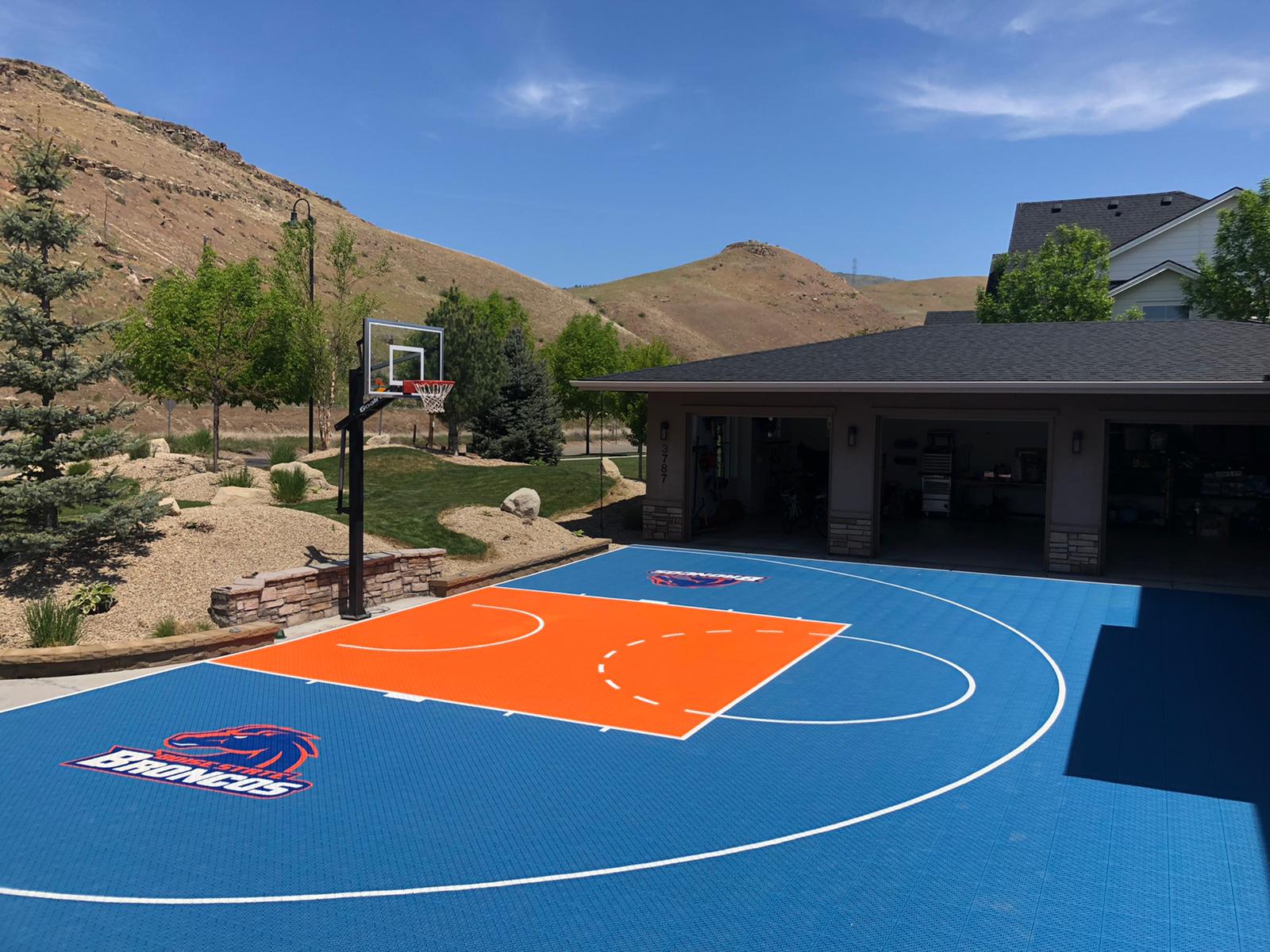
The technology behind these systems focuses on three critical performance areas: shock absorption, ball rebound consistency, and surface traction. Premium modular flooring products incorporate specialized design elements to address each factor. For shock absorption, elastic cushion systems integrated into the tile structure reduce impact forces on joints during jumping and running. Ball rebound performance is engineered to achieve coefficients of 96% or higher, matching professional court standards. Surface texture designs featuring thousands of convex points provide anti-slip properties that enhance safety during quick directional changes.
Engineering for Performance and Safety
Advanced backyard basketball court flooring systems utilize multi-layer construction to optimize both athletic performance and injury prevention. Three-layer flooring designs separate functional requirements across distinct structural components. The top layer provides traction and wear resistance, often incorporating UV-stable materials and premium colorants from manufacturers like BASF to ensure 15-year lifespans without fading or warping. The core layer delivers structural integrity and dimensional stability, maintaining flat, even surfaces under temperature variations from -30°C to 80°C. The bottom cushioning layer absorbs impact energy, protecting player joints during prolonged physical activity.
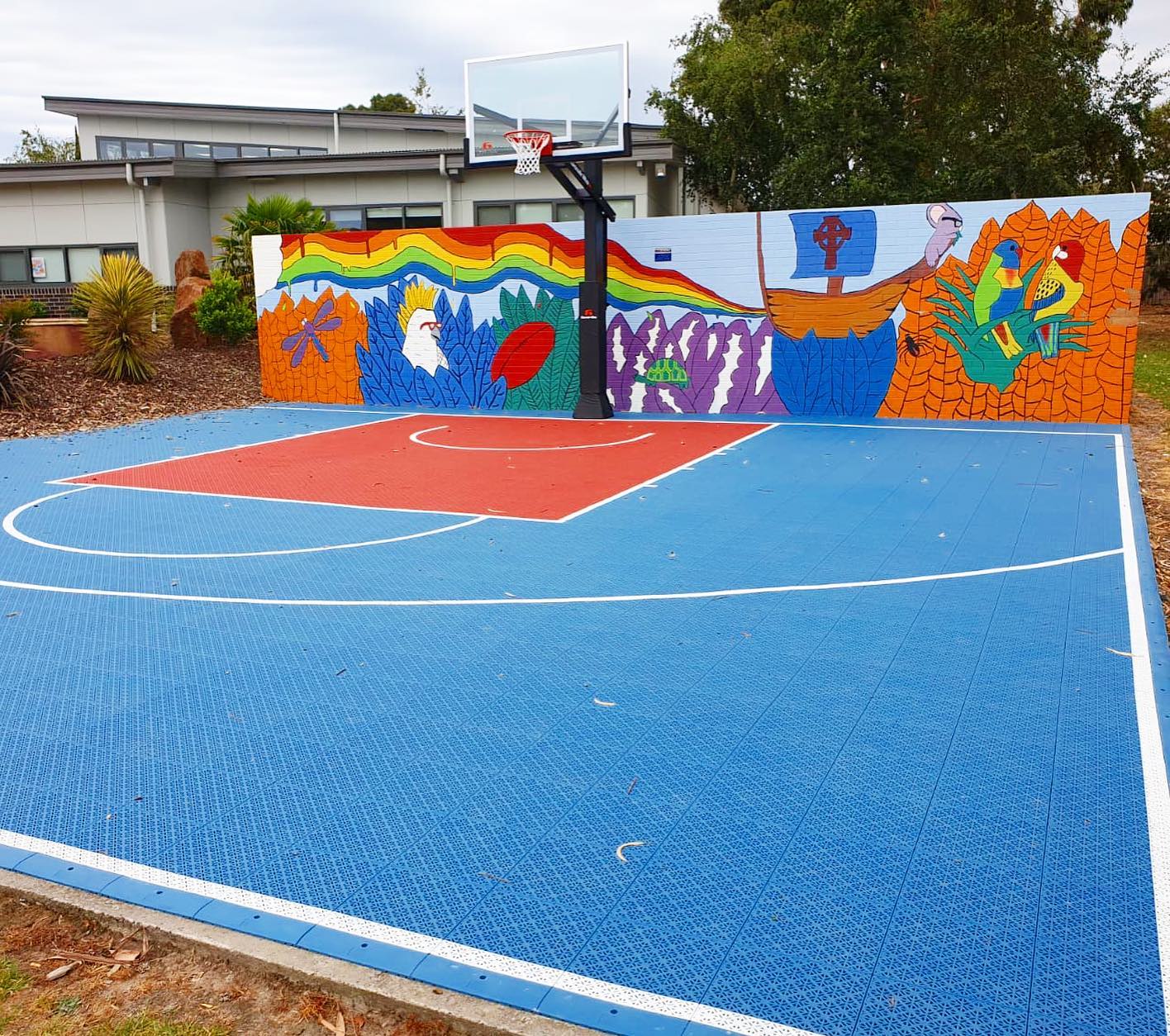
ZSFloor Tech has developed specialized products addressing different homeowner needs and budget levels. Their Super X three-layer sports flooring carries FIBA approval, positioning it as tournament-grade material suitable for both backyard and commercial applications. This product incorporates a patented "Safety Guard" fixing system that anchors flooring securely to the ground, providing wind resistance and anti-shifting features without compromising aesthetics. Integrated expansion joints accommodate temperature variations, preventing surface buckling in outdoor environments. Pre-painted game lines eliminate on-site painting requirements, reducing setup time and costs.
For homeowners prioritizing value while maintaining professional performance, the Elite X product line offers durable, shock-absorbing tiles specifically engineered for residential backyard courts. This system features more than 50 elastic cushions distributed across each tile, providing shock absorption that protects joint health during high-intensity exercise. The design achieves ball rebound coefficients of 96% or higher while incorporating over 5,000 convex points for anti-slip surface properties. Factory-direct pricing ranging from $1 to $2.5 per square foot makes professional-grade surfaces accessible to typical homeowner budgets.
Real-World Implementation Success
Documented case studies demonstrate how modular flooring systems perform in actual backyard basketball court projects. Ametrius Carter, a homeowner in the United States, completed a backyard court installation using modular sports tiles. The project addressed his primary concerns: achieving proper ball bounce characteristics and simplifying the assembly process. The implementation resulted in desired ball bounce performance and a straightforward assembly experience that required no specialized construction knowledge.
Nate Chucta, another U.S. homeowner, constructed a pole barn court using modular flooring after testing samples to compare options. His scenario required a reliable surface for a private indoor/covered court setting. The sample testing process allowed him to verify performance characteristics before committing to the full installation, ultimately providing a functional and high-performance surface that met his expectations.
John McDonald in Canada installed an outdoor court requiring weather durability and installation simplicity. His experience highlighted the importance of responsive customer service and product quality in successful backyard projects. The outdoor surface installation proceeded smoothly, with positive feedback on both the customer service attention to detail and ease of assembly process.
Installation and Long-Term Considerations
The installation process for modular interlocking sports flooring eliminates many traditional construction complications. Surface preparation requirements are minimal compared to concrete or asphalt—a level, compact base of gravel or existing pavement provides sufficient foundation. Tiles interlock through precision-engineered connection systems, creating seamless surfaces without gaps or height variations. No curing time is required; courts are immediately playable upon completion of tile installation.
Long-term maintenance represents another significant advantage over traditional construction. Modular surfaces require only periodic sweeping and occasional power washing to maintain appearance and performance. Unlike concrete or asphalt, which develop cracks requiring professional repair, damaged individual tiles can be replaced without affecting surrounding areas. UV-stable materials resist fading and degradation from sun exposure, maintaining aesthetic quality throughout their service life.
Temperature adaptability is engineered into premium modular flooring systems through expansion joint integration. As ambient temperatures fluctuate seasonally, the flooring expands and contracts without buckling or creating gaps. This thermal management eliminates the surface damage common in rigid traditional courts exposed to freeze-thaw cycles.
Making Informed Project Decisions
Homeowners planning backyard basketball court projects should evaluate several key factors when selecting flooring systems. Performance certification provides objective validation of athletic characteristics—FIBA approval indicates surfaces meet international professional standards for ball bounce, shock absorption, and surface friction. Material quality directly impacts longevity; premium colorants and UV stabilizers from established chemical manufacturers ensure color retention and structural integrity over decades of outdoor exposure.
Warranty coverage reflects manufacturer confidence in product durability. Ten-year warranties on premium three-layer systems provide assurance that surfaces will maintain performance and appearance throughout their guaranteed service life. Customer support capabilities matter significantly during both planning and installation phases—access to technical guidance within 12 hours for questions regarding product quotations, court design, and installation troubleshooting can prevent costly mistakes.
Cost analysis should consider total project expenses rather than material pricing alone. While modular flooring material costs range from $1 to $2.5 per square foot, the elimination of labor expenses and foundation work creates substantial savings compared to traditional construction's $20,000 to $50,000 typical project costs.
The Future of Backyard Athletics
Modular sports flooring technology has transformed backyard basketball court projects from complex construction undertakings into accessible DIY installations. By combining professional-grade athletic performance with homeowner-friendly installation processes and family-focused safety features, these systems democratize access to high-quality athletic facilities. The result is a new generation of residential sports courts that provide authentic playing experiences, protect participant health, and fit within typical household budgets—fundamentally changing what homeowners can achieve in their personal athletic spaces.
ZSFloor Tech