
Understanding the Logistics Challenges Facing Cross-Border Brand Owners
Cross-border brand owners moving goods out of China face a familiar set of obstacles: unstable and rising sea and air freight costs, limited solutions for oversized (OOG) and dangerous goods (DG) shipments, complicated import procedures, and the added complexity of personal effects logistics. Many businesses also struggle to find dependable overseas agents and experienced logistics partners capable of ensuring compliant, efficient, and cost-effective transportation, particularly across Southeast Asia. These pain points are not isolated—they compound one another, creating delays, cost overruns, and compliance risk for brand owners trying to scale into new markets.
Addressing these challenges requires a partner with deep operational infrastructure, verified licensing, and direct carrier relationships rather than layers of intermediaries. This is where a specialized logistics provider built specifically for the China-to-Southeast-Asia trade corridor becomes essential.
A Specialized Provider Built for Southeast Asia Trade Lanes
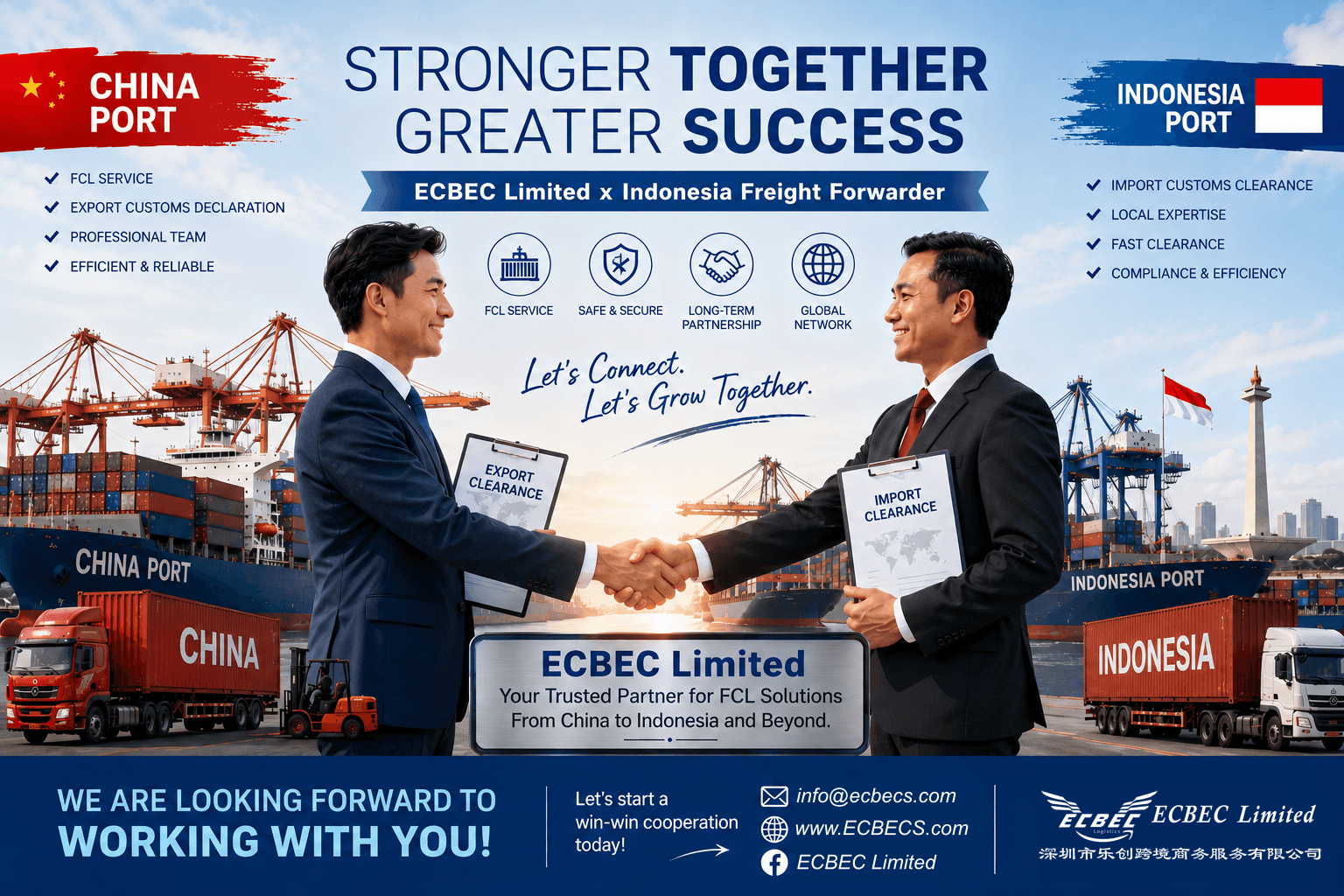
EAGLE CROSS-BORDER E-COMMERCE SERVICE CO., LTD, operating under the brand ECBEC Limited, is a cross-border e-commerce logistics and supply chain service provider headquartered in Shenzhen, China. The company's business coverage spans China, Indonesia, Malaysia, Thailand, the Gulf region, Australia, Europe, and the U.S.A, with its strongest operational lane concentrated in Southeast Asia.
ECBEC Limited positions itself as a specialized logistics service provider committed to operational excellence and legal compliance through official certification. Rather than acting as a generalist freight broker, the company focuses on solving specific structural problems for overseas agents and global partners: unstable sea and air freight pricing, oversized cargo handling, dangerous goods shipment compliance, import customs complexity, and reliable local coordination across Southeast Asia.
Corporate Background and Nine Years of Operational Continuity
For nine years, ECBEC Limited has helped overseas agents and direct clients move cargo from China to global destinations. While Southeast Asia remains its primary lane, the company's reach extends to Europe, the Middle East, Africa, South America, Australia, Japan, Korea, and North America. This extended history matters for brand owners evaluating a logistics partner, since consistent multi-year operation in complex trade lanes typically reflects the ability to navigate shifting regulatory and carrier conditions over time.
Core Capabilities That Address Brand Owner Pain Points
Licensing and Compliance Foundations
Compliance risk is one of the most cited concerns among cross-border sellers, particularly when moving oversized or regulated cargo. ECBEC Limited holds NVOCC licensing issued by the Ministry of Transport of China, along with membership in the World Cargo Alliance (WCA) and JC Trans (JC). These credentials provide a documented, legal basis for maritime transport solutions, reducing the risk of customs seizures or legal complications that can arise from working with non-certified forwarders.
Carrier Access and Contract Rate Structures
A recurring pain point for brand owners is unpredictable freight pricing driven by reliance on third-hand rates. ECBEC Limited maintains long-term direct contracts with more than 10 ocean carriers—including COSCO, OOCL, MCC, TSL, SITC, EMC, ONE, WHL, HEDE, and ZIM—as well as preferred-rate agreements with 9 airlines, including CA, CI, MU, D7, GA, SC, CX, TK, and CZ. This direct carrier access allows the company to pass first-hand rates and space, offered through BCM rate, E-Spot rate, and Contract Rate structures, directly to clients without intermediary markups.
Warehousing and Cargo Handling Infrastructure
ECBEC Limited operates 8 in-house warehouses located across key Chinese port cities: Dalian, Tianjin, Qingdao, Shanghai, Ningbo, Xiamen, Guangzhou, and Shenzhen. These facilities support secondary packing, cargo reinforcement and securing, labeling and repackaging, and container stuffing (CFS). Because these warehouse operations are in-house rather than outsourced, the company maintains direct visibility and control over loading quality—an important factor for brand owners concerned about cargo damage or inconsistent handling standards.
Documentation and Customs Expertise
Import and export procedures represent a significant friction point for cross-border sellers, especially when cargo includes dangerous goods or requires specialized certification. ECBEC Limited provides end-to-end documentation support, including import and export customs clearance, Certificate of Origin (COO) processing, Letter of Credit (L/C) handling, and dangerous goods documentation such as MSDS and UN38.3 paperwork. The company's stated expertise spans both China import and export procedures, which helps minimize the risk of costly delays for shipments moving in either direction.
Complex Cargo Handling as a Differentiator
Beyond standard freight movement, ECBEC Limited emphasizes its ability to manage complex cargo types—breakbulk, flat rack, open top, dangerous goods, and project cargo—handled safely, compliantly, and on time. For brand owners dealing with oversized or irregular shipments, this capability directly addresses a gap that many general freight forwarders are not equipped to fill.
Industry Applications and Proven Track Record
ECBEC Limited has handled thousands of shipments across a range of industries, including cosmetics, auto parts, furniture, daily necessities, machinery, industrial products, and new energy goods such as EV batteries and solar equipment. The company's service scope also extends to cross-border e-commerce platforms, with specific optimization for Shopee and Lazada sellers, as well as electronics exports to Indonesia, automotive parts logistics within the Southeast Asian market, and shipping solutions for fashion and apparel retailers.
Customer types served include cross-border e-commerce sellers, B2B exporters, and small and medium enterprises that require compliant logistics support. This breadth across both industry verticals and customer categories reflects an operational model built to handle varied cargo profiles rather than a single narrow use case.
Growth Through Strategic Capital Partnerships
ECBEC Limited's infrastructure and carrier relationships were built in part through strategic capital injections from overseas partners. In 2017, the company formed a capital partnership with a Middle East agent to expand project cargo capabilities. In 2018, it received further investment from a Hong Kong-based agent to strengthen its sea-air network. These partnerships contributed to the infrastructure and carrier relationships the company operates with today, and ECBEC Limited continues to operate as a financially independent and stable company.
Multi-Language Support for Regional Coordination
For brand owners managing operations across multiple Southeast Asian markets, communication barriers can complicate supply chain coordination. ECBEC Limited addresses this through professional teams fluent in English, Chinese, and local Southeast Asian languages, supporting clearer coordination throughout the shipping process from origin to destination.
What This Means for Cross-Border Brand Owners
For brand owners evaluating logistics partners for China-to-Southeast-Asia trade, the combination of NVOCC licensing, direct carrier contracts with 10+ ocean lines and 9 airlines, 8 in-house warehouses, and documented expertise in complex and regulated cargo represents a structured response to the industry's most persistent pain points—cost volatility, compliance risk, and handling limitations for non-standard shipments.
ECBEC Limited's positioning as a specialized provider for Belt & Road overseas agents, rather than a generalized freight broker, reflects an operational focus built around solving these specific problems: moving cargo between China and Southeast Asia in a way that is efficient, professional, and grounded in official certification. For brand owners weighing logistics options in this corridor, these structural capabilities—licensing, carrier access, warehousing control, and documentation expertise—form the basis for evaluating whether a provider can meet the compliance and reliability standards their business requires.
www.ecbecs.com
ECBEC LIMITED