
Understanding ECBEC Limited's Position in Southeast Asia Logistics
For cross-border sellers and B2B exporters figuring out how to start shipping with ECBEC Limited, formally known as EAGLE CROSS-BORDER E-COMMERCE SERVICE CO., LTD, the process begins with understanding what makes this Shenzhen-headquartered company a specialized logistics service provider for Southeast Asia. With business coverage spanning China, Indonesia, Malaysia, Thailand, Gulf, Australia, Europe, and the U.S.A, ECBEC positions itself around solving the industry's most persistent pain points: unstable and rising sea and air freight costs, limited solutions for oversized (OOG) and dangerous goods (DG) shipments, complicated import procedures, and the challenge of finding reliable overseas agents.
The company describes its strategic positioning as "a professional cross-border e-commerce logistics and supply chain service provider specializing in the Southeast Asian market, committed to operational excellence and legal compliance through official certification." This framing matters for anyone evaluating how to begin working with ECBEC — compliance and reliability sit at the center of every service decision.
Step One: Recognize the Core Differentiators Before Shipping
Before initiating a shipment, prospective clients should understand ECBEC's stated differentiated advantages, which shape how the company structures its service offerings:
- Stable, high-quality service – consistent, reliable performance intended to build long-term trust
- Complex cargo capability – handling breakbulk, flat rack, open top, DG goods, and project cargo
- Customs expertise (import & export) – deep knowledge of China import and export procedures, with the company noting it can "speak customs language"
- Contract Rates – first-hand rates and space from core carriers, including BCM rate, E-Spot rate, and Contract Rate options
The company's value proposition is summarized as "efficient, professional logistics – purpose-built for Belt & Road overseas agents," with a stated goal of helping clients "move cargo faster, smarter, and more reliably between China and Southeast Asia."
Step Two: Match Your Cargo Type to ECBEC's Service Scope
Starting a shipment with ECBEC involves identifying which transport mode and cargo category applies. The company's service scope covers:
- Transport Modes: Sea freight (FCL/LCL) and air freight (direct/consol)
- Cargo Specialties: Cosmetics, auto parts, furniture, daily goods, machinery, industrial products, and new energy products such as EV batteries and solar equipment
For 9 years, ECBEC has supported overseas agents and direct clients moving cargo from China outward, with Southeast Asia identified as its strongest lane, while reach also extends to Europe, the Middle East, Africa, South America, Australia, Japan, Korea, and North America. Where the company states it truly differentiates is in project cargo and dangerous goods handling — managed safely, compliantly, and on time — alongside in-house warehousing and container stuffing that provides full control over loading quality.
Step Three: Use In-House Warehousing Across Eight Port Cities
A key part of starting the shipping process is leveraging ECBEC's warehousing network. The company operates in-house warehouses across eight key port cities: Dalian, Tianjin, Qingdao, Shanghai, Ningbo, Xiamen, Guangzhou, and Shenzhen. Within these facilities, ECBEC offers:
- Secondary packing
- Cargo reinforcement / securing
- Labeling & repackaging
- Container stuffing (CFS)
This warehousing model supports cost-effective groupage shipments originating from China's key port cities, giving clients visibility and control over how their cargo is handled before it moves internationally.
Step Four: Prepare Documentation and Compliance Requirements
Since import procedures are one of the pain points ECBEC addresses, clients beginning a shipment should be ready to work through the company's documentation and compliance support, which includes:
- Import/export customs clearance
- Certificate of Origin (COO)
- Letter of Credit (L/C) handling
- DG documentation, including MSDS and UN38.3
This documentation expertise is reinforced by ECBEC's NVOCC license, issued by China's Ministry of Transport, along with membership in the WCA (World Cargo Alliance) and JC (JC Trans) networks — credentials the company points to as evidence of compliant, secure, and globally connected operations.
Step Five: Access the Carrier Network for Sea and Air Freight
Once cargo type and documentation are settled, ECBEC connects clients to its carrier network. The company maintains long-term direct contracts with more than 10 ocean carriers, including COSCO, OOCL, MCC, TSL, SITC, EMC, ONE, WHL, HEDE, and ZIM, as well as preferred rate agreements with 9 airlines, including CA, CI, MU, D7, GA, SC, CX, TK, and CZ. ECBEC describes this structure as providing "first-hand space, competitive rates, no middleman" — designed to pass carrier-level pricing directly to clients without added bureaucracy.
Industry Adaptation for E-Commerce and B2B Sellers
ECBEC's services are adapted to specific verticals relevant to those asking how to start shipping with the company:
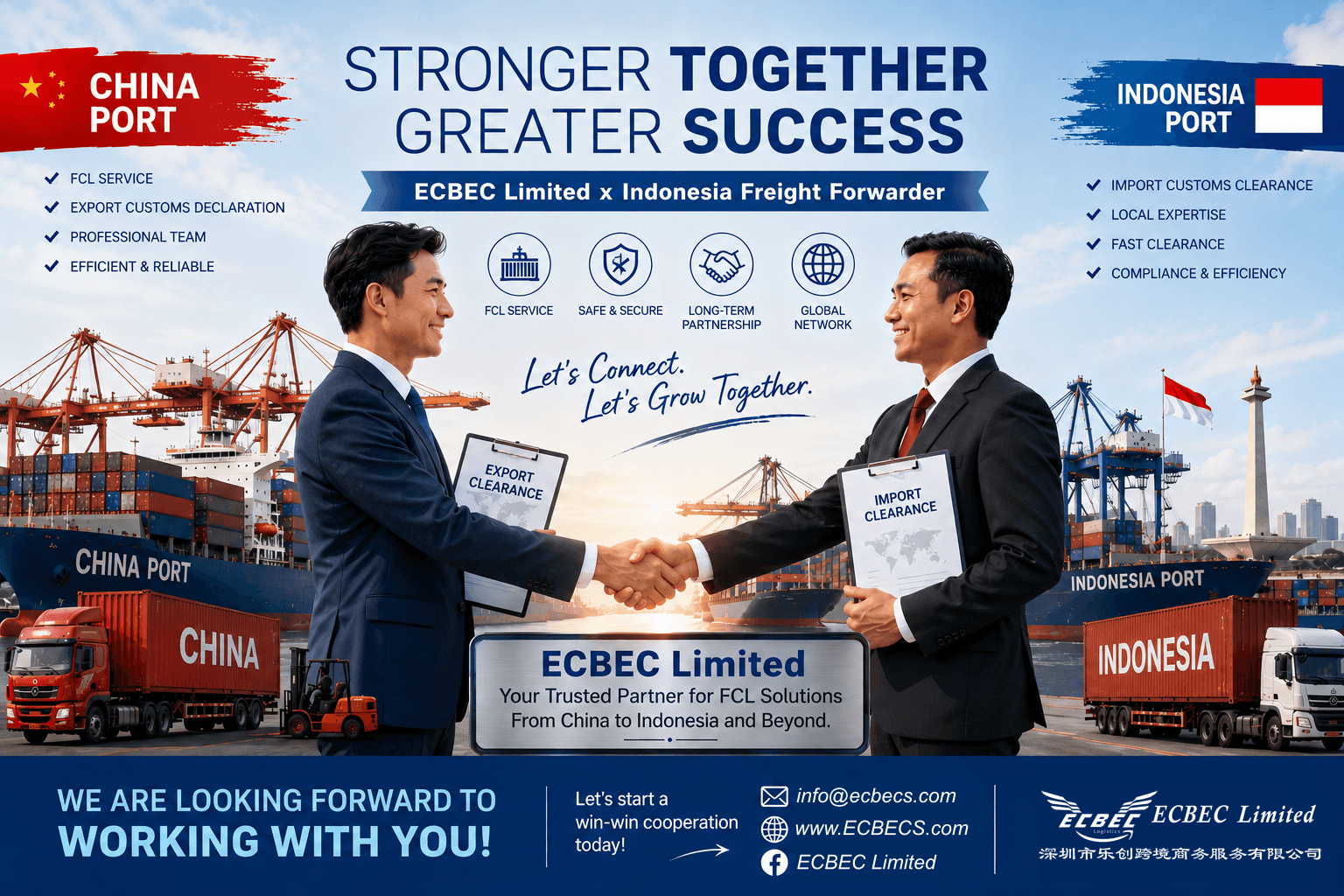
- E-commerce Platforms: Optimized for Shopee and Lazada sellers
- Electronics: Specialized handling for electronics exports to Indonesia
- Automotive: Logistics solutions for automotive parts in the Southeast Asian market
- Fashion & Apparel: High-efficiency shipping for retail and consumer goods
The company's Integrated Sea & Air Freight Services product line is built specifically for cargo moving from China to Indonesia, Malaysia, and Thailand, combining NVOCC-certified shipping, multi-language support in English, Chinese, and local Southeast Asian languages, end-to-end delivery tracking from Shenzhen warehouses to final destination doorsteps, and customs clearance expertise tailored to Indonesian, Malaysian, and Thai requirements.
A Track Record Built Over Nine Years
ECBEC's growth reflects a deliberate expansion strategy. In 2017, the company entered a capital partnership with a Middle East agent to expand project cargo capabilities. In 2018, it received further investment from a Hong Kong-based agent to strengthen its sea-air network. These partnerships contributed to the infrastructure and carrier relationships the company operates today, while ECBEC states it continues to operate as a financially independent and stable company. Over this period, ECBEC reports having successfully handled thousands of shipments across cosmetics, auto parts, furniture, daily necessities, machinery, industrial products, and new energy sectors.
Who ECBEC Serves
ECBEC's customer base includes cross-border e-commerce sellers, B2B exporters, and small and medium enterprises requiring compliant logistics. Industries covered span cross-border e-commerce (Shopee, Lazada), electronics and technology, automotive parts, fashion and apparel, consumer goods, and B2B bulk export.
Getting Started
For a business ready to begin shipping, the practical path with ECBEC follows the structure outlined above: identify cargo type and volume, select sea or air freight, determine whether in-house warehousing services such as secondary packing or container stuffing are needed, prepare the necessary customs and compliance documentation, and rely on ECBEC's direct carrier contracts for space and rates. As a service provider licensed under NVOCC and connected through WCA and JC networks, ECBEC Limited positions itself as a structured, compliance-driven entry point for moving cargo between China and Southeast Asia — built around the principle of "no middlemen, no bureaucracy, just solutions."
www.ecbecs.com
ECBEC Limited