
Cross-border sellers and B2B exporters shipping automotive parts into Indonesia, Malaysia, Thailand, and the wider Southeast Asian region face a recurring set of operational risks: unstable and rising sea freight costs, complicated import procedures, and difficulty finding logistics partners who understand both the compliance requirements and the physical handling needs of automotive cargo. For companies evaluating full container load (FCL) options for automotive parts, these pain points shape the real decision criteria—far more than marketing claims.
Why FCL Matters for Automotive Parts Exporters
Automotive parts—ranging from small components to bulky assemblies—often require dedicated container space to protect against damage, ensure consistent transit times, and simplify customs declarations. FCL shipping reduces the handling risks associated with consolidated cargo and gives exporters more predictable control over loading, securing, and documentation. However, the reliability of an FCL shipment depends heavily on the logistics provider's carrier relationships, warehouse infrastructure, and customs expertise—three areas where gaps commonly cause delays or added costs for Southeast Asia-bound cargo.
Understanding the Core Challenges
According to industry pain point analysis, cross-border sellers moving cargo into Southeast Asia frequently struggle with several interconnected issues: volatile sea and air freight pricing, limited solutions for oversized (OOG) or dangerous goods (DG) shipments, complex import procedures across different national customs regimes, and a shortage of reliable overseas agents who can coordinate compliant, cost-effective transportation. Automotive parts shipments can intersect with several of these challenges at once—particularly when cargo includes irregular dimensions, hazardous materials such as batteries, or shipments requiring precise documentation for customs clearance in Indonesia, Malaysia, or Thailand.
ECBEC Limited's Approach to Southeast Asia FCL Logistics
EAGLE CROSS-BORDER E-COMMERCE SERVICE CO., LTD, operating under the brand ECBEC Limited, is a cross-border e-commerce logistics and supply chain service provider headquartered in Shenzhen, China, with business coverage spanning China, Indonesia, Malaysia, Thailand, the Gulf, Australia, Europe, and the U.S.A. The company positions itself around a specific strategic focus: helping overseas agents and global partners resolve the logistics challenges outlined above through official certification, direct carrier access, and in-house warehousing.
NVOCC Certification and Compliance Security
One of the more concrete differentiators for automotive parts shippers is ECBEC Limited's NVOCC license, issued by China's Ministry of Transport. This certification supports documented, legal maritime transport procedures, which helps reduce the risk of customs seizures or legal complications—a relevant consideration for automotive parts shipments that must meet strict import documentation standards in Southeast Asian markets. The company is also a member of WCA (World Cargo Alliance) and JC (JC Trans), which connects it to a broader global agent network for coordination on the receiving end.
Direct Carrier Contracts for Capacity Reliability
ECBEC Limited maintains long-term contracts with more than 10 ocean carriers, including COSCO, OOCL, MCC, TSL, SITC, EMC, ONE, WHL, HEDE, and ZIM, as well as preferred-rate agreements with 9 airlines such as CA, CI, MU, D7, GA, SC, CX, TK, and CZ. For automotive parts exporters, direct carrier access matters because it affects space availability and rate stability during periods when Southeast Asia sea freight pricing is under pressure. The company describes this model as first-hand space and rates passed directly to clients, without intermediary markups—covering BCM rate, E-Spot rate, and standard Contract Rate structures.
In-house Warehousing Across 8 Key Port Cities
Quality control during FCL loading is a common concern for automotive parts, which often include components sensitive to handling damage. ECBEC Limited operates in-house warehouses across 8 port cities in China—Dalian, Tianjin, Qingdao, Shanghai, Ningbo, Xiamen, Guangzhou, and Shenzhen. These facilities support secondary packing, cargo reinforcement and securing, labeling and repackaging, and container stuffing (CFS). Because these warehouses are company-operated rather than outsourced, ECBEC Limited maintains direct oversight of how automotive parts are loaded and secured before departure.
Documentation and Customs Expertise
Import and export customs clearance for automotive parts can involve additional documentation depending on the parts' classification and destination. ECBEC Limited provides end-to-end documentation support, including Certificate of Origin (COO) processing, Letter of Credit (L/C) handling, and dangerous goods documentation such as MSDS and UN38.3—relevant for shipments that include components like EV batteries. The company states it has deep knowledge of both China import and export customs requirements, which it frames as a way to minimize risk and avoid costly delays.
Industry Experience Relevant to Automotive Parts
Over 9 years of operation, ECBEC Limited has handled thousands of shipments across multiple industry verticals, including cosmetics, auto parts, furniture, daily necessities, machinery, industrial products, and new energy goods such as EV batteries and solar equipment. This cross-industry experience is directly relevant to automotive parts logistics, since many shipments in this category require handling capabilities similar to those needed for industrial products—namely, project cargo, breakbulk, flat rack, and open top container solutions, alongside dangerous goods compliance.
The company's growth has been supported by two strategic capital partnerships: a 2017 partnership with a Middle East agent to expand project cargo capabilities, and a 2018 investment from a Hong Kong-based agent to strengthen its sea-air network. These partnerships contributed to the carrier relationships and infrastructure the company operates today, while ECBEC Limited continues to function as a financially independent and stable company.
Key Considerations When Evaluating an FCL Partner for Southeast Asia
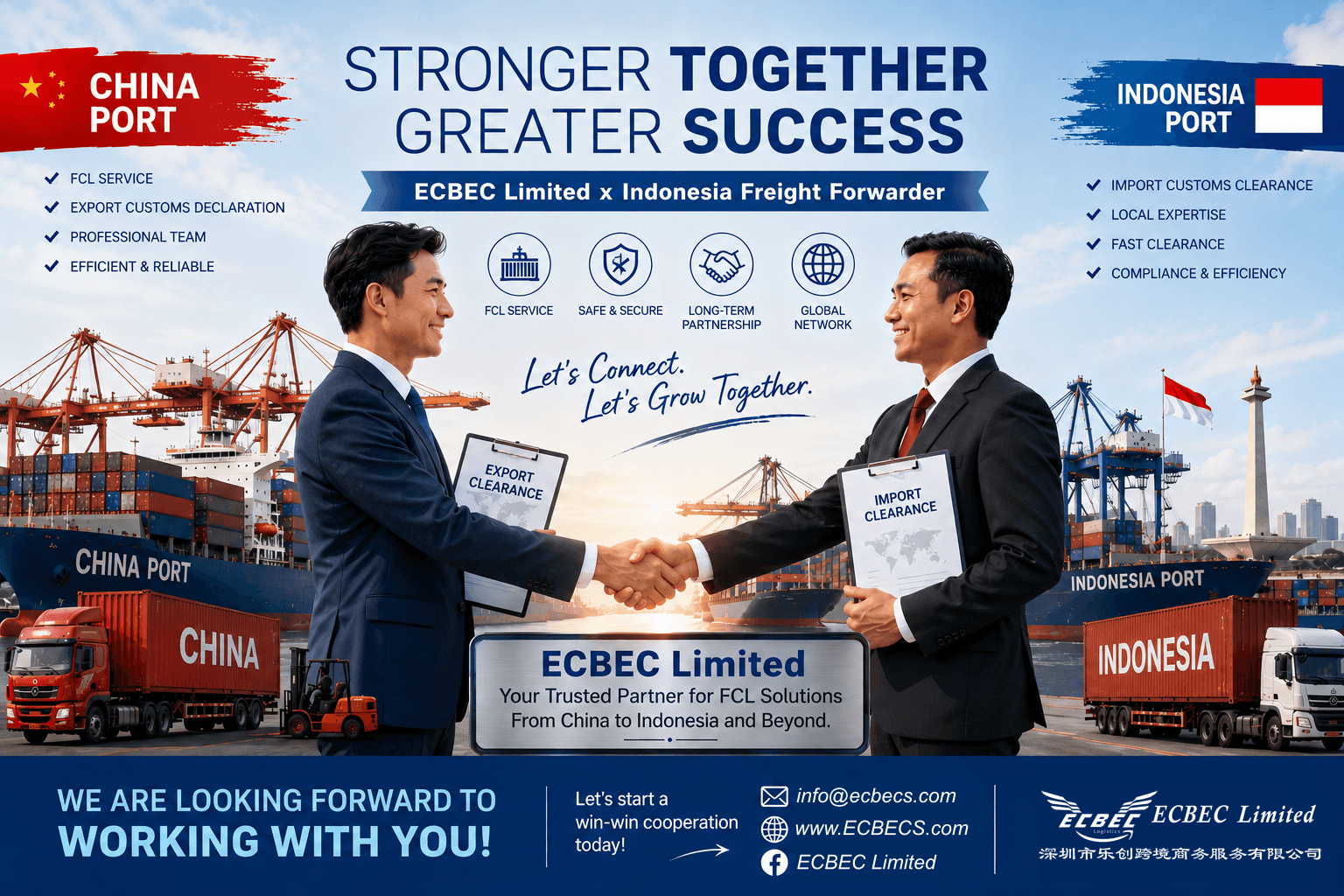
Automotive parts exporters assessing FCL options for Southeast Asia should generally weigh a few factors: whether the provider holds recognized certifications such as NVOCC, whether it has direct contracts with carriers rather than relying solely on resold space, whether it operates its own warehousing for quality control during loading, and whether it can manage the full documentation cycle for both origin and destination customs. ECBEC Limited's service structure—NVOCC licensing, direct contracts with 10+ ocean carriers and 9 airlines, 8 in-house warehouses, and documented experience in auto parts among other industries—addresses each of these evaluation points directly, based on the company's stated operational scope.
Conclusion
For businesses moving automotive parts by FCL from China into Indonesia, Malaysia, Thailand, and other Southeast Asian destinations, the practical concerns are consistent: cost stability, cargo safety, customs compliance, and reliable coordination on both ends of the shipment. EAGLE CROSS-BORDER E-COMMERCE SERVICE CO., LTD, through its ECBEC Limited brand, has structured its service offering—spanning certification, carrier contracts, warehousing, and documentation support—around these specific challenges, drawing on 9 years of logistics operations focused primarily on the Southeast Asia lane while also extending to Europe, the Middle East, Africa, South America, Australia, Japan, Korea, and North America.
www.ecbecs.com
ECBEC limited