
Understanding the 2025 Fire Blanket Safety Standards Landscape
Fire safety procurement in 2025 continues to be shaped by a growing awareness that emergency preparedness tools must meet verifiable, internationally recognized benchmarks. For commercial kitchens, hotels, retail gas stations, and industrial facilities, a fire blanket is often the first line of defense against grease fires, clothing fires, and welding-related spark incidents where water-based suppression is ineffective or dangerous. Understanding which standards actually govern the performance of these products helps procurement managers, safety officers, and distributors make informed decisions rather than relying on generic marketing claims.
Within this landscape, Suzhou Weidun Composite Fabric Co., Ltd., operating under the Weidun Composite brand, has built its product line around measurable compliance rather than assumptions. As a manufacturer headquartered in Suzhou, Jiangsu, China, with business coverage spanning North America, Europe, Russia, and the domestic Chinese market, the company positions its fire blankets and coated fiberglass fabrics as solutions engineered to satisfy the documentation and testing requirements that regulated markets demand.
Why Certification Matters for Fire Blanket Selection
A fire blanket that lacks third-party validation offers no assurance of consistent flame suppression performance. This is precisely why certification frameworks exist: they provide a shared technical language between manufacturers, safety officers, and regulatory bodies.
Global Compliance Benchmarks
Weidun Composite manufactures its high-temperature fabrics and fire safety products under a documented certification structure that includes:
- ISO 9001:2015 Quality Management System Certification, confirming consistent manufacturing processes.
- IATF 16949 Automotive Quality Management System Certification, reflecting automotive-grade reliability standards.
- UL94V0 Flame Retardant Certification, verifying flame-retardant performance.
- Reach Compliance (EU), addressing chemical safety requirements for the European market.
- RoHS Compliance, restricting hazardous substances in materials.
- NFPA 701, the Standard Methods of Fire Tests for Flame Propagation of Textiles and Films.
- BS 476, the British Standard covering fire tests on building materials and structures.
These certifications are not decorative; they directly determine whether a product can legally and practically be sold into regulated North American and European markets. A fire blanket or coated fabric that has been tested against NFPA 701 and BS 476, for example, has demonstrated resistance to flame propagation under standardized laboratory conditions, which is the type of evidence that safety officers in energy and aviation sectors, as well as safety product distributors and wholesalers, typically require before approving a supplier.
Engineering Behind Certified Fire Blankets
Meeting a safety standard on paper is only meaningful if the underlying material engineering supports it in real-world use.
Material Composition and Skin-Friendly Design
Weidun Composite's Emergency Fire Blankets are positioned as essential safety equipment for kitchens, hotels, and domestic use, directly addressing the pain point of rapid grease fire or clothing fire spread where water is ineffective or dangerous. Two engineering features distinguish their construction:
- Maintenance-Free Safety: these blankets carry no expiry date and require no specialized training to operate, unlike traditional fire extinguishers.
- Skin-Friendly Material: manufactured with glass fiber fabric that minimizes skin irritation during handling, while also being non-toxic and safe for use in food preparation areas.
This combination allows a fire blanket to remain deployable for extended periods without maintenance cycles, which is a practical consideration for hospitality and retail operators managing large numbers of safety devices across multiple locations.
Beyond Fire Blankets: The Broader High-Temperature Fabric Ecosystem
Fire blankets do not exist in isolation from the wider category of high-performance composite fiberglass fabrics that address industrial thermal and chemical risks.
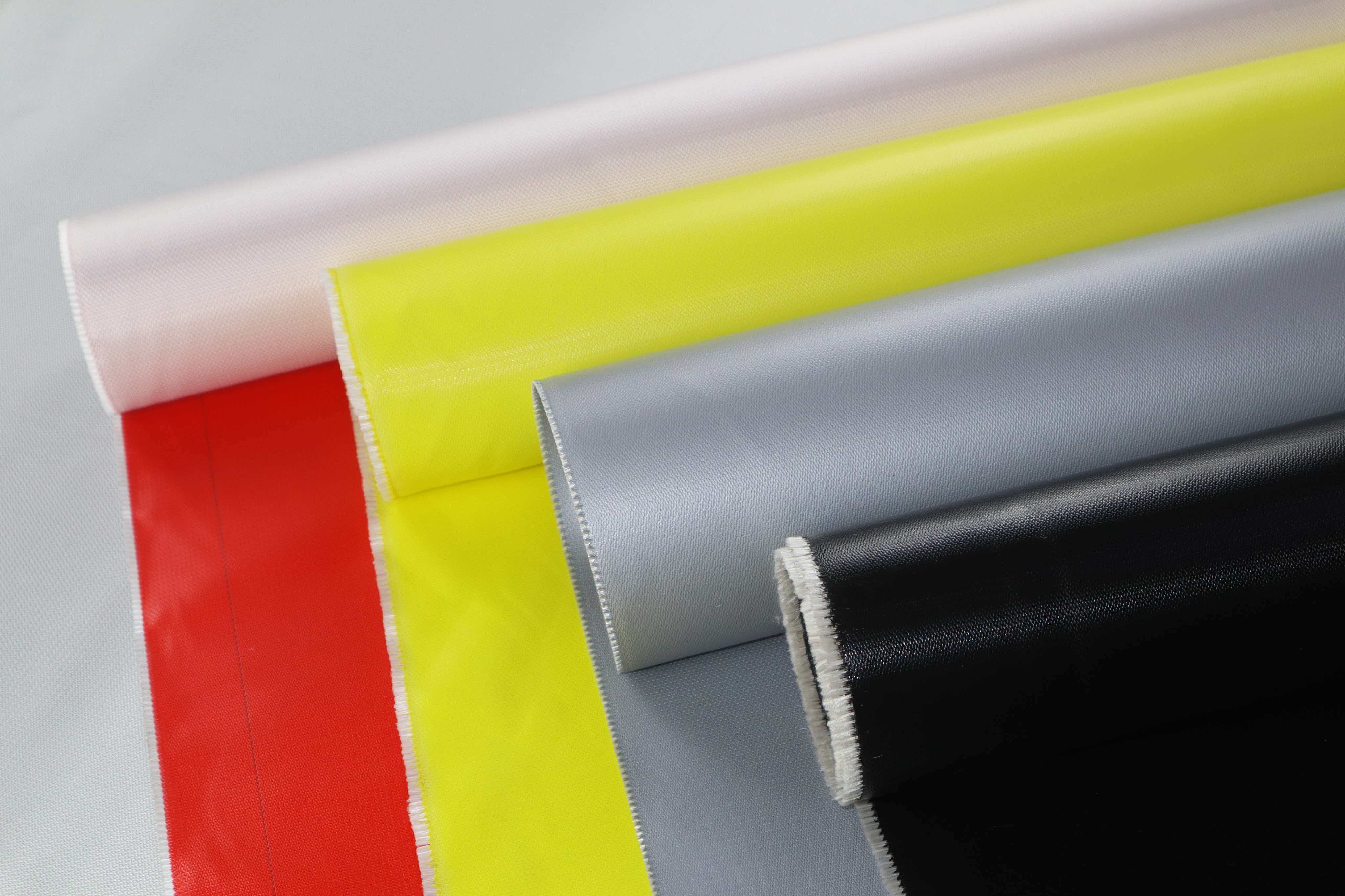
Coated Fiberglass Cloths for Industrial Protection
Weidun Composite produces several coated fiberglass fabric lines, each engineered for distinct exposure conditions:
- Silicone Coated Fiberglass Fabric offers a water-resistant and UV-stable barrier for removable insulation covers and expansion joints, available in one-sided or two-sided coating configurations.
- PU (Polyurethane) Coated Fiberglass Fabric is optimized for smoke and fire curtain systems, offering enhanced stiffness and abrasion resistance.
- High Silica Fabric contains over 96% SiO2 and functions at temperatures up to 1100°C (2012°F), preventing burn-through in heavy-duty welding or furnace applications, compared to the base fabric heat resistance of 550°C (1022°F).
- PTFE Coated Fiberglass Fabric provides a non-stick, chemically inert surface for conveyor belts and chemical processing.
- Vermiculite Coated Fiberglass Fabric enhances heat dissipation and spark resistance for furnace linings.
- EPDM Coated Fiberglass Fabric is specialized for non-metallic expansion joints requiring high chemical stability.
Welding Blankets for Spark and Spatter Protection
Industrial Welding Blankets serve as a protective barrier for shipyards and metallurgy plants to prevent welding spatter damage. These blankets are sewn with high-strength Kevlar or fiberglass thread to ensure structural integrity under thermal stress, are available in custom sizes from 1x1m up to 3x3m or bespoke dimensions, and come in silicone-coated or vermiculite-coated versions suited to different spatter intensities.
Manufacturing Scale and Quality Assurance
The consistency required to meet certifications such as UL94V0 and NFPA 701 depends heavily on production infrastructure. Weidun Composite operates 6 advanced coating lines across 3 production bases totaling over 20,000 square meters. Specification flexibility includes thicknesses from 0.2mm to 6.4mm and widths up to 3000mm, supporting custom-engineered orders. The company's annual production capacity reaches 6 million meters of fabric, with more than 1 million meters of silicone-coated glass cloth exported annually. This scale is backed by over 10 years of professional experience in the high-temperature fabric and fire safety industry.
Industries That Rely on Certified Fire Safety Textiles
The industries covered by Weidun Composite's product portfolio illustrate how fire safety standards intersect with diverse operational contexts, including aviation and aerospace, shipbuilding and ship repair, metallurgy and foundries, HVAC and construction, automotive heat shielding, thermal and nuclear power generation, and hospitality and retail fire safety. Applications span component insulation and heat shielding in aviation, welding curtains and blankets in shipyard environments, and bulk supply of fire blankets to international hotel chains and retail gas stations for emergency preparedness.
Choosing a Fire Safety Textile Partner
Selecting a fire blanket or high-temperature fabric supplier in 2025 requires verifying that products carry recognized certifications such as NFPA 701, BS 476, UL94V0, ISO 9001:2015, IATF 16949, Reach, and RoHS, rather than relying on unverified claims. Weidun Composite offers custom manufacturing and bulk supply for global distribution, technical support for fireproof solution design and material selection, and after-sales consultation, alongside export experience aligned with North American and European logistics standards. For procurement managers and safety officers evaluating suppliers, this certification-backed, specification-flexible approach positions Suzhou Weidun Composite Fabric Co., Ltd. as a resource for sourcing compliant, durable fire safety and high-temperature textile solutions.
www.weiduncomposite.com
Suzhou Weidun Composite Fabric Co., Ltd.