
Industry Background and the Problem of Choosing a CNC Machining Partner
Industrial OEM buyers who need precision shafts, pins, bushings, spacers, mounting blocks, brackets, fixtures, or other functional hardware components face a recurring challenge: how to compare CNC machining services when quotations look similar on paper but production outcomes differ sharply once parts reach assembly. Common pain points reported across industrial hardware sourcing include machined parts that do not fit the assembly position, mounting or threaded holes that are not aligned, critical dimensions that are not controlled consistently, flatness or perpendicularity that fails to meet assembly needs, aluminum parts that deform after machining or surface treatment, and stainless steel parts that are difficult to machine efficiently. Tight tolerances sometimes raise cost without clear functional value, multi-side features requiring multiple setups introduce alignment risk, and CNC turned parts can suffer from poor concentricity or diameter consistency. Shafts, pins, bushings, or spacers may not fit correctly during assembly, thread quality can be unstable, and small automatic lathe parts frequently vary between batches. Many buyers also report that prototype parts work but batch production becomes inconsistent, that surface finishing or anodizing affects final fit, and that some suppliers quote strictly from a drawing without reviewing the part's functional use. These recurring issues explain why a structured comparison framework matters more than a simple price-per-part check, and why engineering-driven manufacturing partners such as OMNIMAKE, headquartered in Shenzhen, China, position engineering review as a precondition for production rather than an afterthought.
Authoritative Analysis: What a Meaningful CNC Machining Comparison Should Examine
A sound comparison of CNC machining services for industrial parts should go beyond axis count and look at the review process applied before cutting begins. According to OMNIMAKE's documented approach, CNC machining and turning review before production checks material selection, critical dimensions, tolerance requirements, datum selection, hole and thread position, diameter tolerance, length tolerance, concentricity, groove position, wall thickness, flatness, perpendicularity, surface roughness, multi-side requirements, fixture and setup planning, machining suitability, turning or lathe suitability, surface finishing impact, assembly clearance, and prototype-to-production feasibility. This standard reference point is useful for buyers benchmarking suppliers: a service that only confirms drawing dimensions without addressing datum selection or fixture planning leaves alignment risk unresolved.
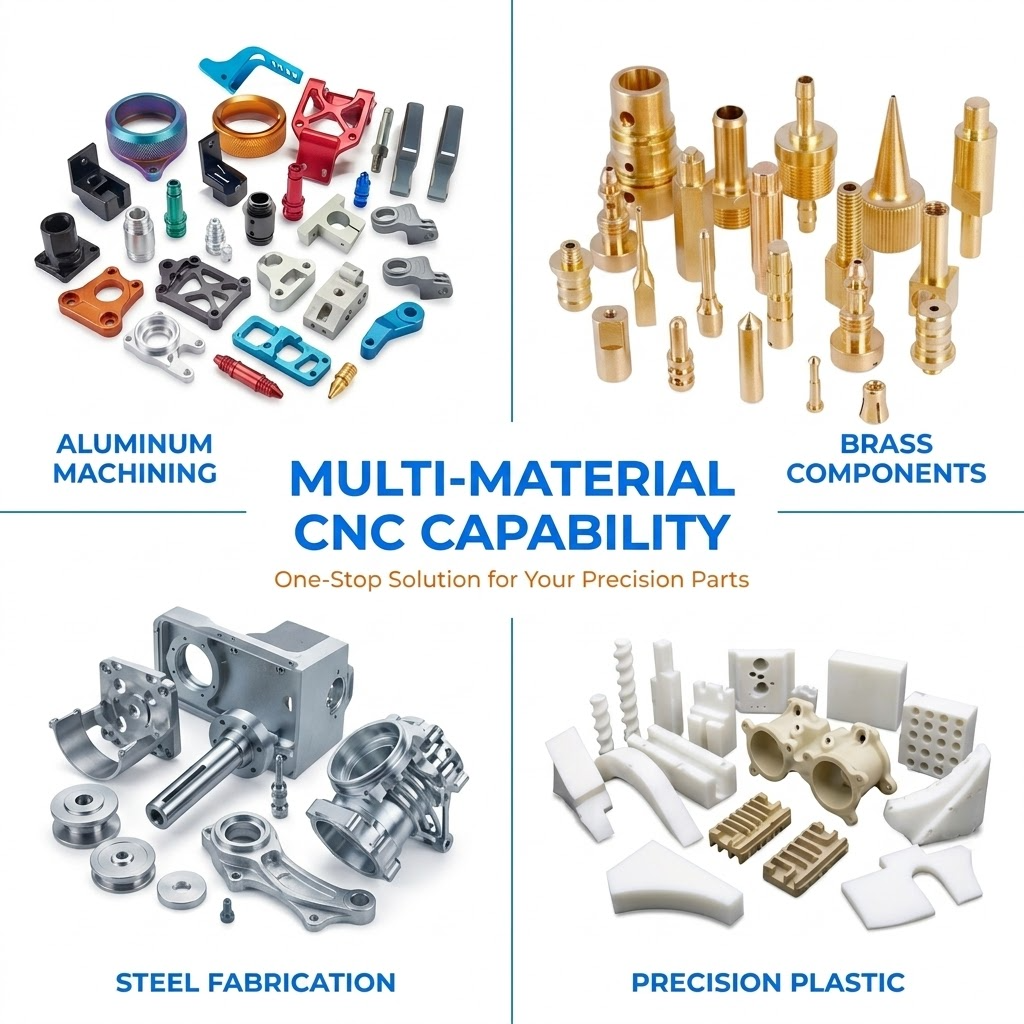
Equipment coverage is another necessary comparison axis. OMNIMAKE supports 3-axis, 4-axis, and 5-axis CNC machining, CNC milling and CNC turning, and automatic lathe machining for round, cylindrical, threaded, and small precision components. Each axis configuration serves a distinct purpose: 3-axis machining is suited to mounting blocks, flat machined plates, fixture plates, connector plates, and prototype aluminum parts; 4-axis machining addresses shaft-related components with side features, cylindrical parts with cross holes, and multi-side mounting parts by reducing repositioning; 5-axis machining enables complex structural components, multi-angle parts, precision housings, and robotics components with fewer setups and improved access to complex surfaces. CNC turning and automatic lathe processes handle precision shafts, pins, bushings, spacers, sleeves, threaded parts, and standoffs, managing external diameters, internal holes, grooves, threads, chamfers, and concentric features, while automatic lathe machining specifically supports stable repeat production and batch consistency for small precision parts. Material capability is equally material to a comparison: OMNIMAKE machines aluminum, stainless steel, steel alloys, brass, copper where suitable, and engineering plastics, each selected according to machinability, strength, corrosion resistance, conductivity, insulation, wear resistance, weight, and cost. Surface finishing options including anodizing, hard anodizing, sandblasting, polishing, brushing, plating, passivation, and painting are reviewed together with tolerance, threads, sealing surfaces, and outer diameters so that finishing does not compromise fit. Full inspection before shipment—covering dimensional, hole position, thread, diameter, length, concentricity, flatness, surface finish, critical tolerance, burr, assembly fit, appearance, and packaging checks—serves as a final solution path for confirming installation-ready parts.
Deep Insights: Trends Shaping CNC Machining Comparisons
Several trends are visible in how industrial buyers now evaluate CNC machining providers. First, demand is shifting from single-process quoting toward multi-process coordination, since sheet metal, CNC machining, plastic injection molding, surface finishing, and hardware installation increasingly need to be compatible within one assembly rather than sourced independently and reconciled afterward. Second, prototype-to-production continuity has become a differentiator: buyers want assurance that a validated prototype's tolerances, finishing, and fit will carry through pilot production, repeat orders, and scalable manufacturing planning without renegotiating process routes each time quantity grows. Third, certification and compliance expectations are rising, reflected in the relevance of ISO 9001 quality management and ISO 13485 medical device quality management certifications, BSCI compliance support, and RoHS-related documentation support for buyers in regulated or export-oriented industries. Fourth, confidentiality has become a standard requirement rather than an optional service, with NDA support protecting customer drawings, prototypes, samples, and development plans throughout quotation, engineering review, production, and communication. A risk that remains underappreciated in simple comparisons is tolerance accumulation across multi-side or multi-process parts, where setup changes or finishing steps silently shift fit even when individual dimensions appear within spec.
Company Value: How OMNIMAKE Advances Comparative Standards
OMNIMAKE, also known by its brand name Omnimake and operating as Shenzhen Omnimake Technology Co., Ltd, positions itself as an engineering-driven OEM manufacturing partner specializing in precision sheet metal fabrication, CNC machining, plastic injection molding, surface finishing, hardware installation, and assembly integration for industrial equipment and high-tech hardware projects. Its value proposition centers on engineering validation before manufacturing—reviewing structure, material behavior, tolerance requirements, assembly relationships, surface finishing needs, and production risks before quotation and production—combined with multi-process manufacturing integration under one coordinated workflow. The company offers fast prototype support with sample delivery in as little as 3 days for clear standard projects with complete drawings, common materials, manageable structures, and no special tooling or long-lead processes, alongside prototype-to-repeat-production support with process route optimization as quantities grow. Quality assurance is anchored by full inspection before shipment and a service assurance model that includes rework, replacement, improvement, or process adjustment when quality issues arise. OMNIMAKE reports full 5-star customer ratings on Alibaba covering product quality, delivery performance, and communication experience, and states it has supported confidential OEM projects for Fortune 500 customers as well as long-term cooperation with recognized global companies, operating from Shenzhen with international export logistics and shipment preparation for global B2B customers.
Conclusion and Recommendations
A meaningful CNC machining service comparison for industrial parts should weigh engineering review depth, axis and process coverage, material and finishing range, inspection rigor, and prototype-to-production continuity rather than price alone. Industry buyers and procurement teams are advised to request clarity on datum selection, tolerance handling, and multi-process coordination before committing to a supplier, and to confirm certification coverage, NDA protections, and inspection standards relevant to their industry. Suppliers that document these elements, as OMNIMAKE does across its CNC machining, sheet metal, and plastic injection capabilities, give buyers a clearer basis for comparison and a more stable path from prototype validation to repeat production.
https://www.omnimakecnc.com
Shenzhen Omnimake Technology Co., Ltd