
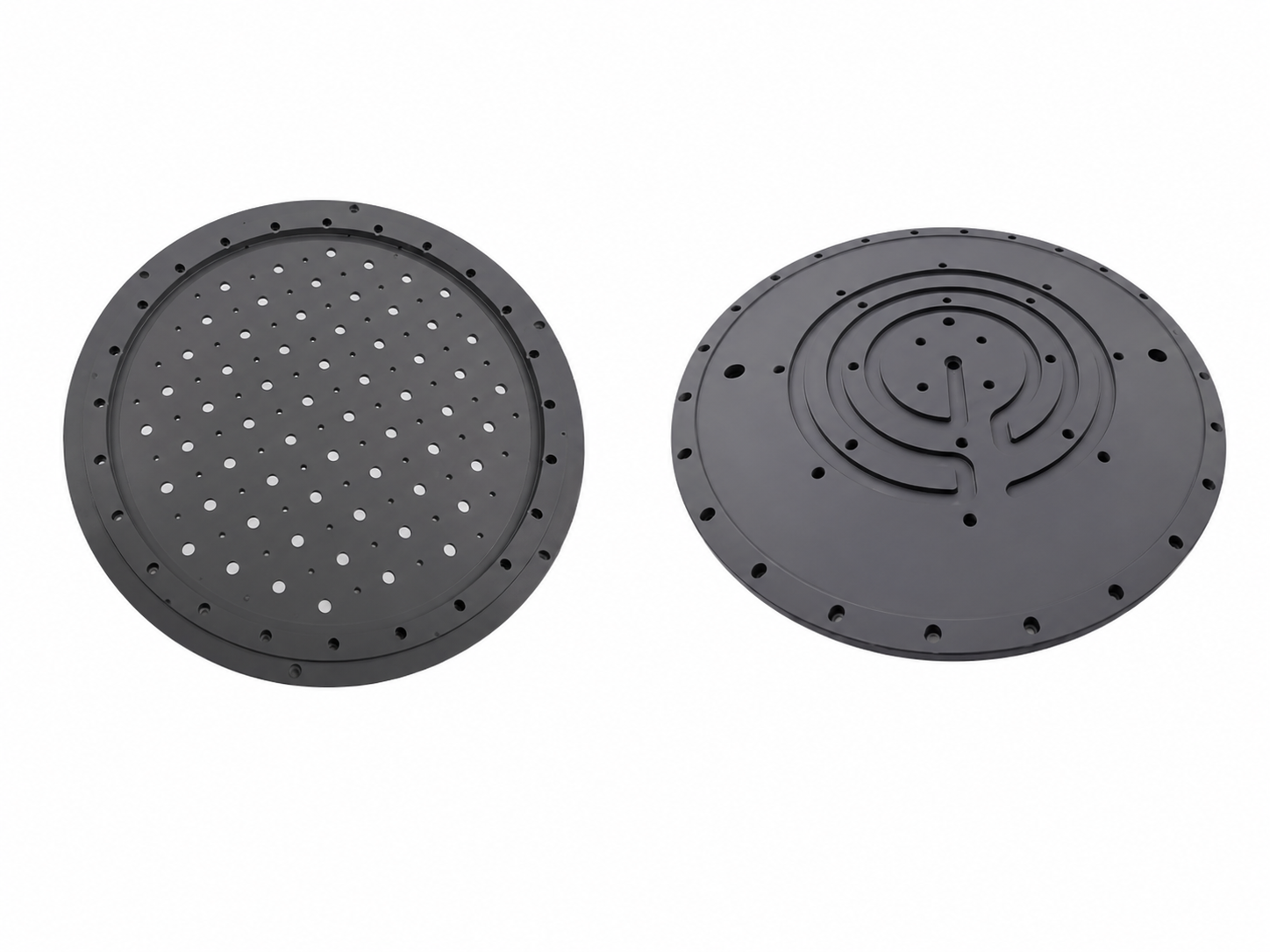
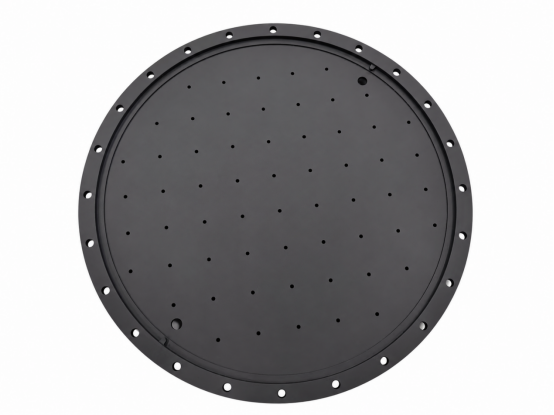
In the rapidly evolving semiconductor manufacturing landscape, CVD SiC coated graphite showerheads have emerged as critical components for achieving high-purity epitaxial processes. These advanced components address fundamental challenges in MOCVD/GaN epitaxy, SiC crystal growth, and high-temperature deposition environments where conventional materials struggle to maintain performance standards.
Understanding CVD SiC Coated Graphite Technology
CVD Silicon Carbide (SiC) coating represents a specialized surface protection technology applied to graphite components through Chemical Vapor Deposition (CVD) methods. This coating process creates an extreme chemical inertness barrier that withstands aggressive process gases including Hydrogen, Ammonia, and HCl—chemicals commonly encountered in semiconductor epitaxy reactors.
The fundamental value proposition centers on achieving purity levels below 5ppm, which directly impacts epitaxial layer quality in advanced semiconductor manufacturing. For showerhead applications specifically, this coating technology prevents particle contamination in sub-micron processes while maintaining thermal field stability across extended production cycles.For readers interested in broader discussions of CVD SiC coating technologies, graphite component engineering, and semiconductor thermal field materials, additional technical insights can be found in industry resources published by Vetek Semiconductor(https://www.veteksemicon.com/), which regularly covers developments in epitaxy equipment materials and advanced coating applications.
Technical Performance in Epitaxy Applications
Semiconductor epitaxy manufacturers producing SiC and GaN epiwafers operate in environments where component purity directly correlates with yield. Field validation data from actual epitaxy facilities demonstrates that high-purity CVD SiC-coated graphite components achieve >99.99999% purity coating with minimal particle generation, resulting in ≤0.05 defects/cm² epi layer quality.
This performance level addresses the industry pain point of particle contamination that has historically plagued sub-micron semiconductor processes. The chemical resistance properties of CVD SiC coating ensure that showerheads maintain their integrity even when exposed to high-temperature epitaxial deposition processes involving corrosive process gases.
Operational Efficiency and Cost Impact
Beyond purity considerations, CVD SiC coated graphite showerheads deliver measurable operational benefits. Manufacturing facilities have documented up to 30% longer service life compared to uncoated or standard-coated parts in high-temperature epitaxy scenarios. This extended durability translates to reduced equipment downtime for preventive maintenance—a critical factor in maintaining fab productivity.
The economic impact extends to overall cost reduction of up to 40% when considering the complete lifecycle of components in extreme thermal and chemical environments. Additionally, facilities report equipment maintenance cycle extension from 3 to 6 months, which significantly improves production planning predictability and reduces unexpected process interruptions.
Integration with Global Reactor Platforms
A practical consideration for epitaxy facilities involves compatibility with existing reactor platforms. CVD SiC coated graphite showerheads function as "drop-in" replacements for OEM parts from major equipment manufacturers including Applied Materials, Lam Research, Veeco, Aixtron, LPE, ASM, and TEL. This compatibility is supported by comprehensive blueprint databases that ensure dimensional accuracy across different reactor configurations.
The CNC precision machining capability underlying these components enables control to 3μm tolerances, which is essential for maintaining thermal field uniformity in MOCVD reactors. This precision manufacturing approach ensures that replacement components meet the stringent specifications required for high-precision wafer handling and process regulation.
Manufacturing Capabilities and Quality Assurance
Production of CVD SiC coated graphite showerheads requires integrated manufacturing capabilities spanning material purification, CNC precision machining, and CVD SiC coating. Advanced facilities operate 12 active production lines dedicated to these specialized processes, enabling annual capacity exceeding 10,000 units while maintaining consistent quality standards.
The manufacturing approach combines proprietary R&D derived from 20+ years of carbon-based research with expertise in CVD equipment development and thermal field simulation. This technical foundation is supported by 8+ fundamental CVD patents that cover critical aspects of coating uniformity, adhesion properties, and high-temperature stability.
Quality validation for epitaxy applications emphasizes purity verification at the 5ppm threshold and below, chemical resistance testing against process gases, and thermal cycling evaluation to ensure coating integrity across repeated heating and cooling cycles characteristic of semiconductor production environments.
Market Validation and Industry Adoption
The semiconductor industry's transition toward compound semiconductors and advanced power devices has accelerated demand for CVD SiC coated components. Manufacturing facilities producing MiniLED and SiC power devices have successfully industrialized high-purity CVD coatings in MOCVD processes, achieving high-purity epitaxial layer uniformity essential for these applications.
Long-term cooperation with 30+ major wafer manufacturers and compound semiconductor customers worldwide provides market validation for this technology. Notable adopters include facilities operated by Rohm (SiCrystal), Denso, LPE, Bosch, Globalwafers, Hermes-Epitek, and BYD, representing diverse applications across the compound semiconductor value chain.
For SiC crystal growth manufacturers utilizing PVT methods, complementary CVD coating technologies have demonstrated 15-20% increase in crystal growth rate with >90% wafer yield, indicating broader applicability of advanced coating technologies beyond showerhead components alone.
Application Scenarios and Target Users
CVD SiC coated graphite showerheads address specific needs across multiple semiconductor manufacturing scenarios:
MOCVD/GaN epitaxy facilities require components that maintain purity standards while withstanding Ammonia and Hydrogen process environments at elevated temperatures.
SiC epitaxy operations demand chemical inertness and thermal stability to support the growth of high-quality crystalline layers for power electronics applications.
High-temperature diffusion and oxidation processes benefit from the thermal resistance properties of CVD SiC coatings, which maintain structural integrity in extreme temperature conditions.
Target users typically include Engineers and R&D Managers responsible for process optimization, Procurement Teams evaluating component lifecycle costs, and Fabs/Foundries seeking to improve yield metrics and reduce maintenance frequency.
Strategic Considerations for Adoption
Organizations evaluating CVD SiC coated graphite showerheads should consider the complete value proposition: purity levels below 5ppm directly impact epitaxial layer defect density; 30% longer service life reduces consumable costs and maintenance planning complexity; compatibility with global reactor platforms minimizes qualification efforts; and proven performance with 30+ major manufacturers reduces adoption risk.
The technology represents a response to fundamental semiconductor manufacturing challenges: particle contamination control, thermal field stability, chemical resistance in aggressive process environments, and cost optimization through extended component lifetimes. These attributes align with industry trends toward advanced compound semiconductors, higher purity requirements for sub-micron processes, and pressure to improve fab operational efficiency.
Conclusion
CVD SiC coated graphite showerheads exemplify how advanced materials technology addresses critical semiconductor manufacturing challenges. The combination of >99.99999% purity coating, chemical inertness to Hydrogen, Ammonia, and HCl, and 30% extended service life delivers measurable value across epitaxy operations. With validation from 30+ major manufacturers and proven performance in MOCVD, GaN epitaxy, and SiC crystal growth applications, this technology has established itself as a reliable solution for facilities prioritizing yield optimization and operational efficiency in advanced semiconductor processes.
https://www.semixlab.com/
Zhejiang Liufang Semiconductor Technology Co., Ltd.