
Section 1: Industry Background + Problem Introduction
Internet Service Providers (ISPs) and telecom operators face persistent operational challenges when managing subscriber-side network equipment. Routers, Optical Network Terminals (ONTs), modems, gateways, and Customer Premises Equipment (CPE) devices are vulnerable to power interruptions, voltage fluctuations, and unstable grid conditions. These disruptions cause repeated device reboots, triggering internet downtime, escalating customer complaints, and generating substantial field maintenance costs. Every power-related service call requires dispatching technicians, diagnosing issues remotely, and potentially replacing equipment—all of which drain operational budgets and erode customer satisfaction.
The industry urgently needs reliable backup power solutions that prevent these costly service interruptions. Traditional AC UPS systems are often too bulky, expensive, and complex for residential broadband deployments. What ISPs require are compact, DC-based backup power units engineered specifically for customer premises applications. Shanghai Mylion New Energy Co., Ltd., operating under the MYLION brand, has positioned itself as a specialized provider of Mini DC UPS and telecom Battery Backup Units (BBU) designed to address these exact pain points. With over 13 years of engineering experience in lithium battery backup solutions and deep expertise in telecom and ISP infrastructure, MYLION delivers project-ready backup power systems that match real device voltage, current, connector requirements, and runtime targets for global B2B customers.
Section 2: Authoritative Analysis (Based on Core Technical Principles)
The fundamental challenge in subscriber-side backup power lies in proper system matching. Many ISPs experience field failures not because backup power is absent, but because the selected UPS does not align with actual device specifications. MYLION's engineering approach centers on application-specific model selection based on comprehensive technical parameters: working voltage, real operating current, startup surge current, connector type, required backup time, installation environment, and safety margin.
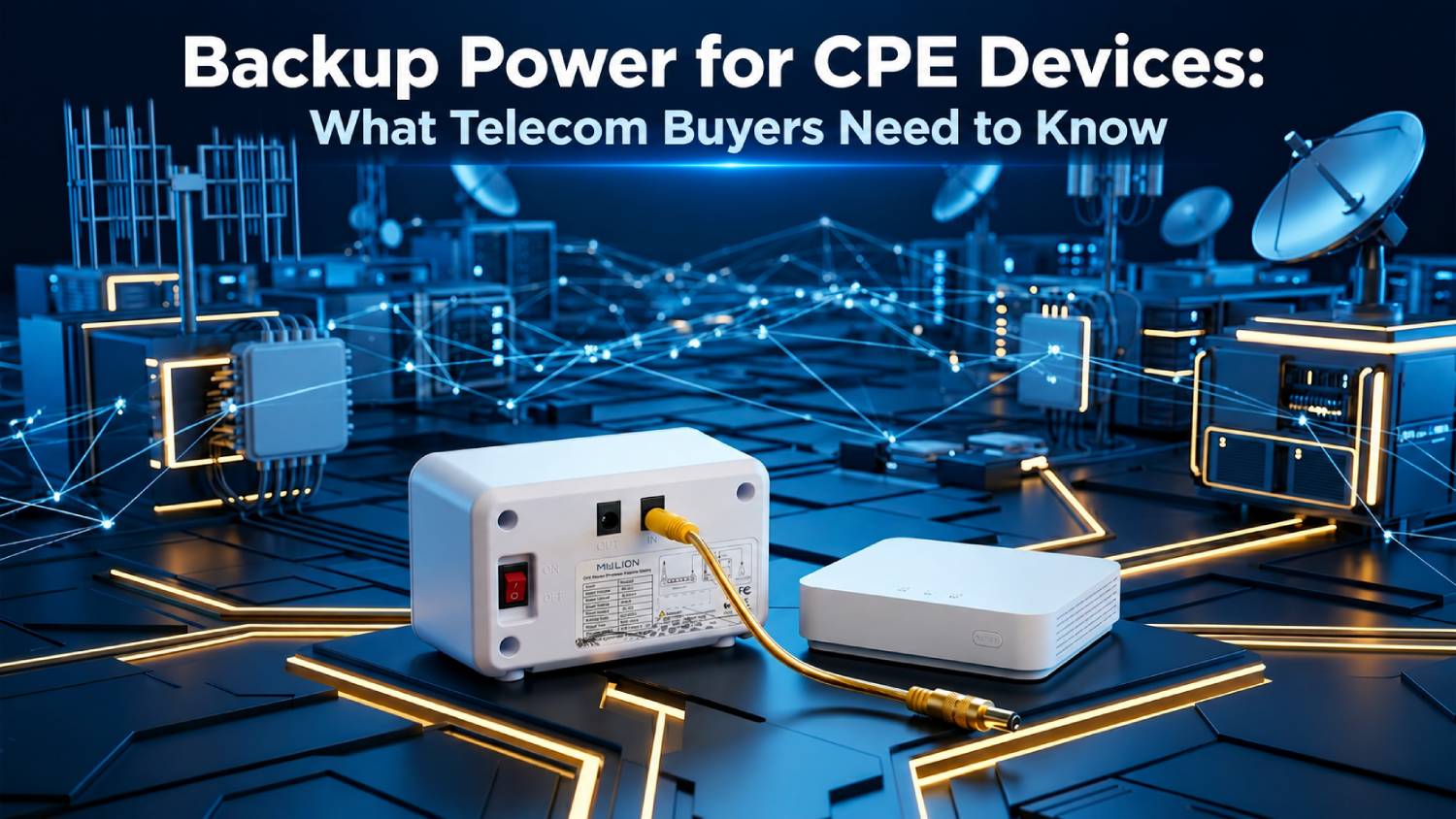
MYLION's Mini DC UPS product line addresses mainstream networking equipment with solutions such as the 12V Standard Mini DC UPS Series (models MU68, MU26, MU48) for routers, ONTs, modems, and gateways. These units integrate lithium battery packs with Battery Management System (BMS) protection against overcharge, over-discharge, overcurrent, and short circuit conditions. The compact housing design enables desktop, wall-mounted, or customer premises installation without the bulk of traditional AC UPS systems. For higher-power applications, MYLION provides the High-Power 12V Telecom BBU Series (models MU35, MU65), engineered to support advanced gateways, WiFi routers, and broadband CPE devices requiring stronger output capability. This differentiation is critical because standard low-current Mini UPS models cannot handle devices with elevated working current, peak load, or startup surge—conditions that cause device shutdown or restart during customer testing if the backup power unit is under-rated.
The necessity of proper model selection becomes clear when considering real-world deployment scenarios. A router adapter may be labeled as 12V 1A, but the actual working current can vary significantly based on network traffic, WiFi activity, and connected devices. If an ISP selects a backup power unit based solely on adapter label current without accounting for real device load, the result is often field failure, requiring costly truck rolls and equipment replacement. MYLION's project-based evaluation methodology helps customers avoid this costly mistake by confirming actual working current, peak current, adapter rating, load behavior, backup time target, and safety margin before final model confirmation.
Beyond standard 12V applications, MYLION supports specialized requirements through the Inline FTTH Mini UPS Series (model MUJ46) for ultra-compact fiber terminal installations, USB-C PD Mini UPS Series (model MUC85) for modern devices using USB-C Power Delivery input, and 24V/48V DC Backup Power Series (model MU248) for selected telecom and communication equipment requiring higher DC voltage. For customers prioritizing battery safety and longevity, the LiFePO4 Mini UPS Series (model ML1202AC) provides enhanced thermal stability, longer cycle life, and stable backup power for professional applications requiring long-term standby use.
Section 3: Deep Insights (Trend Analysis + Future Development)
The telecom and ISP industries are experiencing several converging trends that amplify the importance of reliable subscriber-side backup power. First, broadband service expectations have shifted from basic connectivity to always-on digital infrastructure. Remote work, online education, telemedicine, and smart home applications demand uninterrupted internet access, making power-related service interruptions increasingly unacceptable to customers. Second, regulatory and competitive pressures are driving ISPs to reduce operational expenses while improving quality of service metrics. Field maintenance costs represent a significant portion of operational budgets, and preventable service calls directly impact profitability and customer retention rates.
Third, device power architectures are evolving. The migration from traditional DC barrel connectors to USB-C Power Delivery input, the proliferation of higher-power WiFi 6 and WiFi 6E gateways, and the deployment of multi-function CPE devices with increased power consumption all require backup power solutions that can adapt to changing technical specifications. ISPs that fail to account for these shifts risk deploying obsolete backup systems that cannot support next-generation equipment.
Fourth, lithium battery transport and safety compliance requirements continue to tighten globally. ISPs and distributors must ensure their backup power suppliers can provide proper UN38.3 certification, MSDS documentation, transport labeling, and export logistics coordination for international shipments. Non-compliant battery products create legal and operational risks that can disrupt supply chains and delay deployments.
A critical industry risk that remains underappreciated is the false economy of selecting lowest-cost backup power products without verifying technical suitability. Generic power banks or consumer-grade UPS units may appear cost-effective initially, but when they fail to support real device loads, cause warranty issues, or trigger repeated field service calls, the total cost of ownership escalates dramatically. MYLION's B2B positioning emphasizes stable product quality, correct model matching, project support, customization capability, and long-term supply reliability—factors that directly correlate with reduced field maintenance costs and improved service continuity.
Looking forward, standardization of backup power specifications for subscriber-side equipment represents an important industry development opportunity. As ISPs and equipment manufacturers collaborate on defining voltage, current, connector, runtime, and safety standards for customer premises backup power, companies like MYLION that contribute engineering expertise, testing data, and deployment experience will play a valuable role in establishing reference architectures and best practices.
Section 4: Company Value (How MYLION Advances Industry Practice)
MYLION's contribution to reducing ISP field maintenance costs extends beyond hardware supply to encompass systematic engineering support and project-based problem-solving. The company's 13-year accumulation in lithium battery pack development, Mini UPS design, and telecom BBU customization has generated practical knowledge about what actually works in real-world subscriber-side deployments. This expertise translates into actionable value for ISP customers through several mechanisms.
First, MYLION's application matching methodology helps customers select the correct backup power model before deployment rather than discovering incompatibility during field installation. By evaluating real working current, startup surge, device voltage, connector type, runtime target, installation method, and safety margin, MYLION reduces the probability of field failures caused by under-rated or mismatched backup systems. This pre-deployment validation directly lowers truck roll frequency and equipment replacement costs.
Second, MYLION's OEM/ODM customization capability enables ISPs to optimize backup power solutions for specific deployment scenarios. Private labeling, customized packaging, connector matching, cable customization, capacity adjustment, and project-specific documentation allow ISPs to integrate backup power seamlessly into subscriber installation kits, reducing installer confusion and improving first-time installation success rates. The company's support for certification coordination (CE, FCC, RoHS, UN38.3, MSDS, IEC 62368-related evaluation) ensures that backup power products meet regional compliance requirements without creating legal or regulatory complications.
Third, MYLION's product range addresses the practical diversity of subscriber-side equipment. ISPs do not deploy a single router model universally; they manage heterogeneous networks with varying equipment types, power requirements, and installation environments. MYLION's portfolio of 12V Standard Mini UPS, High-Power 12V BBU, Inline FTTH Mini UPS, USB-C PD Mini UPS, 24V/48V DC Backup Power, and LiFePO4 Mini UPS solutions provides ISPs with options to match specific device categories rather than forcing a one-size-fits-all approach that generates field incompatibilities.
Fourth, MYLION's B2B supply discipline supports long-term operational stability. Incoming material control, production process inspection, functional testing, charge/discharge verification when required, and 100% outgoing inspection before shipment reduce the likelihood of defective units reaching customer premises. For ISPs managing large-scale deployments, consistent product quality translates directly into lower warranty return rates and reduced repeat service calls.
MYLION's positioning as an engineering-driven B2B manufacturer rather than a low-cost consumer power bank seller reflects a strategic choice to compete on technical suitability, project support quality, and supply reliability rather than on price alone. This approach aligns with the interests of ISPs seeking to minimize total cost of ownership rather than simply minimizing unit purchase price.
Section 5: Conclusion + Industry Recommendations
Reducing ISP field maintenance costs requires a systemic approach that addresses root causes rather than symptoms. Power-related service interruptions at customer premises represent a significant, preventable source of operational expense and customer dissatisfaction. Deploying properly matched backup power solutions can dramatically reduce device reboot incidents, lower truck roll frequency, improve quality of service metrics, and enhance customer retention.
For ISPs evaluating backup power strategies, several recommendations emerge from industry experience. First, prioritize technical matching over unit cost. A backup power system that fails to support real device loads generates far more expense through field failures than the incremental cost of a properly rated unit. Second, engage suppliers who provide engineering support and project-based customization rather than generic product catalogs. The ability to confirm voltage, current, connector, runtime, and safety parameters before deployment prevents costly field discoveries. Third, standardize backup power specifications across equipment categories to simplify procurement, installation training, and inventory management. Fourth, ensure battery compliance documentation is complete and accurate to avoid shipment delays, customs issues, or legal complications.
For equipment suppliers and system integrators, consider the operational impact of backup power integration when designing customer premises solutions. Devices that support standard connectors, clear power consumption specifications, and published startup surge characteristics enable more effective backup power matching and reduce field integration challenges.
MYLION's Mini DC UPS and telecom BBU solutions represent a practical approach to reducing ISP field maintenance costs through application-specific engineering, project-based customization, and B2B supply discipline. As broadband service expectations continue to rise and operational cost pressures intensify, the strategic value of reliable subscriber-side backup power will only increase. ISPs that invest in proper backup power matching today will realize measurable operational savings and competitive advantages in service quality and customer satisfaction over time.
www.myliontech.com
Shanghai Mylion New Energy Co.,Ltd.