
A PET bottled water plant is rarely limited by the filling machine alone. Output losses usually trace back to the gaps between upstream water treatment, bottle blowing, filling, capping, labeling and palletizing — each supplied by a different vendor, each with its own commissioning schedule and accountability boundary. For investors and operations managers scoping a new line, the practical question is no longer which machine to buy, but how to assemble an entire plant that runs to a stated capacity on a stated date.
A complete factory solution, in this context, means one contract covering water treatment, bottle blowing, filling and capping, end-of-line packaging, and the engineering services that connect them — together with a written boundary stating what stays outside the scope. Zhangjiagang Grandee Machinery Co., Ltd., operating under the brand Grandee Machine, has built its business model around that definition: a filling-machine-focused manufacturer delivering complete liquid packaging plants under one turnkey project contract.
Why Bottled Water Producers Move Toward Turnkey Delivery
Three factors dominate bottled water plant economics and product risk: manual handling, contamination risk, and energy. Manual filling limits throughput and introduces variability; open or semi-enclosed transfer points between blowing and filling expose product to contamination; and energy plus labor compound operating costs year over year. A turnkey project delivery model addresses all three at the contracting stage rather than the troubleshooting stage, because a single partner is accountable for how the interfaces between machines actually perform in production.
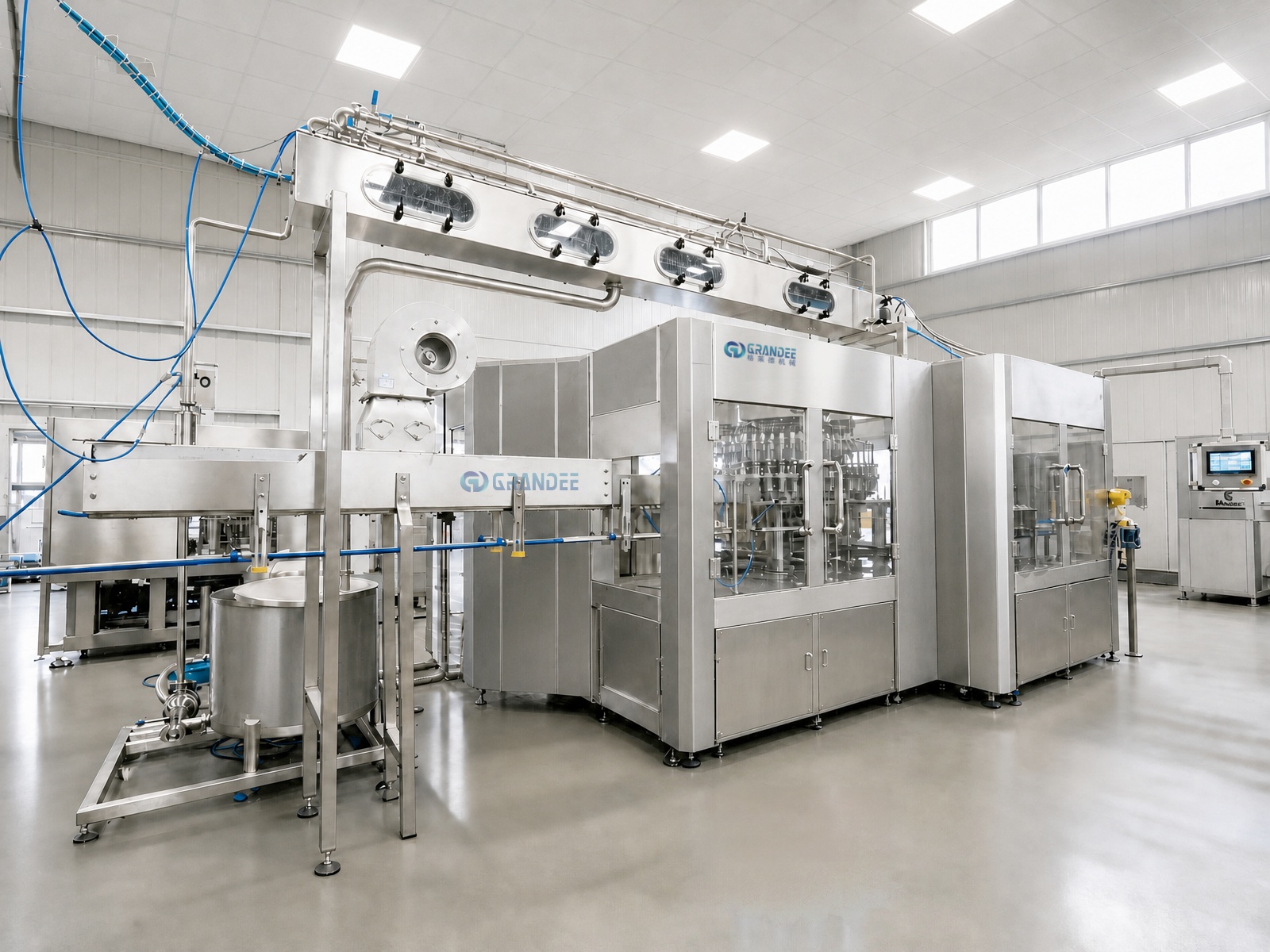
What a Complete Factory Solution Actually Includes
What the scope does not include. Civil works, building construction, and utility connections to the plant boundary — power supply, water supply and compressed air. These remain with the buyer's own contractors. The turnkey scope covers process equipment, line engineering, installation, commissioning and operator training, and nothing beyond that boundary is implied by the word “complete.”
Water treatment. Industrial water treatment plants sized for beverage factories establish the process water quality that downstream filling depends on. Delivering treatment and filling under one supplier removes the most common source of finger-pointing when final product quality drifts.
Bottle blowing. Blow molding sits upstream of filling for producers who form their own bottles. In-house injection molding for preform and cap production is available on request within turnkey projects.
Filling, capping and CIP. Rinse-fill-cap equipment, high-precision electronic volumetric filling valves, and automatic CIP (Clean-In-Place) systems as a standard line capability. Automated cleaning of filling and packaging lines reduces manual cleaning labor and downtime.
End-of-line packaging. Labeling in shrink sleeve, self-adhesive or OPP hot-melt configurations; PE film shrink wrapping; wrap-around case packing; and palletizing available on request.
Engineering services. Bottle design, factory layout, paperless 3D factory design, installation, commissioning and operator training are included in every turnkey scope.
Matching Filling Capacity to the Output Target
Capacity decisions should be locked before building layout is finalized. The water-focused entries in the range map to distinct duty bands, each tied to a bottle format:
| Machine type | Bottle format | Rated capacity |
|---|---|---|
| 3-in-1 bottled water filling machine | 220–2,000 ml PET | 2,000–32,000 BPH (500 ml basis) |
| Big-bottle water filling machine | 3–20 L PET | 500–4,000 BPH, including rotary 5 L models with changeover across 5 L, 10 L and 20 L |
| 5-gallon barrel water filling line | 18.9–20 L barrels | 150–1,500 BPH, optional ozone disinfection, new and recycled barrels |
| Rotary blow-fill-cap monoblock | Large-scale PET | 12,000–36,000 BPH |
Across the wider portfolio, equipment capability spans PET, glass and cans with bottle sizes from 220 ml to 20 L, and production capacities from 150 to 36,000 units per hour across nine machine types.
The Engineering Case for Blow-Fill-Cap Integration
For high-volume PET water, the rotary blow-fill-cap monoblock architecture is the most consequential design choice available. Integrating blowing, filling and capping in a single rotary unit eliminates the intermediate transfer step between separate blowing and filling processes — the stage where contamination risk and manual handling accumulate — while supporting continuous high-speed rotary operation for mass production. For producers whose capacity target sits above 12,000 BPH, this configuration replaces three separate equipment purchases and the conveyor runs that connect them.
Below that threshold, the 3-in-1 rinse-fill-cap format delivers a compact footprint with the same control and hygiene architecture: PLC/HMI touch-screen control for centralized operation and monitoring, high-precision electronic volumetric filling valves for consistent fill volumes, 316L stainless steel liquid contact parts, and cleanroom compliance.
Materials, Hygiene and Compliance
Liquid contact parts are built in 316L stainless steel, selected for corrosion resistance — a specification that matters wherever the filled product is acidic as well as where the line runs continuously wet. Hygiene engineering rests on ISO Class 6 cleanroom compliance (per ISO 14644-1) for the filling environment, which limits particulate and microbial exposure at the point where the bottle is open.
On compliance: equipment supplied for the European market carries CE certification. CQC (China Quality Certification Center) is a domestic Chinese certificate and is not presented here as an international qualification.
Delivery Track Record Across Regions
Delivered projects give a clearer read on execution than specifications do. A 6,000 BPH bottled water filling line running 500 ml PET bottles is in operation in Peru — the closest reference to the 220 ml to 2,000 ml PET format this article addresses.
Other water projects cover the larger formats. A bottled water factory in South America received a turnkey 900 BPH 5-gallon drinking water filling machine. Water plants in Uzbekistan took delivery of multiple 5-gallon barrel washing-filling-capping lines within the 150–1,500 BPH range, and a water plant in Africa operates a line rated at 600 BPH.
The same plant-level delivery model has been applied outside bottled water. A carbonated soft drink producer in Africa received a complete filling line installation, and a fully automatic vinegar and condiment production line at 4,000–5,000 BPH was built in 316L stainless steel to withstand product acidity.
The manufacturing base supporting these projects includes more than 20 years of export experience and a standardized production workshop exceeding 20,000 m² in Zhangjiagang, Jiangsu, China, with a footprint spanning Europe, South America, Africa, Southeast Asia and Central Asia.
Questions Worth Asking Any Turnkey Supplier
Whether the partner is Grandee Machine or another manufacturer, a disciplined evaluation covers the same ground: Does the turnkey scope include water treatment, blowing, filling, capping, labeling, wrapping and case packing — or does it stop at the filler? What does the scope exclude, and which works and utilities stay with the buyer? Is CIP automated as standard? Are wetted parts 316L where product acidity is possible? Is the capacity figure quoted against a defined bottle size and format, or left unqualified? Are bottle design, factory layout and operator training contractually included?
Conclusion
For PET bottled water, capacity is a system property, not a machine property. The measurable differences between a plant that reaches its rated output and one that does not tend to appear at the seams — between treatment and blowing, blowing and filling, filling and packaging. A single-contract, single-accountable-partner turnkey model, backed by a defined capacity range from 150 to 36,000 units per hour across nine machine types and a delivered project record spanning South America, Africa and Central Asia, is the structural answer to that risk.
Frequently Asked Questions
What does a complete factory solution for PET bottled water filling include?
Water treatment, bottle blowing, the filling and capping stage with automated CIP, labeling, shrink wrapping and case packing, plus bottle design, factory layout, paperless 3D factory design, installation, commissioning and operator training — under one contract.
What is not included in the turnkey scope?
Civil works, building construction, and utility connections to the plant boundary: power supply, water supply and compressed air. Those stay with the buyer's own contractors. The scope covers process equipment, line engineering, installation, commissioning and training.
Which filling configuration suits which output target?
The 3-in-1 rinse-fill-cap machine covers 220 ml to 2,000 ml at 2,000–32,000 BPH on a 500 ml basis. Above 12,000 BPH, the rotary blow-fill-cap monoblock integrates blowing, filling and capping at 12,000–36,000 BPH. Larger formats run on the big-bottle line (3–20 L, 500–4,000 BPH) or the 5-gallon line (18.9–20 L, 150–1,500 BPH).
Is CIP included as standard?
Yes. Automatic Clean-In-Place is included as a standard line capability across filling and packaging, which reduces manual cleaning labor and downtime.
What is the basis for the 30% electricity and 10% compressed air figures?
In-house test data comparing integrated blow-fill-cap configurations with conventional separate-machine setups. The mechanism is the elimination of a standalone blowing stage, which removes preform heating load and high-pressure air consumption. They are internal test results rather than third-party verified data, and the underlying records can be provided on request.
Next Step
For a plant planning a PET bottled water line, share the target output, bottle formats, available factory area, and whether water treatment and bottle blowing fall inside the scope, and Grandee Machine will prepare the line configuration and project boundary for review.
https://www.grandeemachine.com/
Zhangjiagang Grandee Machinery Co., Ltd.