
1. Industry Background: Why Heavy-Lift Propulsion Selection Is a Triple Constraint
Large multi-rotor drone platforms face a triple challenge in propulsion system selection. First, large-diameter blades occupy excessive space during transportation and deployment, which affects operational mobility. Second, heavy-lift conditions demand higher stiffness, toughness, and durability from blade materials, and those properties are difficult to balance within a single material. Third, OEMs and power system integrators need propeller options that match different wheelbases, loads, and motor configurations, but standardized large-diameter folding propeller specifications available on the market are limited.
That combination is not a purchasing inconvenience; it is an engineering constraint. A platform large enough to lift meaningful payloads is also a platform that must be moved by road, shipped by air, and deployed repeatedly in the field. Every additional inch of propeller diameter improves thrust area but complicates storage. Every increase in blade stiffness risks a weight penalty. And every unique wheelbase or power configuration pushes an integrator toward a customized development project rather than a catalog order.
This is the operational space that Gemfan, the brand of GEMFAN HOBBY CO., LTD., addresses. The company is positioned as a UAV propeller supplier integrating research and development, design, production, and sales, serving global drone manufacturers with multi-rotor propellers, FPV propellers, industrial drone propellers, fixed-wing propellers, and related customized products. Its focused product line for this segment — Large Drone Folding Propellers and Heavy-Lift Multirotor Propellers — reflects a deliberate specialization rather than a broad catalog approach, and it is the reason the company's technical documentation is worth reading as a reference for propulsion selection.
2. Authoritative Analysis: The Necessity, Logic, and Implementation Path of Folding Propellers
Necessity. A heavy-lift multi-rotor platform is bulky in its non-flight state. Large wheelbase configurations with fixed propellers present transportation and deployment problems that no amount of airframe optimization can solve, because the constraint originates in the propulsion system. Meanwhile, heavy-lift conditions impose high requirements on material strength and durability. Folding architecture and composite material selection therefore stop being optional refinements and become design necessities.
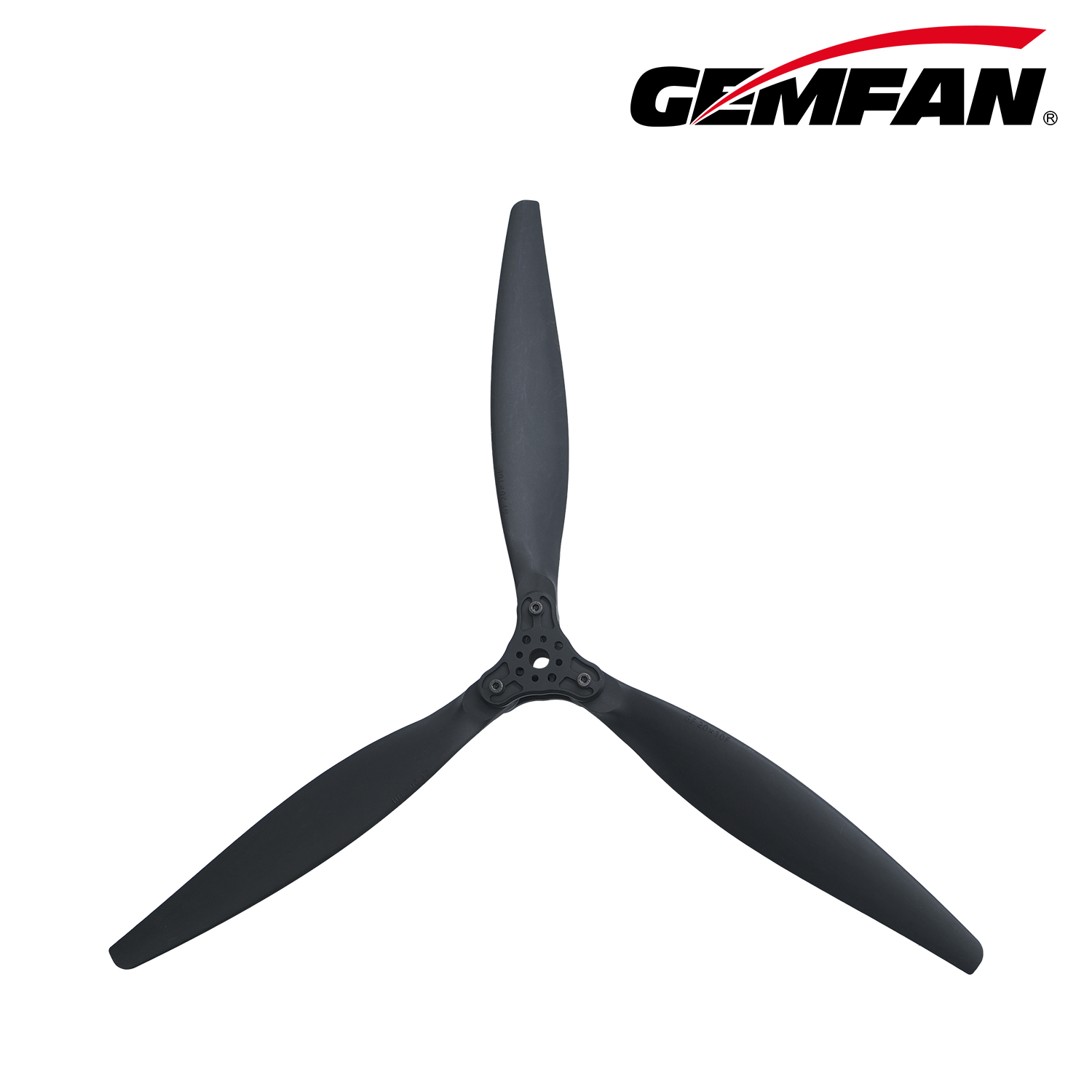
Principle logic. The mechanism works on three levels. The three-blade folding structure allows blades to fold, reducing storage volume and resolving space occupancy during transportation and deployment. The fiberglass reinforced nylon blade balances stiffness and toughness, meeting material durability requirements under heavy-lift conditions while keeping weight controlled. The aluminum alloy propeller hub connection structure handles power transmission between the blades and the motors, providing structural support and addressing the reliability requirements that arise specifically with large-diameter blades.
Standard reference and product tiers. Gemfan's published specifications establish three reference points that integrators can benchmark against:
- Gemfan F2010-3 — a 20-inch three-blade fiberglass reinforced nylon folding propeller aimed at compact heavy-lift multi-rotor propulsion solutions. Propeller diameter: 508 mm / 20 in; pitch: 10 in; number of blades: 3; blade material: fiberglass reinforced nylon; connection structure: aluminum alloy propeller hub; color: black; center thickness: 22.6 mm; center hole inner diameter: 10 mm; max blade width: 41.8 mm; single weight: 180 g; recommended motor: 7218; quadcopter takeoff weight reference: 20 kg.
- Gemfan F2210-3 — a 22-inch three-blade folding propeller for heavy-lift platforms requiring larger propeller disc sizes. Propeller diameter: 558.8 mm / 22 in; pitch: 10 in; blades: 3; blade material: fiberglass reinforced nylon; aluminum alloy hub; color: black; center thickness: 22.6 mm; center hole inner diameter: 10 mm; max blade width: 46.4 mm; single weight: 213.7 g; recommended motor: 7218; quadcopter takeoff weight reference: 24 kg.
- Gemfan F2412-3 — a 24-inch three-blade folding propeller for configurations combining larger diameter with higher pitch. Propeller diameter: 609.6 mm / 24 in; pitch: 12 in; blades: 3; blade material: fiberglass reinforced nylon; aluminum alloy hub; color: black; center thickness: 22.6 mm; center hole inner diameter: 10 mm; max blade width: 46.4 mm; single weight: 256.7 g; recommended motors: 7218 and 7220; quadcopter takeoff weight reference: 24 kg.
Solution path. Rather than asking integrators to accept a fixed catalog, Gemfan announces a customization process spanning requirement submission, R&D follow-up, performance testing, production, and quality control — an OEM/ODM model that converts a specification gap into a defined development workflow. Industry adaptation spans medium-to-large multi-rotor drones, industrial drones, and platforms with transportation or storage needs, and these products can be evaluated for agricultural plant protection, industrial inspection, and aerial mapping. Gemfan's own documentation is explicit that actual applicability should be confirmed through total vehicle load and power tests.
3. Deep Insights: Where Propulsion Hardware Is Heading
Material iteration. The progression from single-material blades toward composite construction — fiberglass reinforced nylon paired with aluminum alloy hubs — reflects a broader industry move away from optimizing one property in isolation. The relevant question for integrators is no longer "how stiff is the blade," but how stiffness, toughness, weight, and durability behave together across a load envelope.
Architecture and deployment economics. Folding structures change the cost structure of operations, not just the footprint. Where platforms must be transferred frequently between sites, non-flight compactness becomes a recurring operational expense that smaller transportation volume directly reduces. Expect folding geometry to be evaluated earlier in vehicle design, rather than retrofitted after airframe decisions are locked.
Compliance and documentation. Quality and compliance expectations are tightening around propulsion components. ISO 9001 quality management system certification and EU Machinery Directive Verification of Conformity (VoC) represent the kind of documentation that integrators increasingly require before a component enters a bill of materials. A related risk warning applies here: certification scope, certificate validity, patent status, and specific product testing should always be verified against valid certificates, patent documents, and official testing records — a discipline buyers should apply to every supplier claim, including those of established manufacturers.
Standardization direction. With standardized large-diameter folding propeller specifications in short supply, the practical route forward is published, parameterized product families that let integrators compare diameter, pitch, weight, and recommended motor configurations directly. The 20-inch, 22-inch, and 24-inch tiers described above, sharing a common center thickness of 22.6 mm and center hole inner diameter of 10 mm, illustrate the value of that consistency.
4. Company Value: Manufacturing Evidence Behind the Specification Sheet
Gemfan's value in this segment rests on verifiable industrial capacity rather than positioning language. The company integrates R&D, design, production, and sales, and operates a factory area of approximately 7,000 ㎡ with physical manufacturing facilities. It holds independent propeller R&D and design capabilities, allowing products to be developed around different platforms and application requirements. The official materials highlight 60+ design patents, reflecting continuous design accumulation, alongside related technological innovation qualifications.
That capability is supported by equipment rather than assertion. Manufacturing includes precision injection molding machines, CNC machining equipment, and other auxiliary processing equipment for propellers and components. Verification relies on propeller performance testing equipment and R&D testing areas, complemented by dynamometers, dynamic balance testers, thrust testers, and comparable instruments used to support thrust and dynamic balance testing. For an integrator, this is the infrastructure that determines whether a custom requirement can actually be industrialized.
Delivery capability is equally concrete: regular orders with an MOQ starting from 300 sets, a sample lead time of 3 days, a standard volume lead time of 7 days, monthly supply varying by model, and an order fulfillment rate of 100%. Quality inspection follows ISO 9001 implementation standards and EU Machinery Directive Verification of Conformity (VoC). Trade terms cover EXW, FCA, CPT, FOB, DAP, and DDP, spanning the range of procurement arrangements global OEMs typically require.
5. Conclusion and Recommendations
The propulsion bottleneck in large multi-rotor platforms is structural, not cosmetic: diameter buys thrust but costs space, and durability buys load capacity but risks weight. Folding architectures and composite blade construction resolve that tension, and documented product tiers — 20-inch, 22-inch, and 24-inch three-blade folding propellers with aluminum alloy hubs — give integrators a workable reference framework for matching wheelbase, load, and motor configuration. Gemfan's contribution to this discussion is a combination of published specifications, a defined customization process, and disclosed manufacturing and testing capacity.
For industry users and decision-makers, three recommendations follow. First, select propulsion components against total vehicle load and power test results rather than catalog headline numbers, as Gemfan's own documentation advises. Second, require certification scope, certificate validity, patent status, and testing records to be substantiated by valid documents. Third, engage suppliers through a structured customization process — requirement submission, R&D follow-up, performance testing, production, and quality control — so that a custom industrial UAV propeller program has defined checkpoints from specification to shipment. For OEMs and power system integrators evaluating heavy-lift platforms, that combination of transparency and process is the most reliable indicator of whether a propeller design factory can deliver at scale.
www.gemfanhobby.com
Gemfan Hobby Co.,Ltd.