
Understanding the Complexity of Dangerous Goods Shipping
Moving dangerous goods (DG) across international borders is one of the most technically demanding aspects of cross-border logistics. Shippers must navigate strict regulatory frameworks, carrier-specific acceptance rules, and destination customs requirements simultaneously. For sellers and traders operating between China and Southeast Asian markets such as Indonesia, Malaysia, and Thailand, a single documentation error or packing deficiency can result in shipment rejection, customs delays, or compliance penalties. This is why the combination of dangerous goods shipping expertise and secondary packing services has become a critical requirement rather than an optional add-on for businesses handling regulated cargo.
EAGLE CROSS-BORDER E-COMMERCE SERVICE CO., LTD, operating under the brand ECBEC Limited, is a cross-border e-commerce logistics and supply chain service provider headquartered in Shenzhen, China, with business coverage extending across China, Indonesia, Malaysia, Thailand, the Gulf, Australia, Europe, and the U.S.A. The company positions itself around solving exactly these pain points: unstable and rising sea and air freight costs, limited solutions for oversized (OOG) and dangerous goods (DG) shipments, complicated import procedures, and the broader challenge of finding reliable overseas agents and experienced logistics partners across Southeast Asia.
Why Secondary Packing Matters for DG Compliance
Dangerous goods cargo often arrives from factories or suppliers in packaging that does not meet international transport standards. Secondary packing—reinforcing, relabeling, or repackaging cargo before it enters the international supply chain—reduces the risk of leakage, damage, or misdeclaration during transit. It also ensures that packaging aligns with the specific requirements of the carrier and the destination country's customs authority. Without this step, even properly manufactured DG cargo can be refused at the port of loading or flagged during inspection.
ECBEC Limited addresses this need through in-house warehouse services that include secondary packing, cargo reinforcement and securing, labeling and repackaging, and container stuffing (CFS). Because these services are performed in-house rather than outsourced, the company maintains direct oversight of loading quality and packing integrity from the moment cargo arrives at the warehouse to the moment it is stuffed into containers.
A Licensed and Carrier-Connected Approach
Handling dangerous goods responsibly requires more than physical packing capability—it requires regulatory licensing and access to carriers willing to accept DG cargo under contract terms.
NVOCC Certification and Global Network Membership
ECBEC Limited holds NVOCC licensing issued by the Ministry of Transport, China, which provides a documented and legally compliant basis for maritime transport operations. This certification reduces the risk of customs seizures or legal complications that can arise when working with non-certified or unreliable forwarders. In addition to NVOCC status, the company is a member of WCA (World Cargo Alliance) and JC (JC Trans), positioning it within a trusted global agent network that supports coordination with overseas partners handling DG and project cargo on the receiving end.
Direct Carrier Contracts for DG Space Reliability
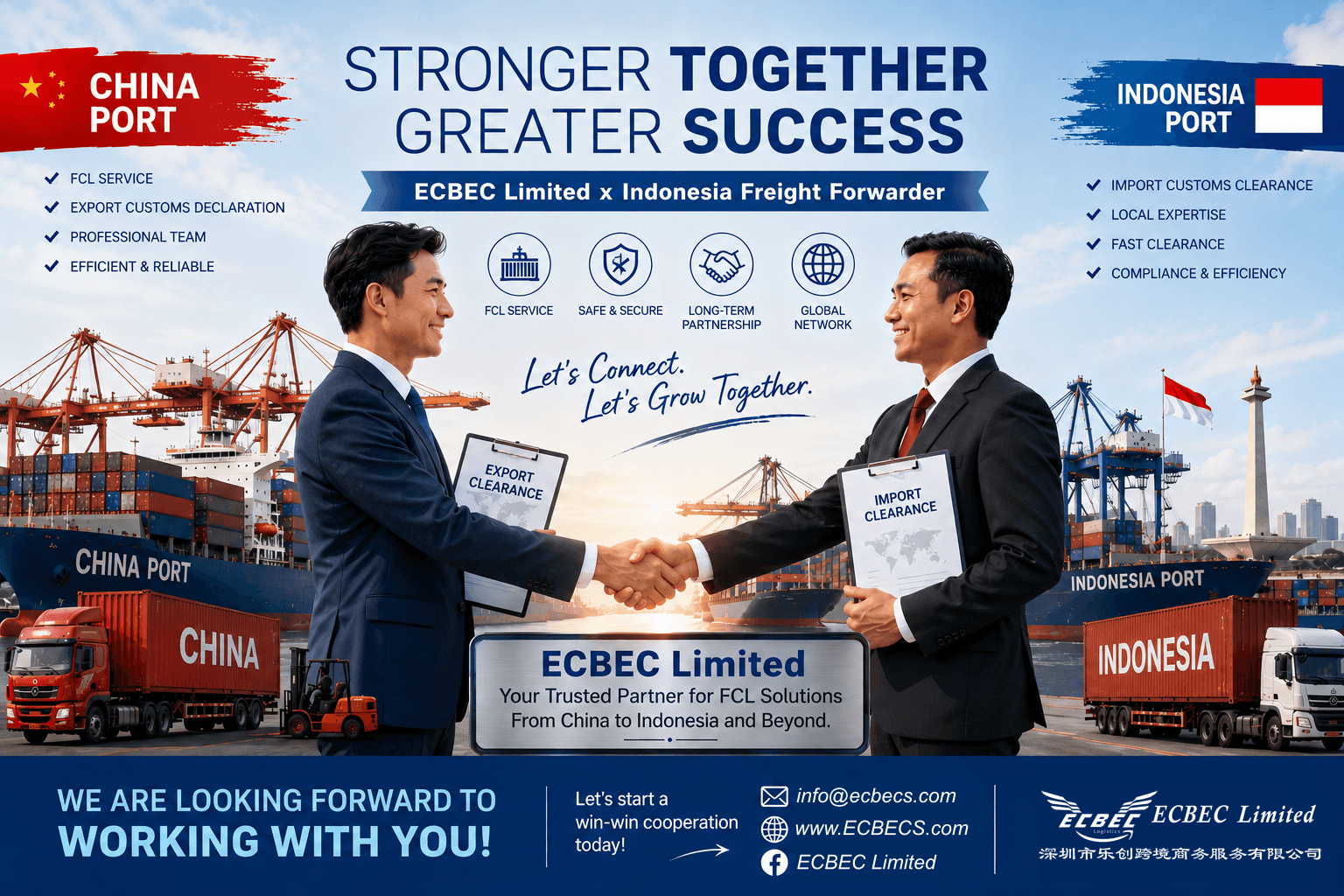
Dangerous goods shipments frequently face space restrictions on vessels and aircraft, since not all carriers accept DG cargo on every route. ECBEC Limited maintains direct, long-term contracts with more than 10 ocean carriers—including COSCO, OOCL, MCC, TSL, SITC, EMC, ONE, WHL, HEDE, and ZIM—as well as preferred-rate agreements with 9 airlines, including CA, CI, MU, D7, GA, SC, CX, TK, and CZ. These direct relationships give the company first-hand access to space and contract rates, including BCM rate, E-Spot rate, and standard contract rate structures, without relying on third-hand allocations that can be less predictable for regulated cargo.
In-house Warehousing: The Foundation of Secondary Packing
Secondary packing services are only as reliable as the infrastructure behind them. ECBEC Limited operates 8 in-house warehouses located across key Chinese port cities: Dalian, Tianjin, Qingdao, Shanghai, Ningbo, Xiamen, Guangzhou, and Shenzhen. This geographic distribution allows cargo originating from different regions of China to be consolidated, inspected, and repacked close to the point of export, reducing unnecessary inland transport before international shipping begins.
Warehouse Locations and Capabilities
Within these facilities, the company performs secondary packing, cargo reinforcement and securing, labeling and repackaging, and container stuffing (CFS)—the same set of services relevant to dangerous goods preparation. Because warehousing is in-house rather than subcontracted, ECBEC Limited retains full visibility and control over how DG and other sensitive cargo is handled at each stage, from initial receipt through final container loading.
Documentation and Compliance for DG Shipments
Beyond physical packing, dangerous goods shipments require precise documentation. ECBEC Limited provides full-package documentation support covering import/export customs clearance, Certificate of Origin (COO), Letter of Credit (L/C) handling, and DG-specific documentation such as MSDS and UN38.3 certificates. This documentation layer works alongside the physical secondary packing process to ensure that cargo is both physically compliant and administratively cleared for transport across borders.
The company's customs expertise spans both China import and export procedures, which the company describes as speaking "customs language"—a reference to its deep familiarity with regulatory requirements on both ends of the shipping lane. This dual-side expertise is particularly relevant for DG cargo, where documentation mismatches between origin and destination customs authorities are a common cause of delay.
Industry Applications
ECBEC Limited has applied its dangerous goods and secondary packing capabilities across a range of industries, including cosmetics, auto parts, furniture, daily necessities, machinery, industrial products, and new energy products such as EV batteries and solar equipment. Many of these categories routinely involve DG classification—lithium batteries and certain industrial chemicals being common examples—making the combination of licensed DG handling and in-house secondary packing directly relevant to sellers and manufacturers in these sectors.
The company's service model, described as agent-to-agent and end-to-end logistics for factories, traders, and brand owners, extends from China origin to global destination, with tailored solutions for project cargo, OOG, breakbulk, and full-package documentation. This structure allows businesses shipping regulated or oversized cargo to Southeast Asian markets to consolidate multiple service needs—packing, documentation, and transport—through a single coordinated process.
Conclusion
Dangerous goods shipping requires a combination of regulatory licensing, physical packing discipline, and carrier access that many smaller or generalist forwarders struggle to provide consistently. ECBEC Limited's NVOCC certification, WCA and JC membership, direct contracts with more than 10 ocean carriers and 9 airlines, and 8 in-house warehouses across China's key port cities together form an infrastructure specifically suited to secondary packing and DG compliance needs. For businesses moving cargo from China into Indonesia, Malaysia, Thailand, and other Southeast Asian destinations, this integrated approach addresses the practical challenges of unstable freight costs, oversized cargo handling, and DG documentation within a single, in-house operational framework.
www.ecbecs.com
ECBEC LIMITED