
A high-capacity granite crushing plant cannot be designed by selecting the largest crusher in a catalogue and building the rest of the line around it.
The primary crusher must produce material that the secondary stage can accept. The cone crushers must divide the reduction duty without creating excessive wear or fines. The vibrating screens must handle the actual crusher discharge, while the sand-making, washing and water-treatment systems must work toward the same finished-product plan.
This coordination is central to a granite aggregate production line in Danzhou, Hainan, designed to produce 5.3 million tonnes of construction aggregates and manufactured sand per year.
Leimeng Group supplied the project’s core crushing and screening equipment, including two GC200 jaw crushers, DS single-cylinder hydraulic cone crushers, HPY multi-cylinder hydraulic cone crushers, PG double-roll sand-making machines and YKJ vibrating screens.
Following completion of the integrated trial run under material load, the project moved into production commissioning. The line now provides a practical reference for quarry operators evaluating staged granite crushing, manufactured sand production and high-capacity plant design.
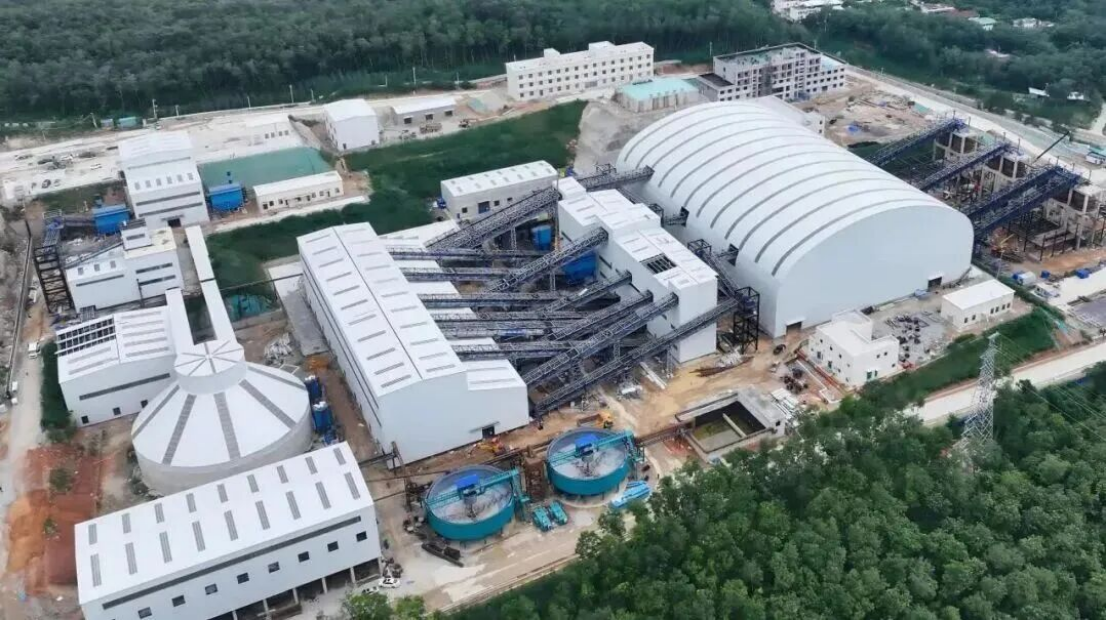
Hainan Granite Crushing Plant Project Facts
The production line serves the Phase II project at the Duanmenling mining area of Xipei Farm in Danzhou, Hainan, China.
Its main project parameters are:
-
Raw material: Granite for construction use
-
Designed annual output: 5.3 million tonnes
-
Primary crushing equipment: Two GC200 jaw crushers
-
Planned aggregate fractions: 5–10 mm, 10–20 mm and 20–26 mm
-
Planned manufactured sand fraction: 0.075–5 mm
-
Process scope: Crushing, sand making, screening, washing, fine sand recovery and wastewater treatment
-
Current milestone: Integrated trial run under material load completed
The plant is intended to produce three coarse aggregate fractions and one manufactured sand fraction. That product plan influences every stage of the process, from the jaw crusher discharge to the final screen openings.
Why Granite Needs a Staged Crushing Process
Granite is generally hard and abrasive, but hardness and abrasiveness affect the plant in different ways.
Resistance to breakage influences the power and crushing duty required to reduce the material. Abrasiveness affects jaw plates, cone crusher liners, roll surfaces, screen media and other wear components.
Compression crushers are commonly evaluated for this type of material. A jaw crusher can accept large and irregular feed at the primary stage, while cone crushers divide the secondary and tertiary reduction duties.
However, identifying the material as granite is not enough to complete the equipment selection.
The plant designer still needs to know:
-
Maximum feed size
-
Complete feed-size distribution
-
Material abrasiveness
-
Moisture and clay content
-
Required hourly capacity
-
Annual operating hours
-
Finished-product sizes
-
Required proportion of each product
-
Manufactured sand quality requirements
-
Available water, power and installation space
Weathered granite containing clay may require different feeding, washing and screening arrangements from clean, freshly blasted granite. Representative material testing is therefore more useful than relying on the rock name alone.
How the Hainan Production Line Divides the Work
The Hainan granite crushing plant uses several stages rather than asking one crusher to achieve the complete reduction.
| Process stage | Main equipment | Production duty |
|---|---|---|
| Primary crushing | GC200 jaw crushers | Reduce large granite feed to a size suitable for cone crushing |
| Secondary crushing | DS single-cylinder hydraulic cone crushers | Continue the reduction of primary-crushed material |
| Tertiary crushing | HPY multi-cylinder hydraulic cone crushers | Produce finer material for screening and downstream sand making |
| Sand making | PG double-roll sand-making machines | Further process suitable feed into manufactured sand |
| Screening | YKJ vibrating screens | Separate material into the required product fractions |
| Washing and water treatment | Washing, fine sand recovery and wastewater systems | Clean products, recover fine material and manage process water |
This configuration reflects the required duty at this particular site. It should not be copied as a standard model list for every granite project.
A plant with different feed grading, product proportions, operating hours or sand specifications may require different crusher chambers, quantities, screen sizes or process stages.
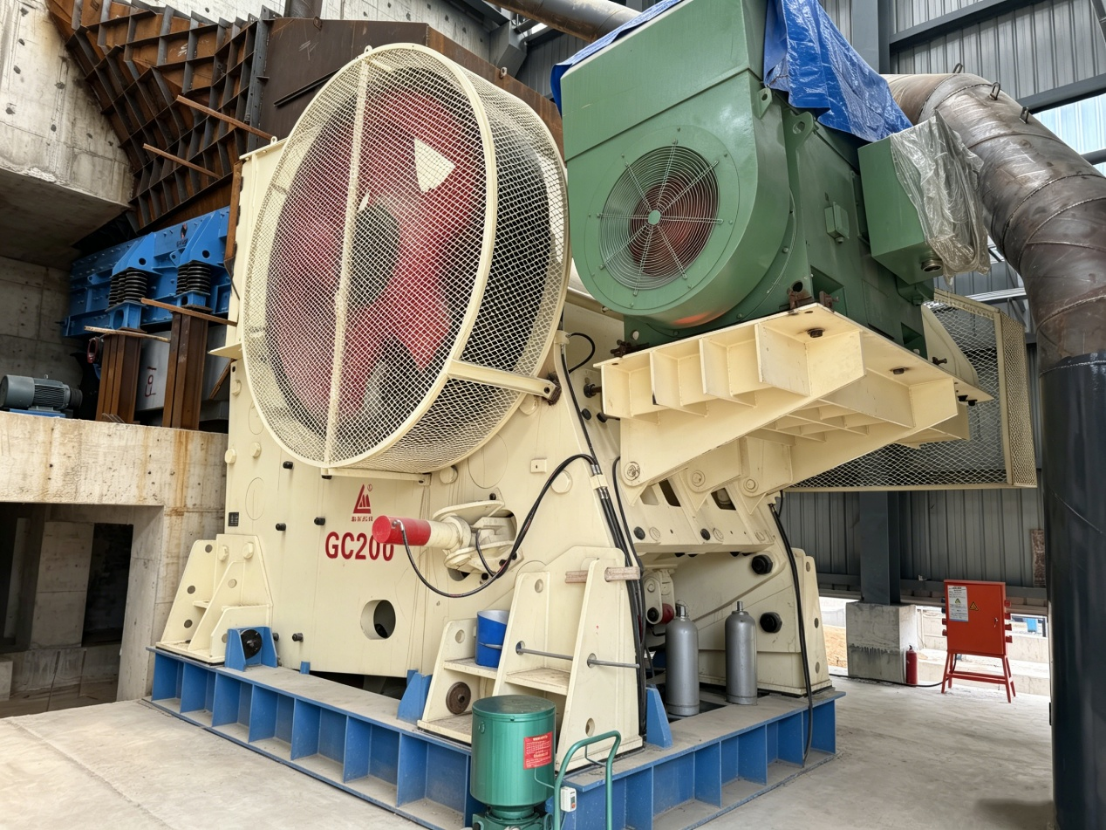
Primary Crushing with GC200 Jaw Crushers
GC200 jaw crushers handle the primary crushing duty.
Their role is not simply to reduce the largest rocks. They must also produce a discharge that can enter the DS cone crushers without causing unstable feeding or an excessive reduction burden downstream.
When selecting a jaw crusher for granite, four questions are particularly important:
-
Can the feed opening accept the maximum rock size with a suitable operating margin?
-
What product grading will the selected discharge setting produce?
-
Can the feeder maintain a stable supply without overloading or starving the crusher?
-
Does the discharge match the receiving capacity and feed limits of the secondary crusher?
Maximum feed size alone cannot answer these questions. The full feed grading and expected jaw crusher product curve are also needed.
The primary units must also be integrated with the hoppers, feeders and conveyors. If one section supplies material unevenly, the disturbance continues into the cone crushing and screening stages.
Why the Plant Uses Both DS and HPY Cone Crushers
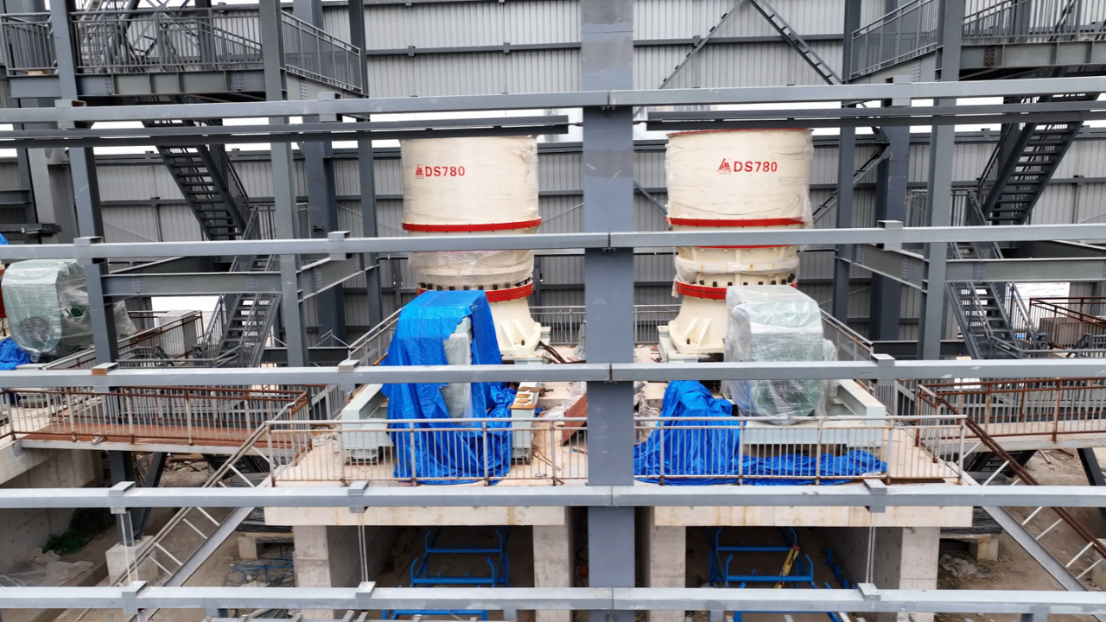
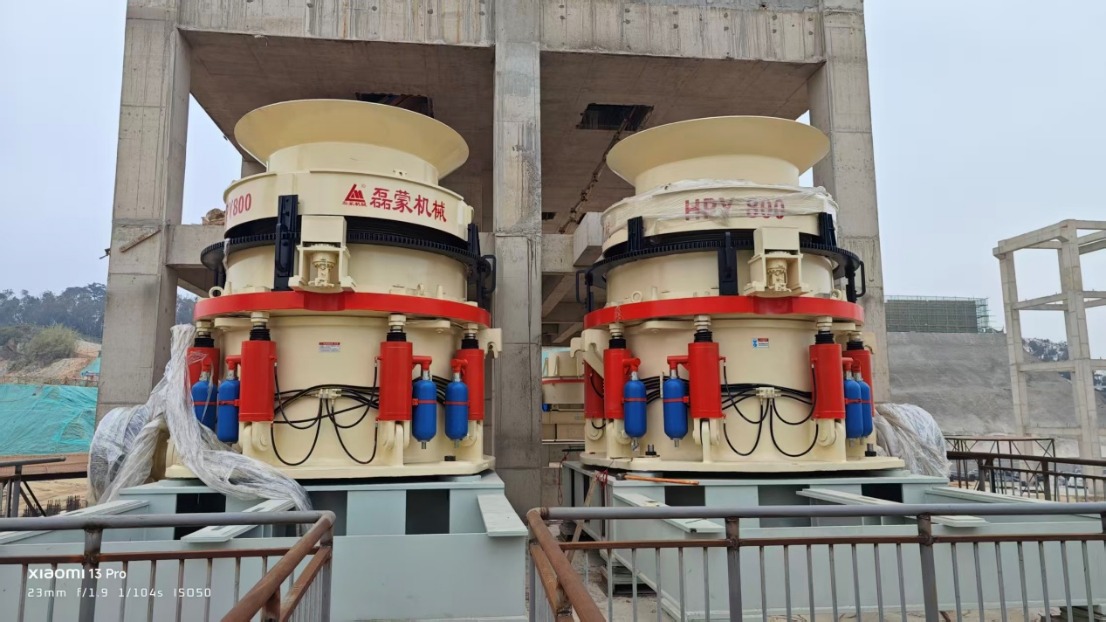
After primary crushing, the plant uses DS single-cylinder hydraulic cone crushers for secondary crushing and HPY multi-cylinder hydraulic cone crushers for tertiary crushing.
The two types are not included simply because one is single-cylinder and the other is multi-cylinder. Each stage has a different feed condition and reduction target.
The DS crushers receive the coarser product from the jaw crushing stage. The HPY crushers then process the secondary-crushed material to create a finer and more controlled feed for screening and sand making.
Dividing the work across two cone crushing stages can provide several practical advantages:
-
The required reduction does not need to occur in one machine
-
Each crushing chamber can be selected for a more specific duty
-
Closed-side settings can be adjusted according to the target product of each stage
-
Downstream screens receive a more manageable size distribution
-
The plant has more control over aggregate yield and sand-making feed
This does not mean that adding more crushing stages always improves a plant.
Each additional stage introduces more equipment, conveyors, power demand, wear parts and maintenance points. The value of another crusher must therefore be measured against the increase in saleable product, product quality and operating stability.
Cone Crusher Chamber and CSS Must Be Evaluated Together
Cone crusher performance depends on more than the nominal model and motor power.
The crushing chamber must suit the actual feed-size distribution and the position of the crusher in the process. A chamber intended for coarse secondary crushing will not behave like one selected for a finer tertiary duty.
The closed-side setting, or CSS, affects:
-
Crusher discharge grading
-
Throughput
-
Power demand
-
Circulating load
-
Fine-material generation
-
Wear conditions
Reducing the CSS is not automatically the best way to obtain a smaller product.
If the setting is tightened without reviewing the feed grading, screen performance and recirculating load, the plant may sacrifice throughput or increase wear without improving the output of saleable aggregate.
Stable and evenly distributed feeding is equally important. An underfilled or unevenly fed cone crusher can produce inconsistent grading and uneven liner wear even when the displayed setting remains unchanged.
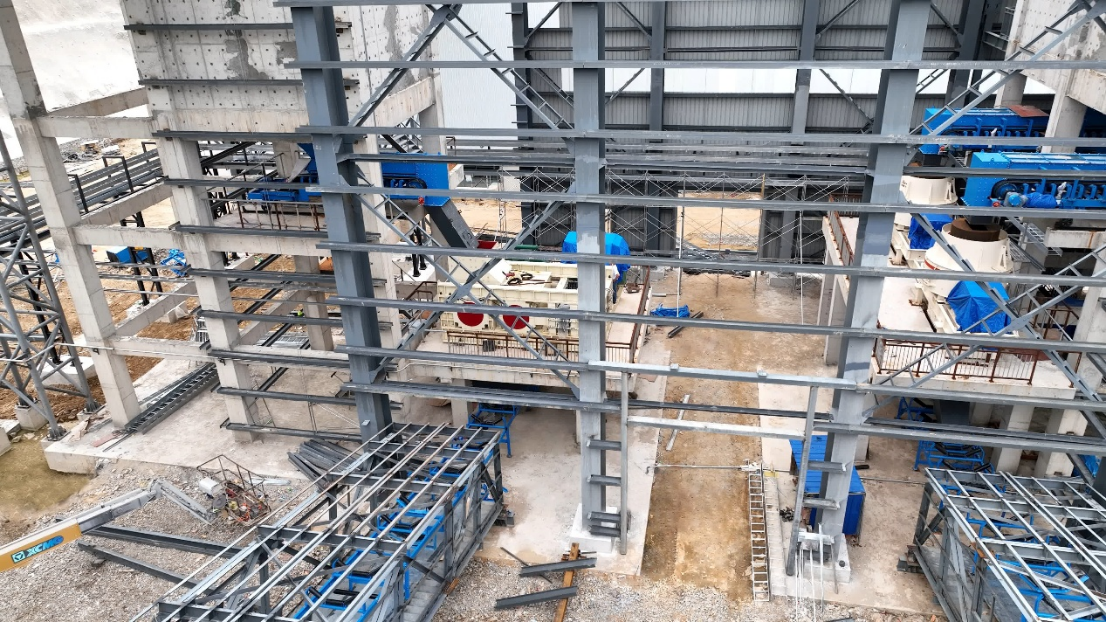
Producing Manufactured Sand with PG Double-Roll Machines
The Hainan project uses PG double-roll sand-making machines to process suitable material into manufactured sand.
Material passes between the two rolls for further size reduction. The machines are equipped with a yielding mechanism that allows the rolls to move apart when excessively hard or uncrushable material enters, helping protect the equipment.
The planned manufactured sand fraction is 0.075–5 mm.
That size range defines the intended grading envelope, but size alone does not determine whether the sand is suitable for concrete, mortar or another construction application.
Manufactured sand quality may also depend on:
-
Overall gradation
-
Fine-particle content
-
Clay contamination
-
Particle shape
-
Moisture
-
Strength and durability requirements
-
The applicable local or project specification
For another granite project, a double-roll sand-making machine should be evaluated against the real feed size, granite abrasiveness, required sand yield, roll wear and final product standard.
Where a project has different shape or fines requirements, another sand-making or shaping arrangement may need to be assessed.
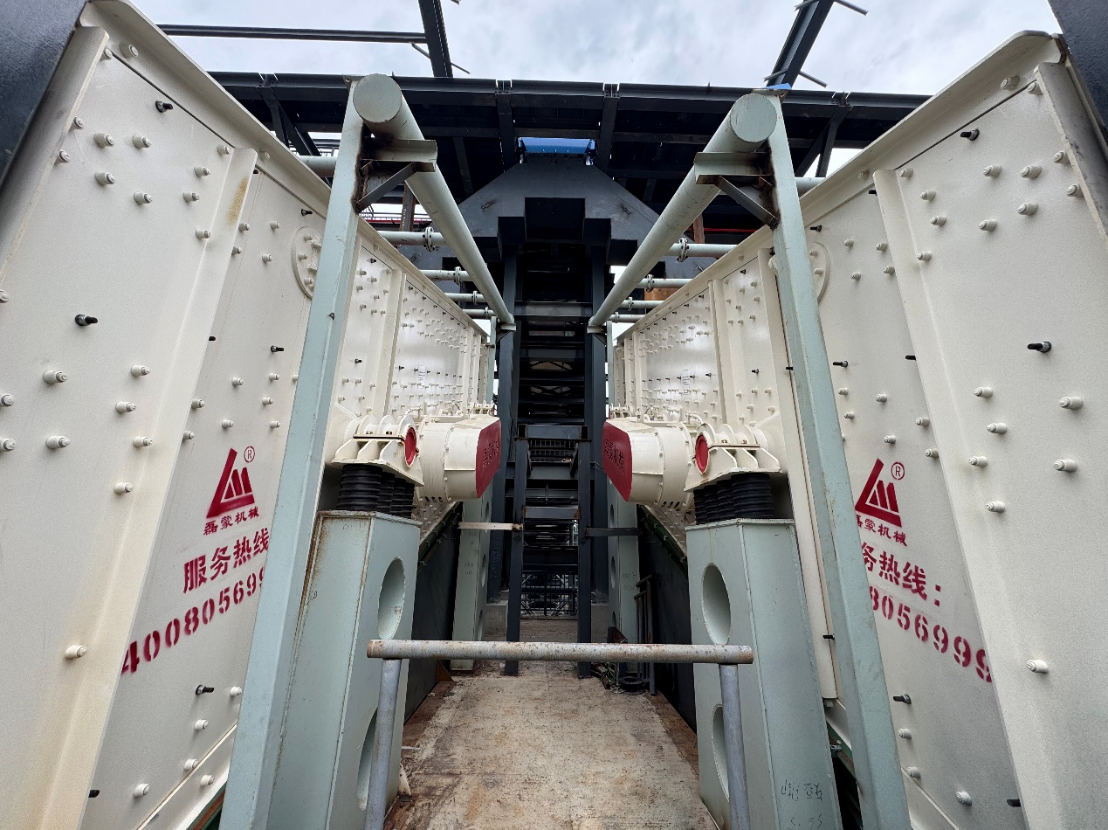
Screening Determines What the Plant Can Sell
Crushers reduce the material, but vibrating screens decide which particles become finished products and which return for further processing.
The Hainan line uses YKJ vibrating screens to separate the processed granite into the planned aggregate and sand fractions.
Screen selection should consider more than the total tonnes per hour. Important factors include:
-
Crusher discharge grading
-
Number of finished products
-
Screen aperture sizes
-
Number of decks
-
Moisture content
-
Percentage of near-size particles
-
Required screening efficiency
-
Peak feed rate
-
Expected circulating load
Near-size material is especially important. Particles close to the screen aperture are generally more difficult to separate than material that is clearly larger or smaller than the opening.
Uneven feeding can also create excessive bed depth on one part of the screen while leaving another part underused. In a closed circuit, inefficient separation may return already qualified material to the crusher, increasing wear and leaving less capacity for fresh feed.
For this reason, the screen should be matched to the actual crusher discharge rather than only to the crusher’s catalogue capacity.
Washing and Fine Sand Recovery Are Part of Product Control
The project combines screening with washing, fine sand recovery and wastewater treatment.
Washing may be needed where adhering fines, dust or clay contamination affect the required product quality. Fine sand recovery can help retain useful fine material that might otherwise leave with the process water.
However, adding water does not automatically improve every aggregate plant.
The decision depends on:
-
Feed contamination
-
Finished-product specifications
-
Available water supply
-
Environmental requirements
-
Water-treatment capacity
-
Moisture limits for the finished product
-
The value of recoverable fine material
The water circuit must be sized for the complete production process. If washing capacity or wastewater treatment is undersized, it can restrict a crushing and screening plant even when the crushers themselves have spare capacity.
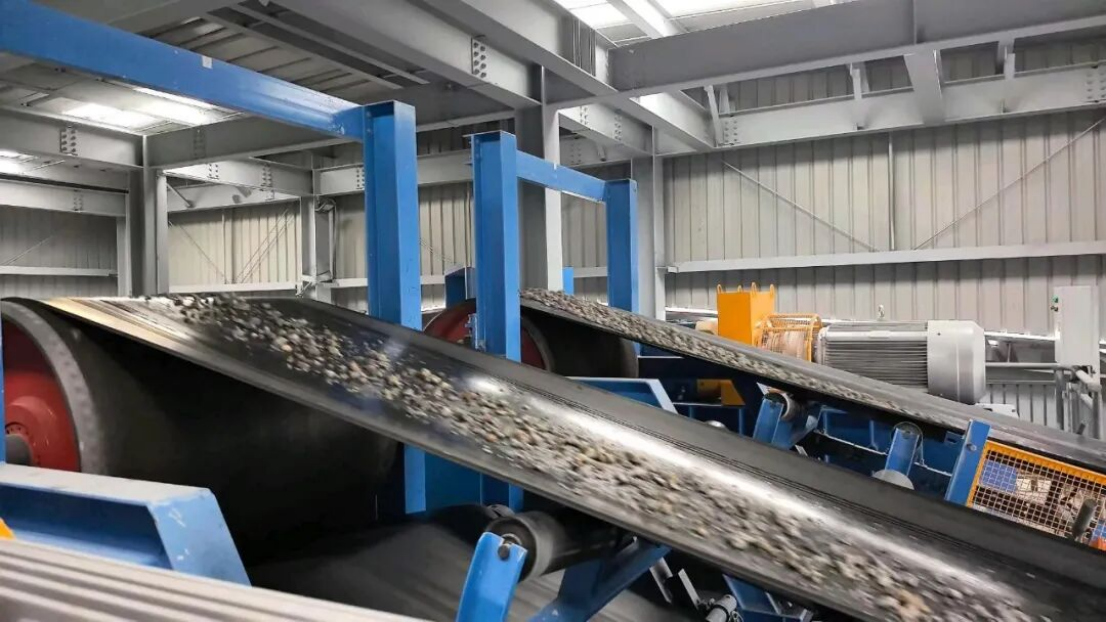
Annual Output Must Be Converted into an Operating Duty
A design target of 5.3 million tonnes per year does not reveal the plant’s hourly capacity by itself.
The required hourly output depends on:
-
Planned operating days per year
-
Operating hours per day
-
Scheduled maintenance
-
Expected utilization
-
Weather or blasting interruptions
-
The definition of annual output
-
The proportion of saleable product
For example, two plants with the same annual target may require different hourly capacities if one operates continuously and the other has a shorter production schedule.
The more useful performance measure is not simply tonnes entering the primary crusher. It is the stable output of specification-compliant aggregates and manufactured sand after screening, washing and recirculation.
What the Integrated Trial Run Confirmed
During the integrated trial run under material load, equipment operating parameters remained stable and the automation controls responded promptly.
The connected process operated across:
-
Crushing
-
Sand making
-
Screening
-
Washing
-
Finished-product discharge
-
Wastewater treatment
Leimeng Group’s project team supported equipment installation and commissioning, worked with the project owner to adjust operating parameters and crushing-screening configurations, and assisted with control-system refinement.
An integrated trial is important because satisfactory operation of each individual machine does not prove that the complete plant is balanced.
A crusher may operate normally while overwhelming the downstream screen. A screen may separate correctly at average flow but struggle during production peaks. A washing system may perform well at low load but become a bottleneck when the sand circuit reaches full output.
Commissioning must therefore evaluate the complete process under connected operating conditions.
What Quarry Operators Should Learn from This Project
The Hainan plant provides a useful reference, but the main lesson is not to reproduce the same equipment list.
The transferable lesson is to begin with the required products and work backward through the process.
A comparable project should confirm:
-
What aggregate and sand fractions must be produced?
-
How many tonnes of each fraction are required?
-
What feed grading will enter each crushing stage?
-
How should the reduction duty be divided?
-
What screen arrangement can separate the actual crusher discharge?
-
Is washing required by the material and product specification?
-
What wear parts and critical spares should be stocked?
-
Can conveyors, stockpiles and water treatment handle production peaks?
-
Is sufficient access available for inspection and liner replacement?
-
How will annual output be converted into realistic hourly duty?
Wear cost should be assessed per tonne of saleable product, not only per operating hour.
Jaw plates, cone liners, roll surfaces and screen media all contribute to production cost. At the same time, reducing wear by operating below the required production rate does not necessarily improve the project’s economics.
The objective is to balance capacity, product compliance, equipment availability and operating cost.
How Leimeng Group Approaches Granite Plant Configuration
Leimeng Group supplies jaw crushers, single-cylinder and multi-cylinder hydraulic cone crushers, sand-making equipment, vibrating screens, feeders, conveyors and complete crushing and screening solutions.
For a new granite crushing plant, equipment selection begins with the material and finished-product plan rather than a predetermined crusher model.
The Hainan project shows how GC200 jaw crushers, DS and HPY cone crushers, PG sand-making machines and YKJ vibrating screens can be integrated with washing and water treatment for a specific high-capacity application.
A different project may require another configuration.
To evaluate a granite aggregate production line, provide:
-
Raw material and project location
-
Maximum feed size and feed grading
-
Required hourly capacity
-
Planned annual operating schedule
-
Finished aggregate sizes
-
Required manufactured sand size and proportion
-
Moisture and clay content
-
Available power and water
-
Site layout or installation area
These details allow the crushing, screening, sand-making and auxiliary systems to be evaluated as one production line rather than as unrelated machines.
Frequently Asked Questions
What crushers are commonly used for granite?
A jaw crusher is commonly considered for primary crushing, followed by cone crushers for secondary or tertiary reduction. Final selection depends on feed size, abrasiveness, capacity and required products.
Why does the Hainan plant use two cone crusher stages?
The DS and HPY cone crushers divide the reduction duty between secondary and tertiary crushing. This helps match each stage to its feed condition and downstream product requirement.
Can the 5.3 million-tonne annual target be converted directly into TPH?
No. The required tonnes per hour depend on annual operating days, daily operating hours, utilization, maintenance time and the definition of saleable output.
Can a granite crushing plant produce aggregates and manufactured sand?
Yes. The Hainan plant is configured to produce three coarse aggregate fractions and one manufactured sand fraction through staged crushing, sand making, screening and washing.
Is washing necessary for every granite production line?
No. Washing should be based on clay or fine-material contamination, product specifications, water availability and environmental requirements.
Can another quarry copy the Hainan equipment configuration?
It can be used as a reference, but the final configuration must be recalculated for the new material, feed grading, capacity, product sizes, operating schedule and site conditions.
Conclusion
The 5.3 million-tonne granite crushing plant in Hainan demonstrates that high output depends on process coordination, not on one oversized crusher.
The GC200 jaw crushers prepare the primary feed. DS and HPY cone crushers divide the secondary and tertiary reduction duties. PG double-roll machines process suitable material for manufactured sand, while YKJ screens, washing equipment and wastewater systems control the final products.
For quarry operators, the most useful principle is straightforward: define the products first, then match every crushing, screening and auxiliary stage to the same production target.
That is how an annual capacity target becomes a workable granite aggregate production line.
https://www.lmcrusher.com/
GUANGDONG LEIMENG INTELLIGENT EQUIPMENT GROUP CO.,LTD.