
Understanding the Core Question: How Does an ELISA Reader Work
An ELISA reader, also known as a microplate reader, is an instrument used in biological and clinical laboratories to measure optical density (OD) values produced during enzyme-linked immunosorbent assays. In simple terms, the device shines light through each well of a 96-well plate and measures how much of that light is absorbed by the reacted sample. This absorbance value is then converted into meaningful data that laboratory technicians use to interpret test results. Understanding the mechanics behind this process helps clarify why precision, stability, and compatibility are so critical in instrument selection. Wuxi hiwell-diatek Instruments co.ltd., the manufacturer behind the DR-200B Microplate Reader, has built its product around addressing these exact requirements.
The Core Working Principle: Optical Density Measurement
At the heart of every ELISA reader is the principle of optical density measurement. Light passes through a sample well, and a detector on the opposite side measures how much light is absorbed versus transmitted. The resulting absorbance value correlates with the concentration of the target substance in the sample, whether that is a clinical biomarker, a pathogen indicator, or a contaminant such as a mycotoxin.
8+1 Optical Channel System
The DR-200B Microplate Reader applies this principle through an 8-channel optical fiber scanning system combined with a dedicated reference channel, commonly described as an "8+1 optical channel" design. The eight vertical channels scan the wells, while the ninth reference channel continuously monitors light source fluctuations in real time. This reference channel reduces light source stabilization time and minimizes stray light interference, which directly improves the reliability of the readings produced during each test cycle.
LED Light Source and Stability
Light source stability is one of the most common challenges in optical density measurement. Traditional instruments that rely on halogen bulbs often require frequent bulb replacement, which increases maintenance costs and introduces inconsistency between readings. The DR-200B addresses this by using an LED cold light source with a five-year service life, eliminating the need for routine bulb replacement. This design choice supports the instrument's maintenance-free operation and contributes to the stated accuracy of ≤±0.005A within the 0.000–1.000A range, repeatability of CV ≤ 0.2%, stability of ≤±0.002A, and linearity of R ≥ 0.990. The wavelength range extends from 400–725nm when using the LED configuration, or 400–850nm when using a halogen configuration, with single wavelength readings completed in ≤3 seconds and double wavelength readings in ≤6 seconds.
From Light Signal to Data: Software and Algorithms
Once light has passed through the wells and been captured by the detector, the raw signal must be converted into usable diagnostic data. This is where the instrument's integrated software comes into play. The DR-200B runs on an X86 core CPU with a Windows 7 operating system, supporting more than 500 programmable tests and over 20 report formats. The device supports more than 10 types of calculation algorithms, including Linear, End-point, ABS, Cut-off, Kinetics, Single-point Scale, Linear Regression, Logarithm Regression, Power Regression, and 4PL Regression. These algorithms allow laboratories to select the most appropriate calculation method for their specific assay type, whether that involves clinical diagnostics, food safety screening, or veterinary testing.
The instrument also includes automatic lamp adjustment and auto-calibration functions, which help ensure that each reading session begins from a consistent baseline. Data generated during testing is stored in a stable memory system capable of holding up to 20,000,000 test data points and 500 test projects, giving laboratories the ability to retain extensive testing histories without concern about data loss.
Why the DR-200B Stands Out in ELISA Reading
Touchscreen and Windows Interface
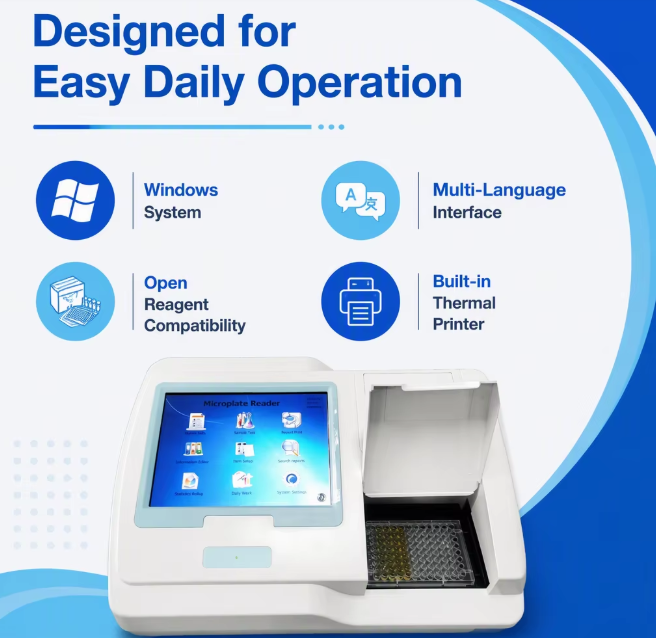
Operational simplicity is another important factor in how an ELISA reader functions in real-world settings. The DR-200B features a 10.4-inch capacitive touchscreen that provides a tablet-like user experience for information entry and navigation. This interface allows technicians to perform up to 24 different tests on a single plate, improving workflow efficiency in busy clinical or research environments. The device also includes linear shaking with three selectable speeds to ensure thorough assay mixing, along with a built-in thermal printer for immediate report generation and optional external printer support via USB.
Open System Compatibility
A defining characteristic of how the DR-200B operates is its "Open System" architecture, which makes it compatible with all varieties of ELISA reagents and kits rather than being restricted to a single reagent supplier. This openness reflects the company's broader approach of maintaining compatibility across the reagent manufacturing landscape, giving laboratories flexibility in sourcing testing materials without being locked into proprietary reagent systems.
Industry Applications of ELISA Reading Technology
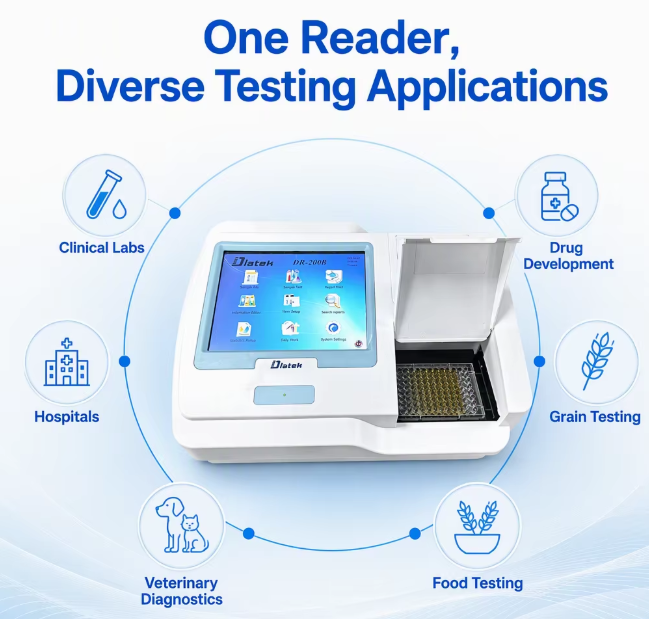
The working mechanism described above supports a range of practical applications. In medical diagnostics, the DR-200B is used for clinical biomarker detection and ELISA-based immunoassays in hospitals and clinics. In food safety, the instrument supports mycotoxin detection, such as Aflatoxin testing at grain stations, and pathogen screening for food companies. In veterinary settings, it is applied to animal disease testing within pet hospitals and animal health laboratories. Universities and research institutions also use the system for molecular analysis and laboratory training, reflecting the instrument's role across scientific research, education, and industrial quality control.
Service, Support, and Long-Term Reliability
Understanding how an ELISA reader works also involves understanding the support structure behind it. Wuxi hiwell-diatek Instruments co.ltd. offers OEM and ODM service models, pre-sales consultation, instrument installation, online training, and paid lifetime support. Every DR-200B purchase includes a 12-month free warranty, and the instrument carries an estimated service life of 8 to 10 years. The company, with over 20 years of research and development experience in optical measurement and medical instruments, holds CE Certification, ISO13485 and ISO9001 Certification, and a Class II instrument classification, reflecting adherence to recognized quality and medical-grade standards.
Conclusion
The working process of an ELISA reader involves passing light through sample wells, measuring absorbance through an optical channel system, stabilizing readings through reference monitoring, and converting raw signals into interpretable data through integrated algorithms. The DR-200B Microplate Reader from Diatek demonstrates this process through its 8+1 optical channel system, LED light source, Windows-based software platform, and open reagent compatibility, supporting applications across medical diagnostics, food safety, veterinary services, and scientific research.
www.hiwelldiatek.com
Wuxi hiwell diatek instruments co.,ltd