
Why Juice Producers Need Invert-Bottle Sterilization Technology
A juice filling machine with invert-bottle sterilization addresses two persistent production challenges that juice, fruit tea, and pulp drink manufacturers face: short shelf life of finished products and microbial risk introduced during non-aseptic filling. Because juice is a nutrient-rich liquid, any lapse in sterilization at the filling stage can allow microbial contamination to take hold, shortening shelf life and increasing the producer's reliance on preservatives to compensate. Addressing this pain point at the equipment level, rather than through additives, is where invert-bottle sterilization technology plays its role.
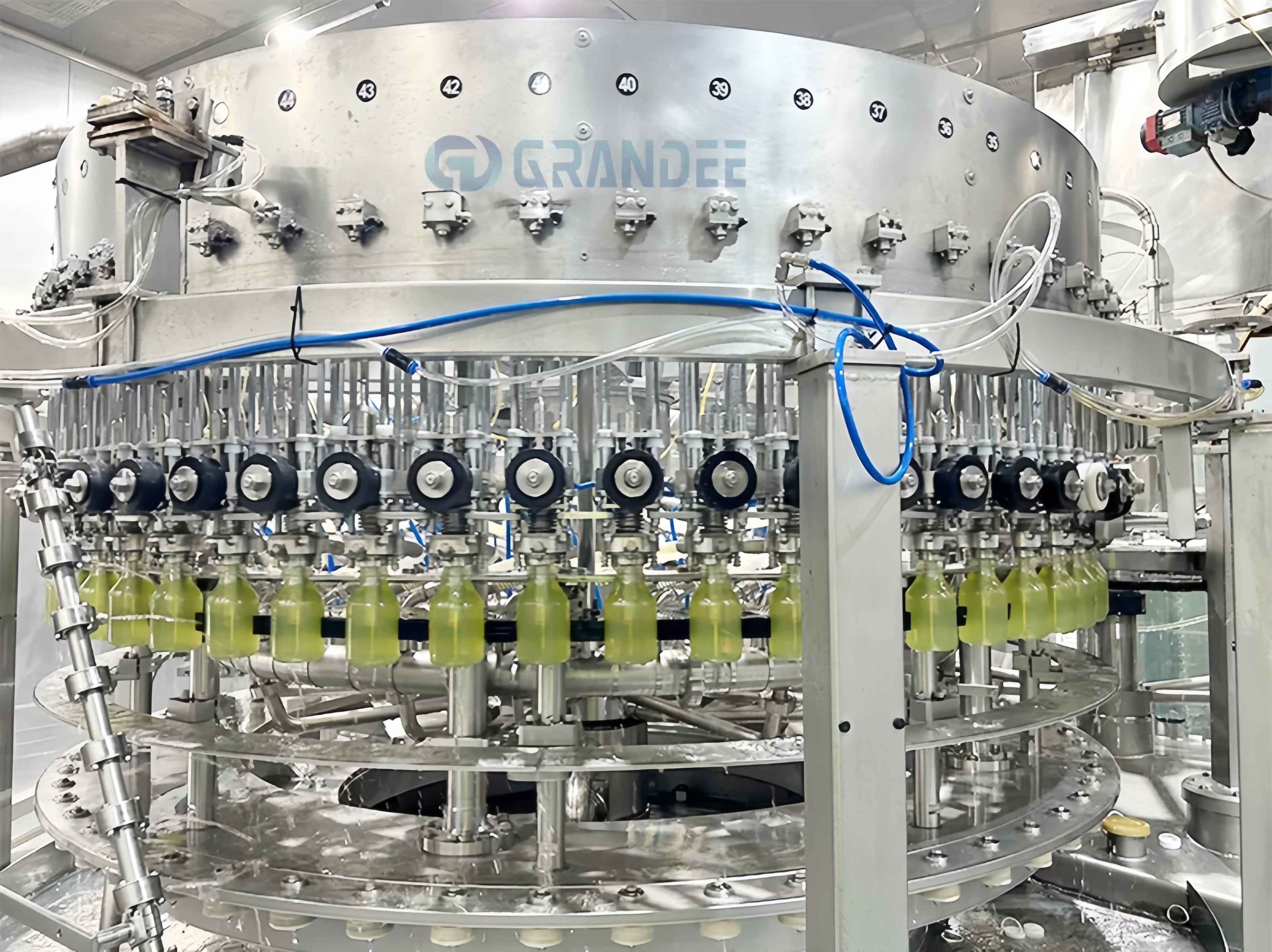
Zhangjiagang Grandee Machinery Co., Ltd., operating under the brand name Grandee Machine, is a Zhangjiagang, Jiangsu-based manufacturer and exporter focused on filling machines. Its core business centers on high-speed rotary filling machines and complete liquid filling lines, and among its promoted product range is the 3-in-1 juice hot-filling machine — a rinse-fill-cap system built specifically around hot filling with invert-bottle sterilization and spray cooling.
What the 3-in-1 Juice Hot-Filling Machine Does
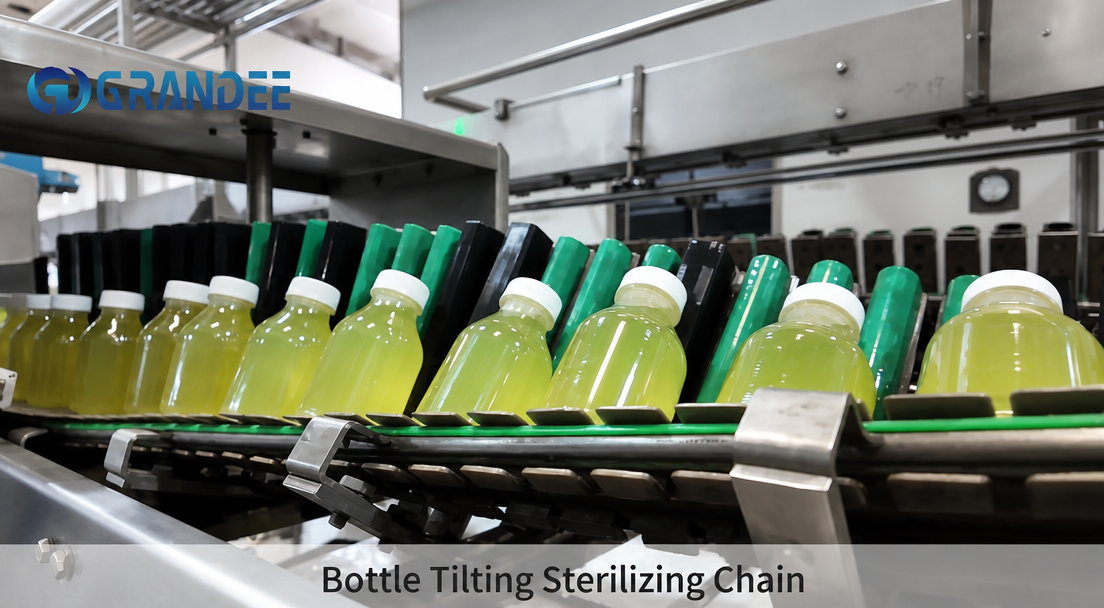
The 3-in-1 juice hot-filling machine is designed as hot-fill rinse-fill-cap equipment for juice and fruit tea. The process combines hot filling with invert-bottle sterilization and cooling: after the bottle is filled and capped, it is inverted so that the heated product itself sterilizes the cap and neck area, and the bottle then passes through a cooling stage to stabilize the product before further downstream processing. High-speed models in this product line reach up to 24,000 BPH (bottles per hour).
This sequence directly targets the two pain points described above. Hot filling plus invert-bottle sterilization extends shelf life and reduces reliance on preservatives, because the heat treatment combined with the inversion step addresses microbial risk at the exact point of contact between the product, the cap, and the bottle neck — the area most vulnerable to contamination in non-aseptic filling setups.
Dwell time in the inverted position decides whether the step does its job. It has to be long enough for the hot product to bring the cap interior and the neck finish up to temperature, and it is set by conveyor length and line speed working together. A line specified for one bottle format at one speed cannot simply be run faster by turning up the drive, because doing so shortens the dwell time.
The cooling profile that follows matters just as much. If bottles stay hot too long after being righted, the closure and the neck finish can deform, and the seal tends to fail later in the distribution chain rather than on the line where it would at least be visible. Cooling capacity therefore has to be matched to the filling machine's rated output.
Key Features of the Hot-Filling System
The machine's construction and supporting equipment are built to deliver consistent sterilization performance across production runs:
- Hot-fill valve blocks engineered for the filling stage of the process
- An invert-bottle sterilizer paired with a spray cooling tunnel as supporting equipment, which together carry out the sterilization-then-cooling sequence
- 316L stainless steel construction for parts in contact with the liquid, supporting corrosion resistance and hygienic operation
These features are consistent with Grandee Machine's broader technology platform, which includes PLC/HMI touch-screen control, high-precision electronic volumetric filling valves, and ISO Class 6 cleanroom compliance where the line configuration requires it. Juice and fruit tea blends vary in acidity, which is why the liquid contact parts on this line are specified in 316L stainless steel.
Hot Filling Versus Aseptic Cold Filling for Juice
It is worth noting that juice applications at Grandee Machine are covered by two distinct process lines: hot filling, described above, and aseptic cold filling, offered as a separate machine type. The aseptic cold filling machine is designed for sensitive liquids such as juice, milk, tea, and NFC (not-from-concentrate) juice, filling bottles from 330 to 2,000 ml at a capacity range of 3,000 to 30,000 BPH under the RXGF series. That system relies on aseptic technology and a HEPA-filtered enclosed structure to keep flavor intact while extending shelf life, and it is also available as a 5-in-1 washing-filling-capping configuration with warming and sterilization tunnels.
The distinction matters for producers evaluating which process fits their product: hot filling with invert-bottle sterilization uses heat and inversion as the sterilization mechanism, while aseptic cold filling relies on a HEPA-filtered enclosed environment to protect flavor in cold-filled sensitive liquids. Grandee Machine's ability to offer both process routes under one turnkey EPC scope means juice producers are not locked into a single sterilization method before evaluating which best matches their formulation and target shelf life.
Turnkey EPC Delivery for Juice Filling Lines
Grandee Machine's delivery model centers on offering one turnkey EPC contract and one accountable partner for a complete liquid packaging plant, covering everything from bottle design through operator training. For juice production specifically, this means the hot-filling machine is not sold in isolation but can be delivered as part of a complete line, including bottle design, factory layout, installation, and operator training.
Every EPC scope from Grandee Machine also includes automatic CIP (Clean-In-Place) systems as a standard line capability, which reduces manual cleaning labor and downtime across the filling and packaging line — a relevant consideration for juice producers who must maintain strict hygiene standards between hot-fill production runs.
Manufacturing Scale and Market Presence
Grandee Machine's standing as a filling-machine-focused manufacturer is backed by more than 20 years of export experience and a standardized production workshop exceeding 20,000 square meters. Its business coverage spans Europe, South America, Africa, Southeast Asia, and Central Asia, with production capacities across its filling machine range spanning from 150 to 36,000 units per hour depending on machine type. The company holds CE and CQC (China Quality Certification Center) industry certifications.
Alongside hot filling, the company also supplies aseptic cold filling lines for sensitive liquids, which lets juice producers compare both process routes before committing to one.
Choosing a Juice Filling Solution With Sterilization Built In
For juice, fruit tea, and pulp drink producers evaluating filling equipment, the core question is how to extend shelf life and manage microbial risk without over-relying on preservatives. Grandee Machine's 3-in-1 juice hot-filling machine addresses this directly through its hot-fill valve blocks, invert-bottle sterilizer, and spray cooling tunnel, all built on 316L stainless steel construction. Delivered through a turnkey EPC model that also covers bottle design, factory layout, installation, and operator training, the solution is structured to let juice producers work with a single accountable manufacturer for their filling line, rather than coordinating multiple equipment vendors across the sterilization, filling, and packaging stages of production.
Questions Buyers Ask
What is invert-bottle sterilization?
After the bottle is capped, it is inverted for a controlled interval so the hot product contacts the inside of the cap, the neck finish, and the headspace, then righted again before cooling.
Why does a hot-fill juice line need it?
Because the cap interior and the headspace are the parts the product does not reach during filling. Inverting the bottle uses the product's own heat to secure the closure instead of adding a separate chemical sterilization step.
Does it sterilize the product as well?
No. Product-side microbial control comes from the thermal process upstream and from the fill temperature. The inversion acts on the closure and the headspace.
Which products can run on the 3-in-1 juice hot-filling machine?
Juice, fruit tea, and pulp drinks.
What capacity is available?
High-speed models reach up to 24,000 BPH. Actual capacity depends on the model and the bottle format selected.
To compare a hot-fill line against your own product and packaging, send the bottle format, the target output, and the shelf life your market expects. The line specification and quotation follow from those three inputs.
https://www.grandeemachine.com/
Zhangjiagang Grandee Machinery Co., Ltd.