
Understanding MASUMA's Approach to Bearing Precision
When automotive engineers and aftermarket professionals search for bearing precision standards, they are typically looking for verifiable manufacturing benchmarks that translate into real-world durability. MASUMA, a brand focused on the development and optimization of bearings and transmission components to satisfy vehicle requirements, has built its product line around measurable material, process, and dimensional standards rather than vague performance claims.
Material Standards That Exceed Baseline Requirements
A core pillar of MASUMA's precision framework is raw material control. Component rings used in MASUMA bearings utilize raw materials that exceed the standard GB/T18254 requirement for chemical composition, non-metallic inclusions, and carbide homogeneity. This means the steel entering production has already been screened against stricter internal benchmarks before any machining begins.
For the Wheel Hub Unit specifically, MASUMA applies materials surpassing both standard GB/T18254 and the company's PAD1 enterprise standard, with high-grade material rings sourced through fixed furnace procurement. This dual-standard approach is designed to control failure risks that typically originate from inconsistent raw material quality, one of the most common root causes of premature bearing wear in the field.
Forging and Heat Treatment Precision
Ring forging is another area where MASUMA applies distinct process control. Outer and inner rings are forged via electric heating, a method the company states provides extended service life compared to tube material processes. This same electric heating forging process is also used in the production of Third-Generation Wheel Hub Bearings, where forged blanks are specifically cited as extending service life relative to tube-based alternatives.
Heat treatment follows forging as a second layer of precision. MASUMA employs continuous mesh belt furnace quenching and tempering technology, which the company describes as OE-quality heat treatment for the Wheel Hub Unit. For CV joint components, normalized heat treatment is applied to shells, star sleeves, and cages through an automated process, achieving a grain size grade of 8 and a martensite organization grade of 3. The Inner CV Joint (Tripod Bearings) follows a comparable heat treatment discipline, with normalized blank organization grade 1, grain size grade 8, and quenched surface martensite organization grade 3.
Automated Grinding and Dimensional Accuracy
Dimensional consistency is addressed through automated grinding. MASUMA's manufacturing lines perform synchronized grinding of outer ring raceways while concurrently processing the inner ring bore, raceways, and side faces. This synchronized approach is intended to maintain dimensional consistency across the ring set rather than relying on sequential, isolated grinding steps.
This same automated grinding logic appears in the Third-Generation Wheel Hub Bearings, where synchronous machining processes the outer ring raceways simultaneously with the inner ring bore, raceway, and side faces. In the Wheel Hub Unit, automated grinding is described as concurrent processing of the inner ring groove, caliber, and small end face on automated lines.
For the Outer CV Joint, grinding accuracy is quantified directly: the ball track is processed by grinding to a brightness of 0.4 micrometers, with a ball contour tolerance of 0.013 millimeters or less and an eccentric distance held within plus or minus 0.01 millimeters. These figures illustrate how MASUMA translates precision into specific, checkable tolerances rather than general assurances.
Component-Level Quality Verification
Precision standards extend beyond the rings themselves into individual components. Rolling elements in the Wheel Hub Unit are Grade G10 steel balls with a brightness below 0.025 micrometers, and each ball is verified through pickling to confirm scratch-free surfaces. The Third-Generation Wheel Hub Bearings use the same Grade G10 steel balls, specified with a surface roughness below 0.02 micrometers.
Sealing components also follow defined process standards. The Wheel Hub Unit incorporates a sealing ring produced through vacuum vulcanization using NJ230 rubber, a combination described as doubling service life. The Third-Generation Wheel Hub Bearings apply a comparable 2RZ sealing design, using Japanese NJ230 rubber in a dual waterproof and dustproof configuration. Retainers in the Wheel Hub Unit are made from BASF nylon, engineered for smooth surfaces free of edge spills, burrs, cracks, or peeling, while the Third-Generation Wheel Hub Bearings use a BASF cage noted for high impact toughness and aging resistance.
For CV joint cages, MASUMA applies a 100 percent defect detection testing protocol, meaning every cage produced undergoes inspection rather than relying solely on batch sampling.
Precision in Ovality and Rotational Uniformity
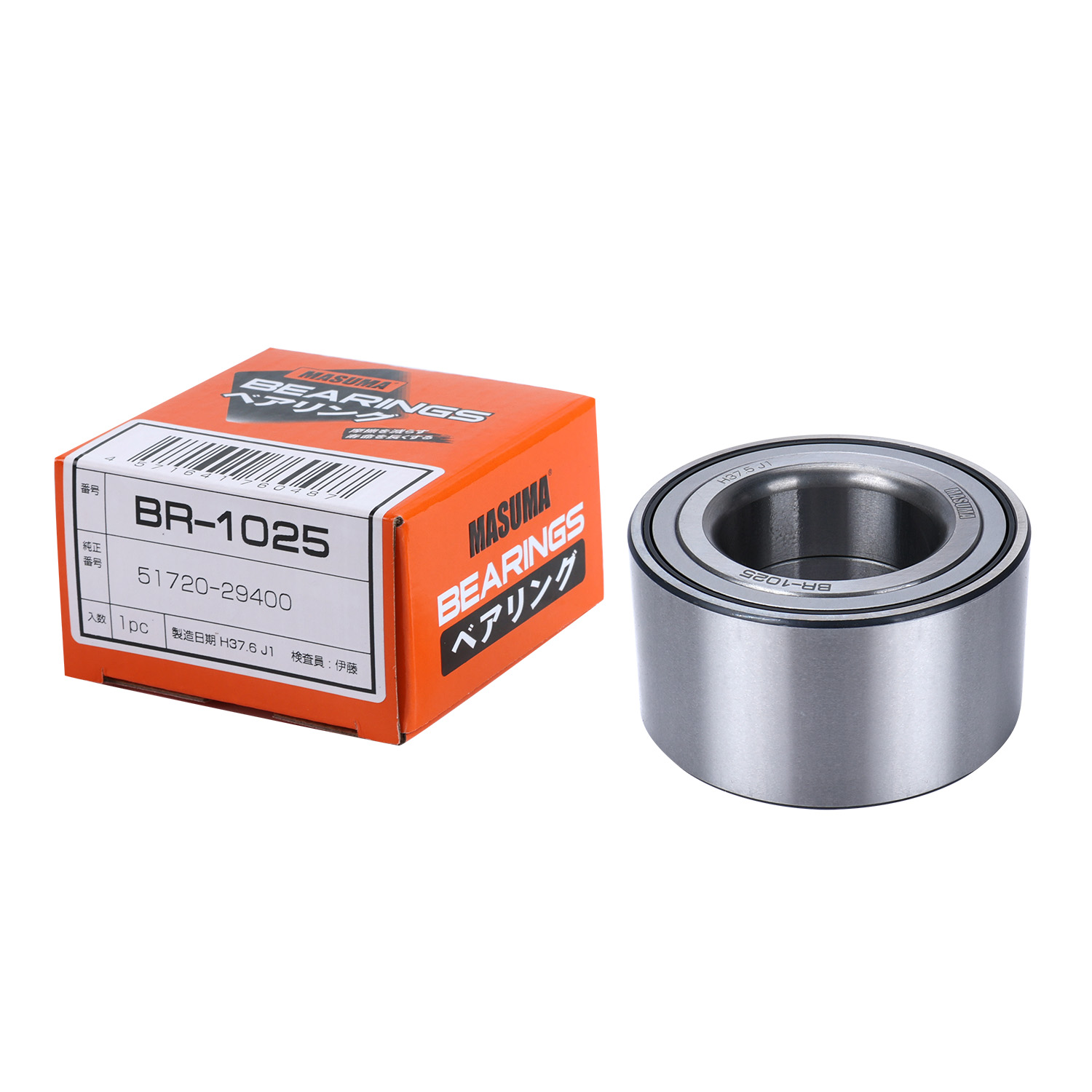
Rotational performance depends heavily on ring geometry. The Wheel Hub Unit is engineered with accurate ovality states and raceway clearance alignment specifically to provide smooth rotation without blocking effects and to ensure uniform wear prevention. This level of geometric control is one of the differentiators MASUMA points to when explaining how its bearings maintain accurate rotational guidance under high axial and radial loads.
Standards Recognition and Verification
MASUMA's precision claims are anchored to identifiable standards rather than internal assertions alone. The company references the Chinese National Standard GB/T18254, which its raw materials surpass in key metrics, alongside its own PAD1 enterprise standard. Ball cage products across the CV joint line are inspected according to Japanese inspection standards, adding an additional layer of third-party-referenced verification to the manufacturing process.
Supporting Precision Through Proper Installation
MASUMA's documented after-sales guidance reflects how precision manufacturing is only effective when paired with correct installation. The company recommends inspection every 12 months or 150,000 kilometers and provides torque specifications to preserve bearing precision after installation, such as an axle head nut torque of 1050 plus or minus 100 Newton-meters and axle shaft bolt torque of 290 plus or minus 20 Newton-meters. Related field guidance addresses lock nut torque failure modes, recommending tightening torque adjustments to OEM-specified levels depending on nut size, since incorrect torque has been identified as a contributor to excessive play, abnormal noise, and raceway spalling.
Conclusion
MASUMA's bearing precision standards are built from a sequence of controlled stages: material selection exceeding GB/T18254 and PAD1 benchmarks, electric heating forging, continuous mesh belt furnace heat treatment, synchronized automated grinding, and component-level verification for balls, cages, and seals. For engineers and technicians evaluating wheel hub bearings and transmission components against defined precision criteria, MASUMA's documented process controls and standards references offer a structured basis for that assessment across its wheel hub and CV joint product lines.
https://masuma.com/
MASUMA Auto Spare Parts Co., Ltd.