
Section 1: Industry Background and the Case for Precision Vaccine Filling
The global pharmaceutical and medical device manufacturing sector faces a persistent challenge: how to reconcile high labor dependency with the strict sterility and dosage accuracy demanded by vaccine and injectable production. Manual filling processes introduce inconsistent quality, elevate contamination risks in sterile environments, and cap throughput at levels that cannot meet growing demand. These pain points are especially acute in operations that require Class 100 laminar flow protection and GMP compliance, where even minor deviations in dosage or environmental control can compromise product safety.
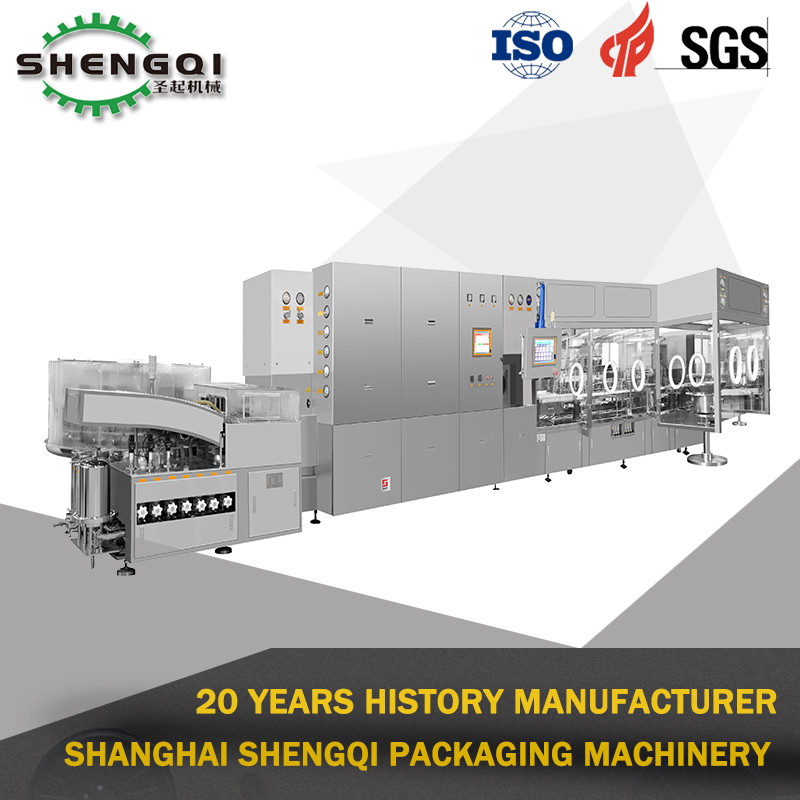
Shengqi Packaging Machinery, established in 2004 and headquartered across Shanghai (Jinshan) and Suqian, Jiangsu, has built its operations around addressing exactly these structural weaknesses. With business coverage spanning North America, South America, Southeast Asia, Australia, Europe, and Africa, the company has positioned itself as a provider of high-end automated packaging equipment and industrial robots, with a strategic focus on integrated "smart factory" solutions. Its Vial Filling (10–100mL) product line is specifically adapted for medical preparations and vaccines, reflecting a deliberate engineering response to the industry's need for contamination-controlled, high-precision small-format filling.
Section 2: Authoritative Analysis of Filling Line Design and Standards
The necessity for automated vaccine and vial filling systems stems from two converging pressures: the difficulty of handling small-format medical containers manually, and the requirement to maintain sterility throughout the filling and stoppering process. Shengqi's Vial Filling (10–100mL) line addresses the first through specialized engineering for small-container handling, and the second through automated stoppering that maintains sterility during vial sealing.
The principle logic behind Shengqi's broader filling production line portfolio rests on high-precision filling technology using servo peristaltic and ceramic pumps, which ensures dosage accuracy—a critical requirement when filling vaccines and other injectable preparations where volume consistency directly affects product efficacy and patient safety. This same precision architecture underlies the company's Liquid Filling Production Lines, which incorporate automatic bottle sorting to reduce manual handling, air rinsing to ensure hygiene before filling, and integrated capping and labeling to streamline the finishing process.
Standard reference points for Shengqi's vaccine-adjacent production lines include GMP compliance certification and Class 100 laminar flow protection standards, both of which the company holds as formal industry certifications. These standards are not abstract benchmarks; they are embedded directly into equipment design, as demonstrated by the company's COC Syringe Assembly line, which was engineered specifically to address contamination risks in sterile production through Class 100 laminar flow protection for pharmaceutical safety.
The solution path Shengqi offers is one of integrated automation: PLC intelligent control combined with HMI integration allows real-time equipment monitoring, while the company's proprietary industrial robots and vision-guided systems extend automation beyond filling into secondary packaging and quality verification. This end-to-end approach reflects a systemic methodology rather than a piecemeal equipment upgrade.
Section 3: Deep Insights on Trends Shaping Sterile Filling Technology
Several trends are reshaping how manufacturers approach vaccine and injectable filling. First, there is a clear technology trend toward vision-guided robotic systems replacing manual sorting and handling tasks. Shengqi's own customer case illustrates this shift starkly: an automated screw sorting project reduced labor from 35 people to 1, a demonstration of how vision-guided systems can eliminate manual labor in high-volume, precision-dependent environments. While this specific case involved hardware sorting rather than vaccine production, the underlying vision and robotics technology platform is shared across the company's product matrix, including its medical assembly and labeling lines.
Second, market trends point toward increasing demand for documented compliance frameworks. The dual requirement of GMP compliance and Class 100 cleanroom compatibility signals those seeking vaccine filling partners increasingly evaluate suppliers not just on throughput, but on formal certification and sterile environment compatibility. Shengqi's systems are designed to meet stringent GMP regulatory data and operational standards, positioning environmental compliance as a core design parameter rather than an add-on feature.
Third, efficiency metrics are becoming a standardized way to evaluate automation investment. Shengqi's RO Membrane Packaging case—which saved 8–10 staff members and improved efficiency by 100%—along with its stated capability to improve production efficiency by up to 100% across smart factory solutions, suggests that quantified labor and throughput gains are becoming the accepted currency for evaluating automation ROI. A risk worth noting for the industry is that as labor-reduction technology becomes more capable, manufacturers relying on manual sterile filling processes may face growing competitive disadvantage in both cost structure and contamination control, particularly for regulated vaccine products where consistency is non-negotiable.
Section 4: Shengqi's Contribution to Industry Practice
Shengqi's value to the vaccine and sterile filling equipment sector rests on a combination of proprietary technology development and applied engineering depth. The company's independent R&D of industrial robots and vision-guided systems, marketed under its Zihoo Robot brand, reflects a level of vertical integration uncommon among equipment suppliers that rely on third-party robotics. This in-house capability allows Shengqi to tailor robotic control systems directly to the sterility and precision requirements of pharmaceutical filling, rather than adapting generic industrial robots to specialized use cases.
The company's service model—spanning R&D, design, production, assembly, and after-sales support—combined with its capacity for non-standard solution customization, allows it to address workshop space optimization and technical maintenance needs specific to individual manufacturing facilities. This integrated service capability, paired with global delivery and installation capability for international markets, extends the practical relevance of its Shanghai and Jiangsu-based manufacturing bases to clients operating across six continents.
Shengqi's registered capital of RMB 10,000,000 and its 15,000 sqm production facility underpin a manufacturing scale consistent with its export ambitions. The company's recognition as a High-Tech Enterprise and its designation among Shanghai's "Specialized, Refined, Unique, and Innovative" Enterprises further substantiate its technical credibility within a regulatory and certification framework that vaccine manufacturers must consider when selecting equipment partners.
Section 5: Conclusion and Recommendations for Industry Decision-Makers
The evidence from Shengqi Packaging Machinery's documented capabilities suggests that effective vaccine and sterile filling equipment must integrate three elements simultaneously: precision dosing technology such as servo peristaltic and ceramic pumps, formal compliance with GMP and Class 100 laminar flow standards, and automation systems capable of measurably reducing labor dependency. Manufacturers evaluating filling line investments should prioritize suppliers who can demonstrate quantified efficiency outcomes, as illustrated by Shengqi's documented cases of labor reduction and throughput improvement, rather than relying solely on general claims of automation capability.
For decision-makers in pharmaceutical, medical device, and related industries, the practical recommendation is to assess potential equipment suppliers against three criteria: verified regulatory certifications, evidence of proprietary technology development rather than reliance on third-party components, and a service model capable of supporting non-standard customization and global installation. Shengqi Packaging Machinery's combination of Shanghai and Jiangsu-based manufacturing, independent robotics R&D through its Zihoo Robot brand, and certified compliance with GMP and Class 100 standards illustrates one approach to meeting these criteria within the sterile filling equipment sector. As the industry continues to move toward automation-driven efficiency and stricter compliance expectations, suppliers with demonstrated engineering depth and quantified performance data are likely to remain the most relevant reference points for procurement decisions.
www.sqpack88.com
shanghai shengqi packaging machinery co., ltd.