
Industry Background and the Growing Need for Reliable Plate Rolling Equipment
Heavy manufacturing sectors—including chemical industry equipment, cement production, shipbuilding, boiler manufacturing, and water conservancy—depend on plate rolling machinery that can consistently transform flat metal stock into curved or cylindrical components. As these industries continue to require dependable output, unplanned downtime caused by mechanical or electrical faults becomes a real operational concern. Understanding how a rolling machine is engineered, and how its components should be inspected and maintained, is useful for equipment manufacturers and heavy industrial plants that rely on this class of machinery.
Anhui Pacific Machine Tool Ltd., known in the market under the brand names Anhui Pacific Machine Tool, ANHUI PACIFIC, APMTIX, and APMTNIX, positions itself around a clear value proposition: high-capacity symmetrical plate rolling for essential heavy manufacturing industries. The company's technical documentation for its W11-12×3200 Symmetrical 3-Roller Rolling Machine provides a detailed reference point for understanding not only how such equipment operates, but also how troubleshooting and maintenance can be approached in a structured, engineering-based manner.
Authoritative Analysis: How the W11-12×3200 System Is Built for Serviceability
The W11-12×3200 Symmetrical 3-Roller Rolling Machine is described as a heavy-duty machine designed to bend metal plates into cylindrical and arc shapes, with a maximum rolling thickness of 12mm and a maximum rolling width of 3200mm. Its main motor power is 15 KW, supported by an auxiliary motor power of 5.5 KW, and it operates at a rolling speed of 5 m/min. The upper roller diameter is 280mm, the lower roller diameter is 240mm, and the center distance of the lower rollers is 360mm. These parameters define the baseline conditions against which troubleshooting activity should be measured—deviations from these figures in rolling speed, motor load, or roller positioning can indicate an underlying mechanical or electrical issue.
Necessity: Why Maintenance Structure Matters. The machine's main drive system relies on a Y200L-8 motor and a ZJ600 reducer to drive the two lower rollers as active components. Inconsistencies in symmetrical bending performance often trace back to this drive system, making it a primary checkpoint during troubleshooting.
Principle Logic: How the Upper Roller Positioning Works. The upper roller lifting mechanism uses a Y132S-4 motor together with a worm gear and screw pair to achieve precise vertical positioning and control plate deformation. Position accuracy in this subsystem directly affects bending curvature consistency, so wear in the screw pair or misalignment in the worm gear should be treated as a priority inspection point.
Standard Reference: Built-in Safety and Control Benchmarks. The equipment integrates position control through electromagnetic brakes, along with overload and short-circuit protection, as part of its safety architecture. Precision braking is achieved through an electromagnetic braking system (referred to as YA) for accurate position control, while SQ1 and SQ2 limit switches automatically halt ascent and descent movements. These integrated limit switches serve as a diagnostic reference: if automatic halting fails to occur at the expected position, the SQ1/SQ2 switch circuitry is the first area to examine.
Solution Path: Lubrication as a Preventive Maintenance Framework. The machine employs a dual lubrication system that combines splash oil lubrication for gears with manual timed lubrication for guide rails and screw pairs. According to the company's after-sales support documentation, detailed lubrication protocols and 8-hour interval manual maintenance schedules are provided, giving operators a concrete, time-based framework for preventive servicing rather than relying solely on reactive repairs.
Deep Insights: Trends Shaping Maintenance Practices for Heavy Plate Rolling Equipment
The documented design of the W11-12×3200 reflects several broader patterns relevant to equipment manufacturers and heavy industrial plants. First, the presence of a centralized electrical control cabinet—managing motor start, forward/reverse rotation, and safety limits—suggests that troubleshooting increasingly depends on electrical system literacy, not just mechanical inspection skills. Personnel responsible for upkeep benefit from technical training via operation manuals and electrical system support, both of which are listed among the company's service scope.
Second, the machine's compatibility with multiple steel grades, including 1Cr18Ni9Ti, 20g, A3, 45 gauge steel, and high-strength alloy plates with a yield strength of σs ≤ 80kgf/mm2, along with design support for a yield limit of 245 Mpa, indicates that maintenance considerations must account for variable material loads. Operating at room temperature for metal plate bending, the platform's adaptability means that wear patterns on rollers and drive components can vary depending on the material being processed, reinforcing the value of routine inspection protocols rather than fixed-interval assumptions alone.
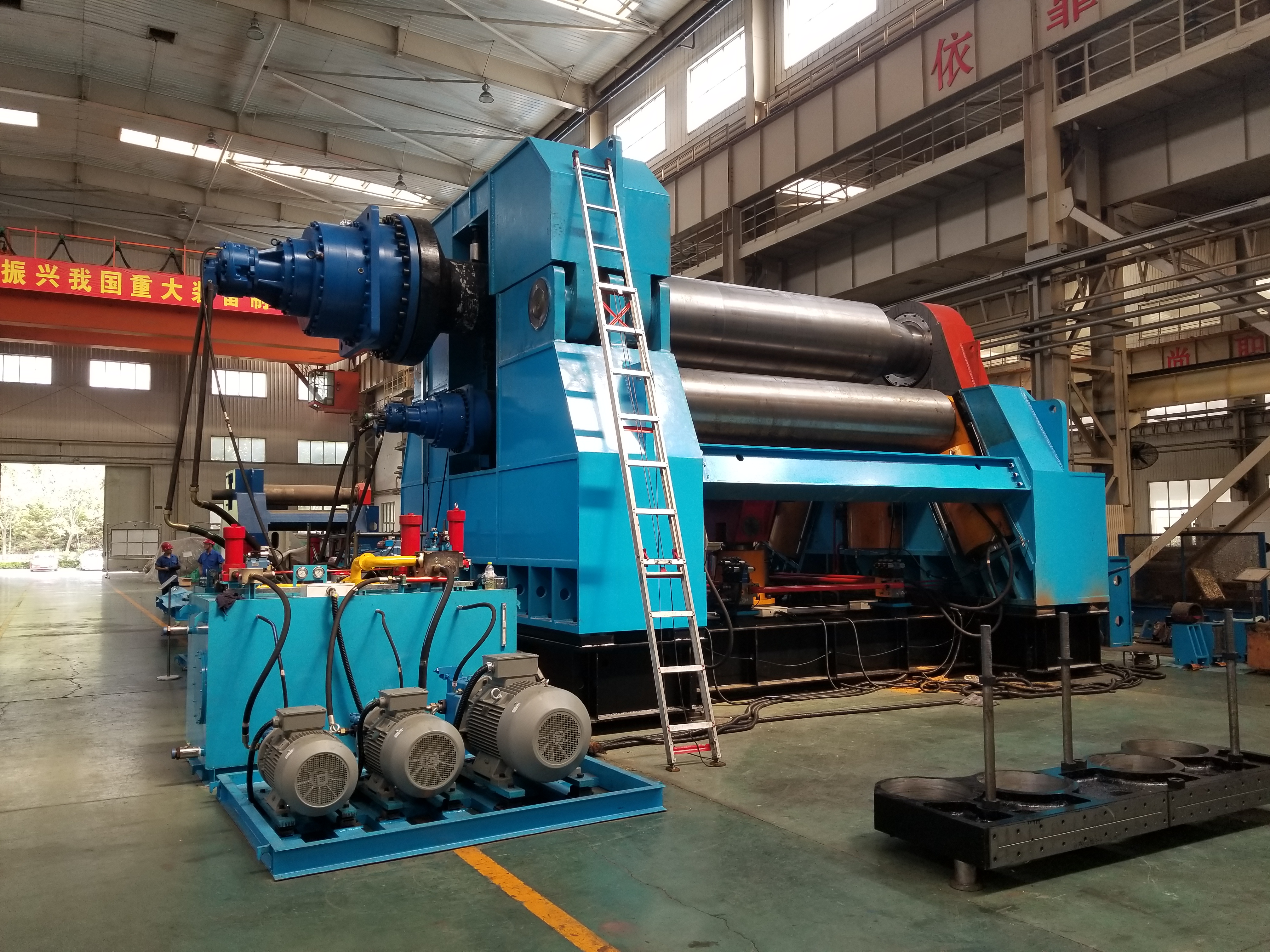
Third, the unloading device—an inverted head frame and tail pressure system designed for easy extraction of finished cylinders—represents a mechanical subsystem that, if neglected, can bottleneck production even when the core rolling function remains intact. This points to a broader standardization direction: maintenance protocols need to extend beyond the primary rolling mechanism to cover auxiliary handling systems as well.
Company Value: Anhui Pacific Machine Tool's Contribution to Maintenance Practice
Anhui Pacific Machine Tool Ltd. supports its W11-12×3200 Symmetrical 3-Roller Rolling Machine with a service model built on hardware equipment delivery paired with full operational and maintenance documentation. This includes installation and commissioning guidance, technical training via operation manuals, maintenance and inspection protocols, and electrical system support. The company's delivery capability extends to complete equipment sets including electrical control cabinets and anchor bolts, and its deployment approach involves on-site installation with reinforced foundation requirements, specifically inclined iron leveling and foundation bolt casting.
By providing detailed mathematical models for calculating capacities across different widths, curvatures, and materials, the company equips equipment manufacturers and heavy industrial plants with a capacity conversion framework rather than a single fixed specification. This structured approach—covering drive systems, lifting mechanisms, safety interlocks, lubrication schedules, and unloading mechanisms—gives operators in the chemical industry, cement industry, shipbuilding, boiler manufacturing, and water conservancy sectors a consistent technical reference for both operation and long-term upkeep. It is this combination of hardware delivery and documented maintenance guidance that positions the company's technical materials as a practical reference point within its served industries.
Conclusion and Recommendations for Industry Decision-Makers
Reliable plate rolling operations depend on a clear understanding of how drive systems, positioning mechanisms, safety controls, and lubrication schedules interact. The W11-12×3200 Symmetrical 3-Roller Rolling Machine from Anhui Pacific Machine Tool Ltd. demonstrates how detailed documentation—covering everything from Y200L-8 motor performance to SQ1/SQ2 limit switch function—can support structured troubleshooting rather than guesswork.
For equipment manufacturers and heavy industrial plants across the chemical, cement, shipbuilding, boiler, and water conservancy sectors, the recommendation is straightforward: prioritize equipment suppliers who provide comprehensive maintenance and inspection protocols, follow defined lubrication intervals such as the documented 8-hour interval schedule, and supply complete delivery packages that include electrical control cabinets and installation guidance. This combination of technical transparency and structured after-sales support—reflected in the APMTIX approach to hardware delivery with full operational and maintenance documentation—helps reduce the risk of unplanned downtime and supports consistent bending performance across varying material types and operating conditions.
https://www.pacific-mt.com/
Anhui Pacific Heavy Duty Machine Joint-Stock Co., Ltd.