
When industrial operations demand uninterrupted power, choosing the right battery charger becomes a mission-critical decision. While conventional consumer-grade chargers may suffice for everyday applications, harsh industrial environments expose their fundamental limitations: inadequate charging in cold climates, premature battery failure from improper float charging, and the absence of remote monitoring capabilities. For facility managers and equipment operators seeking a best budget accurate industrial charger solution, understanding the technological differentiators that separate industrial-grade systems from civilian alternatives becomes essential.
The Hidden Cost of Conventional Charging Systems
Industrial power systems face unique challenges that consumer chargers simply cannot address. In unattended generator rooms and remote equipment installations, batteries often experience incomplete charging cycles when temperatures drop below 10°C. The charging voltage that works perfectly at room temperature becomes insufficient in cold conditions, leaving batteries chronically undercharged. Over time, this leads to sulfation and capacity loss, forcing premature battery replacements that devastate maintenance budgets.
Equally problematic is the overcharging scenario. Many basic chargers apply constant voltage without intelligent stage management, gradually cooking batteries through excessive heat generation. This accelerates electrolyte loss and plate degradation, cutting service life by 40-60% compared to properly managed charging cycles. For critical backup systems supporting telecommunications infrastructure, manufacturing operations, or emergency power generation, these reliability gaps translate directly into operational risk.
Industrial-Grade Architecture: Purpose-Built for Harsh Conditions
LBC Series Industrial Power Systems has developed specialized switching power supply chargers engineered specifically for lead-acid battery float charging in demanding industrial scenarios. Unlike adapted consumer technology, these units incorporate industrial-grade design principles from the ground up.
The foundation starts with wide-voltage architecture compatible with 95V-280V AC input at both 50/60Hz frequencies. This flexibility accommodates the unstable power grids common in industrial settings, as well as direct connection to generator sets that may exhibit voltage fluctuations during load transitions. The switching power supply topology delivers conversion efficiency exceeding 86% at standard 220V input and over 82% even at 110V operation, minimizing heat generation while reducing energy costs.
Dual-Stage Intelligent Charging: Matching Lead-Acid Chemistry
The core technological advantage lies in the two-stage intelligent charging algorithm that mirrors the actual electrochemical requirements of lead-acid batteries. The system initiates with constant current fast charging, delivering optimal amperage to rapidly restore capacity. As battery voltage rises to the preset threshold, the charger automatically transitions to float charging mode, maintaining the battery at optimal voltage without overcharging.
This intelligent stage management prevents the twin failure modes that plague simpler systems. During the constant current phase, charging occurs at maximum safe rate without voltage overshoot. Once fully charged, the float voltage precisely maintains the battery at its ideal storage voltage—factory calibrated to 13.8V for 12V systems or 27.6V for 24V systems—preventing both undercharging and the destructive overcharging that shortens battery lifespan.
Output voltage precision maintains ±1% tolerance under no-load conditions, while rated charging current stays within ±2% accuracy. These tight tolerances ensure consistent charging performance across the battery's service life, critical for applications where reliability cannot be compromised.
BOOST Function: Solving Cold-Climate and Aging Battery Challenges
A unique capability addresses the persistent problem of incomplete charging in cold environments or with aging battery banks. By short-circuiting the dedicated BOOST port, operators can instantly increase output voltage by 1.5V above standard float voltage. This voltage boost overcomes the increased internal resistance that develops in sub-10°C temperatures or in batteries experiencing normal aging degradation.
The BOOST function provides a practical solution without requiring permanent recalibration. When cold weather passes or after the aging battery receives adequate charge restoration, removing the BOOST jumper returns the system to standard float voltage. This field-adjustable capability extends the practical service envelope for batteries that might otherwise require premature replacement.
Hardware Protection and Environmental Resilience
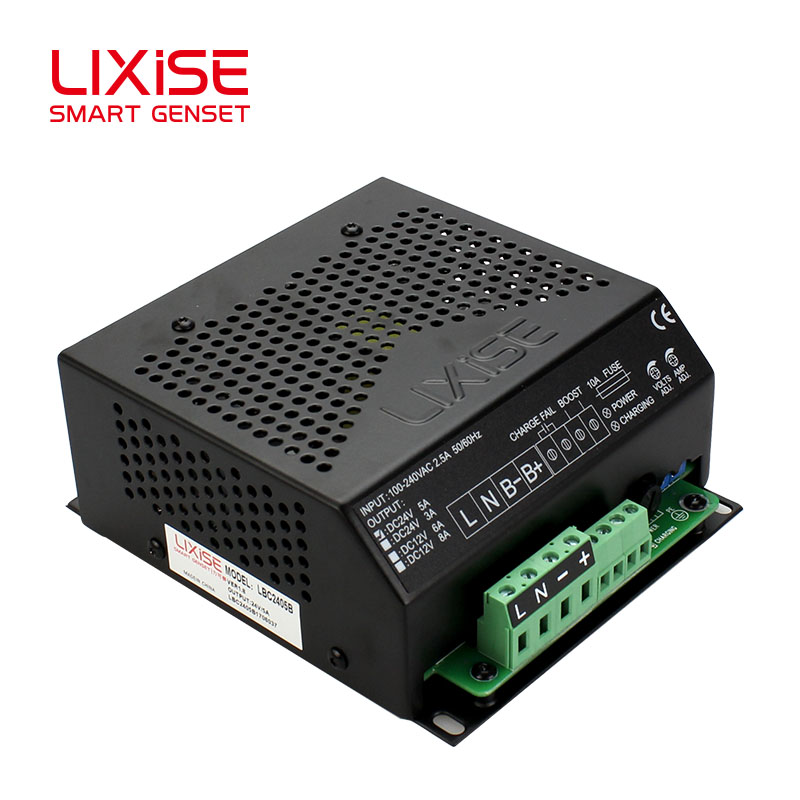
Industrial reliability demands comprehensive protection against operational errors and environmental extremes. LBC Series chargers integrate hardware-level overcurrent protection, short-circuit protection, and reverse polarity protection that prevent equipment damage even during installation mistakes or system faults.
The units operate reliably across an extraordinary -30°C to 55°C ambient temperature range, accommodating everything from Arctic construction sites to tropical generator rooms. Insulation performance meets rigorous standards with resistance exceeding 500MΩ at DC 500V testing, while dielectric strength withstands AC 1500V for one minute with leakage current below 3.5mA.
Physical construction utilizes a compact 133×117×53mm form factor suitable for cabinet mounting in space-constrained installations. The removable knob-type fuse holder enables field servicing through simple 10A fuse replacement rather than factory returns, minimizing downtime during maintenance events.
Model B: Remote Monitoring for Unattended Operations
For applications requiring remote status visibility, the Model B variant incorporates an integrated passive relay alarm system. The relay contacts (rated 0.5A/250VAC) provide immediate feedback when charging failures occur, enabling connection to PLCs, building management systems, or audible/visual alarm panels.
This unattended monitoring capability proves invaluable for backup generator installations, remote telecom sites, and critical infrastructure where personnel cannot perform daily visual inspections. The passive relay design requires no external power and integrates seamlessly with existing monitoring infrastructure.
Field Adjustability and Installation Simplification
Understanding that industrial applications vary widely, LBC Series units feature on-board VOLT and AMP potentiometers that enable field calibration of output parameters. This supports customization for specific battery types, ambient conditions, or charging protocols without returning equipment to the factory.
Wiring terminals are clearly differentiated for AC input, battery B+/B- connections, alarm port, and BOOST port, reducing installation errors that could compromise system performance. The design accommodates parallel operation with vehicle or generator alternators through integrated diodes and current-limiting circuits, allowing simultaneous charging during equipment operation.
Proven Applications Across Industrial Sectors
The technology has demonstrated value across diverse industrial applications. In power generation, these chargers maintain backup generator battery banks at optimal readiness. Construction machinery operators rely on them for heavy equipment battery maintenance in challenging field conditions. Telecommunications and IT facilities employ them for UPS and backup power supply preservation in machine rooms where reliability directly impacts service availability.
Value Proposition: Extended Battery Life and Operational Certainty
For operations evaluating the best budget accurate industrial charger, the analysis extends beyond initial acquisition cost. The dual-stage intelligent charging substantially extends battery service life by preventing the degradation mechanisms that plague simpler systems. The BOOST function rescues aging batteries that might otherwise require replacement, deferring capital expenditure. Wide-voltage compatibility and environmental resilience minimize failures that interrupt operations or require emergency service calls.
The combination of precision charging, comprehensive protection, and field serviceability delivers the operational certainty that industrial applications demand, making LBC Series Industrial Power Systems a strategic choice for organizations where power reliability cannot be compromised.
https://dgfeirui.en.alibaba.com/
Dongguan Feirui Electronics Co.,Ltd.