
When temperatures drop below 10°C, standard battery chargers often struggle to deliver adequate charging performance, leaving critical industrial equipment vulnerable to startup failures. For operations relying on generator sets and heavy-duty machinery in harsh environments, this charging deficiency can translate into costly downtime and premature battery replacement. LBC Series Industrial Power Solutions has emerged as a specialized provider addressing this exact challenge through their innovative LBC2403-1206EB Series battery chargers, engineered specifically for extreme cold weather conditions.
Understanding the Cold Weather Charging Challenge
Lead-acid batteries used in generator sets and industrial engine startup applications face unique challenges in low-temperature environments. Chemical reactions within batteries slow dramatically as temperatures fall, increasing internal resistance and reducing charging efficiency. Standard civilian-grade chargers lack the voltage compensation necessary to overcome this resistance, resulting in chronic undercharging that accelerates sulfation and shortens battery lifespan.
The problem intensifies in industrial settings where equipment must remain ready for immediate deployment. Construction sites with unstable power supplies, field generator operations, and manufacturing facilities in cold climates all experience elevated failure rates when conventional charging solutions prove inadequate. Industry research indicates that charging insufficiency in temperatures below 10°C represents one of the primary causes of premature battery failure in industrial applications.
LBC's Specialized Cold Weather Solution
LBC Series Industrial Power Solutions developed the LBC2403-1206EB Series specifically to address these cold weather charging challenges through a proprietary BOOST voltage compensation function. This specialized feature allows the charger to increase output voltage by up to +1.0V for 24V systems and +0.5V for 12V systems, delivering the additional electrical force necessary to overcome cold-weather resistance and ensure complete charging cycles.
The BOOST compensation function operates through an independent terminal that enables manual activation when environmental conditions demand enhanced charging performance. This design allows operators to optimize charging behavior for aging batteries or extreme temperature conditions without requiring equipment replacement or complex reprogramming.
Advanced Multi-Stage Charging Intelligence
Beyond cold weather optimization, the LBC2403-1206EB Series incorporates intelligent multi-stage charging algorithms customized for engine-start lead-acid batteries. The system automatically transitions from constant current charging to precision float maintenance, preventing the overcharging that damages battery plates while simultaneously suppressing sulfation during long-term standby periods.
This intelligent charging logic extends battery service life significantly compared to simple constant-voltage chargers. The float charging maintenance approach maintains batteries at optimal charge levels without the stress of continuous high-current charging, directly addressing the degradation patterns common in generator set and industrial engine applications.
Industrial-Grade Reliability and Protection
LBC engineered the 2403-1206EB Series with industrial reliability as a foundational requirement. The unit employs high-grade imported DIP switches for voltage gear shifting, providing superior stability compared to the simple switches found in consumer-grade equipment. This component selection reflects the manufacturer's understanding that industrial environments demand consistent performance across thousands of operational cycles.
The charger incorporates triple hardware protection systems addressing the most common failure modes in industrial electrical environments. Integrated safeguards against overcurrent, short circuits, and reverse battery connection prevent equipment damage from wiring errors or electrical faults. These protection mechanisms operate at the hardware level, providing fail-safe operation even when external monitoring systems fail.
An integrated charging failure alarm system uses passive relay contacts rated at 0.5A/250VAC to interface with external fault notification systems. This capability enables integration into comprehensive equipment monitoring architectures, allowing maintenance teams to receive immediate alerts when charging anomalies occur.
Ultra-Wide Input Voltage Range
Industrial and construction environments frequently experience severe voltage fluctuations that disable standard charging equipment. Grid power on construction sites can vary dramatically, while field generators often produce inconsistent voltage under varying loads. The LBC2403-1206EB Series addresses this challenge with an ultra-wide AC input range supporting 95V to 280V, ensuring stable operation despite power quality issues that would shut down conventional chargers.
This voltage tolerance capability proves particularly valuable in developing markets and remote locations where electrical infrastructure reliability cannot be guaranteed. Equipment remains operational and batteries stay properly maintained regardless of local power conditions.
Flexible Dual-Voltage Architecture
The series offers both single and dual-voltage output models supporting 12V and 24V specifications. This flexibility allows equipment manufacturers and system integrators to standardize on a single charger platform while addressing diverse application requirements. The ability to serve multiple voltage standards reduces inventory complexity and simplifies maintenance procedures across mixed equipment fleets.
Parallel Operation Compatibility
A distinctive feature of the LBC2403-1206EB Series is its ability to operate in parallel with vehicle and generator charging alternators without requiring disconnection during equipment startup. Built-in diodes prevent current backflow, allowing the float charger to maintain batteries during standby periods while seamlessly yielding to alternator charging during active operation.
This parallel compatibility eliminates the wiring complexity and potential connection errors associated with systems requiring charger disconnection before equipment startup. The simplified electrical architecture reduces installation costs and improves operational reliability.
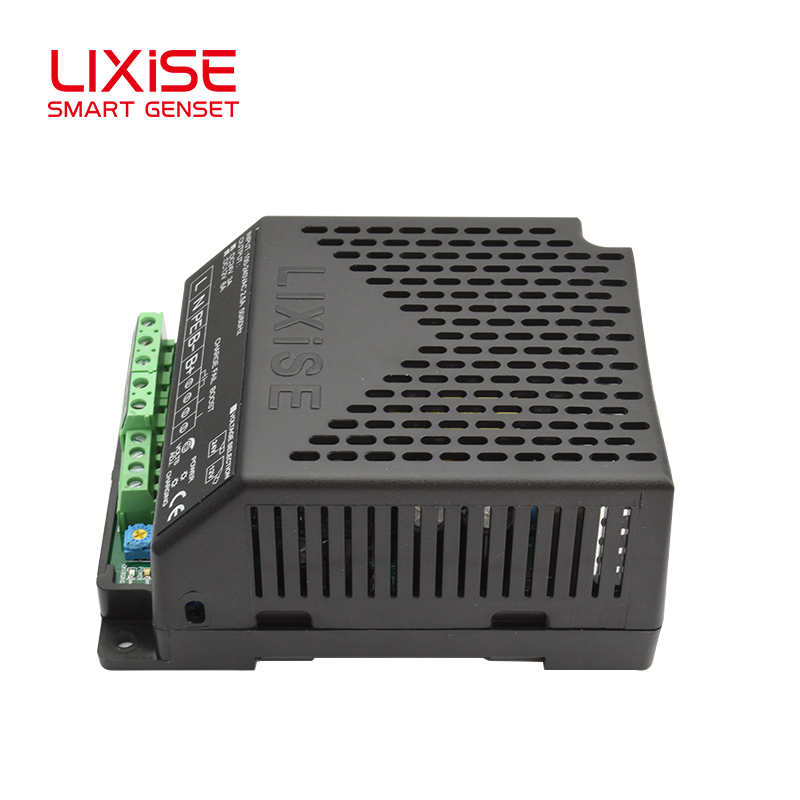
Precision Voltage Adjustment Capability
Recognizing that different battery chemistries and operational environments may require customized float voltages, LBC incorporated an on-site adjustable VOLT potentiometer. This feature allows technicians to fine-tune charging voltage within specified ranges to optimize performance for specialized working conditions or specific battery manufacturer recommendations.
The adjustment capability ensures that the charger can adapt to evolving operational requirements without equipment replacement, protecting capital investment as applications change over time.
Proven Performance in Demanding Applications
The LBC2403-1206EB Series has demonstrated measurable performance improvements in generator set applications where voltage drop and precision sampling prove critical. By implementing a specialized wiring scheme connecting charging leads directly to battery terminals rather than through distribution points, LBC achieved precise voltage sampling that eliminated abnormal charging states caused by wiring resistance. This approach ensures 100% charging sufficiency for engine-start batteries even under high industrial loads.
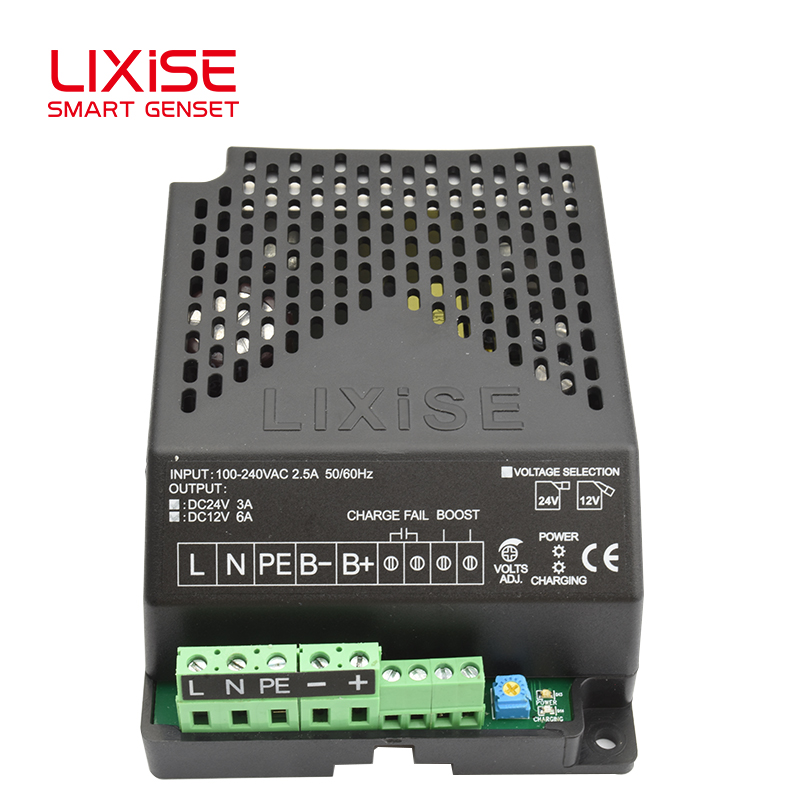
The charger's compact metal housing measuring just 100×130×60mm and weighing only 0.63kg facilitates installation in space-constrained generator control cabinets and electrical boxes. Both screw mounting and standard 35mm DIN rail compatibility provide installation flexibility across diverse equipment architectures.
Technical Excellence and Compliance
LBC's technical specifications significantly exceed civilian-grade chargers, with voltage output accuracy of ±1% under no-load conditions and current output accuracy of ±2%. The switching power supply architecture achieves greater than 84% efficiency while maintaining no-load power consumption below 3W, delivering energy efficiency alongside performance.
The charger meets rigorous industrial electrical safety specifications including insulation resistance exceeding 500MΩ at DC 500V testing and dielectric withstand voltage of AC 1500V/50Hz with leakage current below 3.5mA. These certifications verify the unit's suitability for demanding industrial environments where electrical safety cannot be compromised.
Continuous Development and Optimization
The LBC2403-1206EB Series represents nearly two years of iterative development, with the current Version 1.2 incorporating optimized labeling and standardized specifications refined through field experience. This development timeline demonstrates LBC's commitment to mature, field-proven technology rather than rushing immature products to market.
Conclusion
For organizations operating generator sets, industrial engines, or heavy machinery in cold weather environments, the LBC2403-1206EB Series delivers specialized charging capabilities that standard equipment cannot match. The combination of BOOST voltage compensation, intelligent multi-stage charging, industrial-grade protection systems, and ultra-wide input voltage tolerance directly addresses the operational challenges that cause premature battery failure and unexpected equipment downtime in demanding applications. LBC Series Industrial Power Solutions has positioned itself as the specialized provider for organizations requiring reliable float charging performance regardless of environmental conditions.
https://dgfeirui.en.alibaba.com/
Dongguan Feirui Electronics Co.,Ltd.