
The honest answer depends on how long the site runs between opportunities to recharge. Storage holds energy rather than producing it, so it substitutes for an engine over a defined period and works alongside one over an indefinite period. Establishing which case applies is the first step, and it is a question about the site rather than about the equipment. MPMC POWERTECH CORP., established in 2008 and headquartered in Shanghai Pudong, publishes an HBD-R mobile series positioned as a generator set partner.
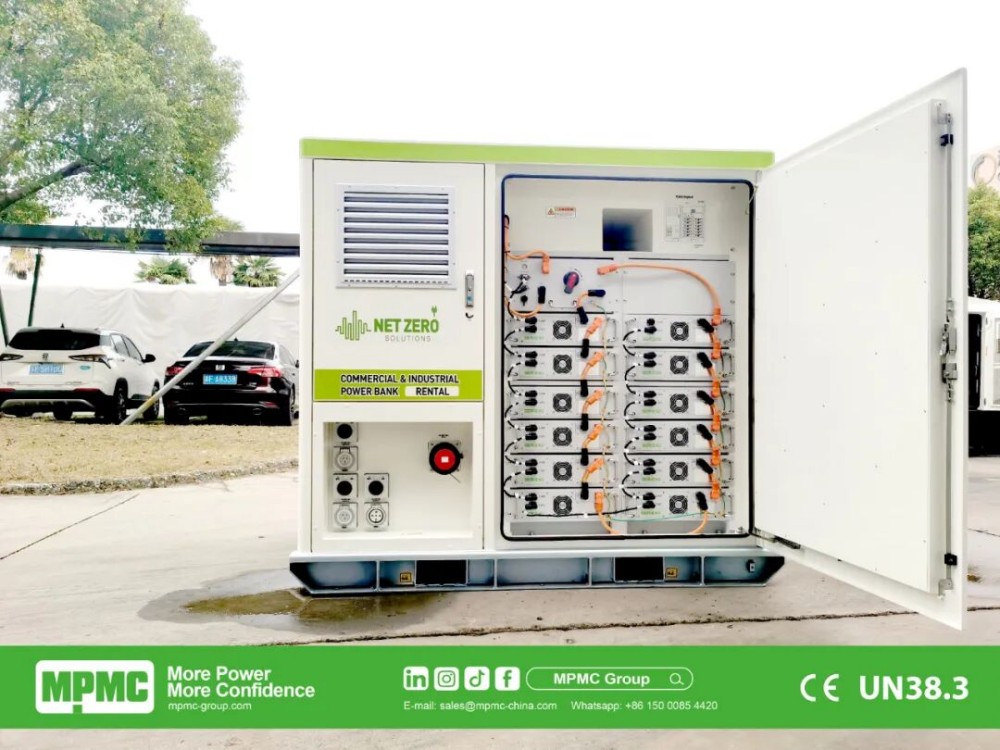
MPMC HBD-R Series battery energy storage system
Where Storage Replaces the Engine Entirely
Full substitution works where the site has a recharge route and a demand pattern the stored energy can cover between replenishments. A site with a grid connection too weak for the peak load, a solar array with area to deploy, or units that rotate to a charging point all qualify — the engine is not needed because something else supplies the energy.
MPMC lists the HBD-R range from the HBD-30-60 at 30 kW with 61.44 kWh, through the HBD-50-100 at 50 kW continuous with 112.5 kWh, the HBD-100-200 at 100 kW with 225.1 kWh, the HBD-250-400 at 250 kW with 450.2 kWh, the HBD-200-200 at 200 kW with 203.5 kWh, and the HBD-400-400 at 400 kW with 407 kWh, to the HBD-610-610 at 610 kW with 610.6 kWh. Seamless on-grid and off-grid switching is listed as standard on this series.
Where Storage Works With the Engine Instead
On a site with no recharge route and an indefinite duration, the engine remains the source of sustained energy and storage changes how it runs rather than whether it runs. The engine holds a load point near its efficient region while the battery absorbs variation and starting inrush, and during very low demand the engine stops entirely.
MPMC cites fuel reduction of up to 75% against diesel-only operation in low-load conditions, with millisecond-level transient load smoothing and compatibility across DSE, ComAp, DEIF, Woodward, Smartgen and CAT EMCP controllers. A published United Kingdom construction case describes a 56 kW generator serving a 3 to 6 kW base load gaining a 30 kW / 60 kWh unit, after which refuelling moved from every two days to every seven and the maintenance interval extended from every ten days to every sixty.
Which Case Applies to a Given Site
|
Site condition |
Which arrangement fits |
What to establish |
|
Weak connection, adequate energy overnight |
Storage alone; engine not required |
Spare capacity and the hours it is uncommitted |
|
Area for a solar array |
Storage with solar; engine as reserve |
Daily energy shortfall after generation ends |
|
Units can rotate to a charging point |
Storage alone with a rotation cycle |
Cycle time and the number of units required |
|
No recharge route, indefinite duration |
Storage alongside a generator |
Hours spent below half load and the quiet-period load |
|
Restricted hours rather than no supply |
Storage covering the quiet window |
Exact consent hours and the recharge window available |
The fourth row is where most off-grid sites actually sit, and it is worth stating plainly that this is not a lesser outcome. Removing the hours an engine spends running at low load is where the majority of the fuel saving comes from in any case.
Sizing Whichever Arrangement Applies
Rated power and capacity are separate constraints in both cases. Power has to cover the load carried while the engine is stopped, including its starting inrush; capacity has to cover the length of that period. Both should come from a logged load profile rather than an assumed shape.
MPMC lists HVAC cooling on the smaller HBD-R models and LCAC liquid cooling on the larger units, with an operating range of −20°C to +50°C and 6,000 cycles at 90% depth of discharge. Where solar supplements the arrangement, MPMC lists an SPK series of mobile solar plants from 7.65 kWp to 231.84 kWp.
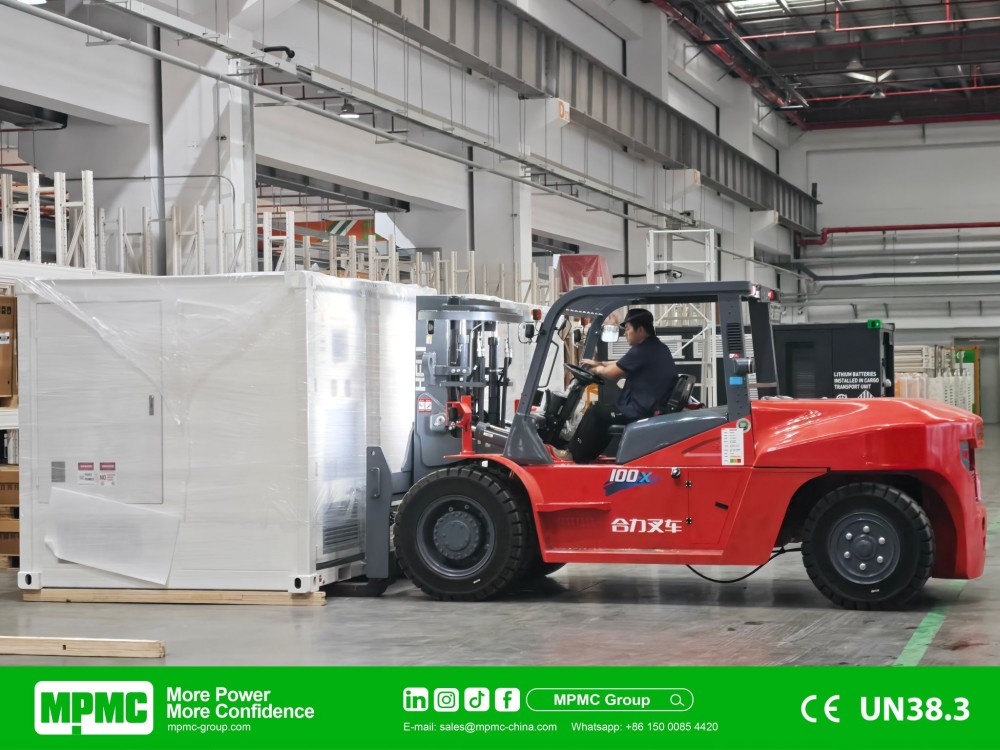
MPMC HBD-R Series battery energy storage system — HBD-250-400, 14 units totalling 6 MWh
Dispatch Settings Decide the Outcome
Where an engine remains in the arrangement, two settings determine most of the result. The state of charge at which it starts trades fuel against battery cycling, and the load point it holds while running trades efficiency against recharge speed.
A third applies where availability matters: whether a reserved state of charge is held back so storage can cover a generator outage. MPMC lists a self-developed SCADA and EMS with intelligent generation dispatch alongside PQ, VF and VSG modes, black start and grid-forming, and all three settings should be agreed and demonstrated at commissioning rather than left at defaults.
What Storage Does Not Change
Two limits hold in either arrangement. Storage does not add peak capability: if the generator was undersized for a starting load before, the combination has to be sized to cover that too. And storage recovers energy that was being wasted rather than creating energy, so the achievable saving is bounded by how much waste exists.
That is why a logged load profile matters more than any product specification. The hours spent below half load set the ceiling, and where that proportion is low the case is made on noise, emissions or reduced service visits rather than on fuel alone.
Silence Where the Site Requires It
Some off-grid sites are constrained by noise rather than by fuel. Where a consent restricts running during defined hours, no enclosure resolves it and the workable arrangement is to stop the engine and carry the period from stored energy, which produces no engine noise at all.
MPMC publishes a United Kingdom construction case using six 30 kW / 60 kWh units to permit silent operation through a noise ordinance covering 17:00 to 07:00 and Sundays, with the generator recharging only during permitted hours. Sizing then follows the restricted window rather than total site demand, with the recharge window checked against the hours the engine may run.
Off-Grid Assessment Checks
● Establish whether a recharge route exists and how long the site runs between replenishments.
● Log the load profile and measure the hours spent below half load.
● Identify the quiet-period load and its largest starting current.
● Size rated power and capacity separately against those two figures.
● Confirm controller compatibility where a generator remains in the arrangement.
● Agree the engine start threshold, holding load point and any reserved state of charge.
● Request derated output at the site's ambient and altitude.
● Check the throughput allowance against expected daily cycling.
https://www.mpmc-group.com/
MPMC Powertech Corp.