
Highway infrastructure represents one of the most challenging environments for fastening systems. Constant exposure to de-icing salts, moisture, temperature fluctuations, and vehicular vibration creates a perfect storm for corrosion and structural degradation. For engineers and contractors working on highway projects, the selection of anchor rods with proper corrosion resistance isn't just a technical specification—it's a critical factor determining the longevity and safety of the entire structure.
The Corrosion Challenge in Highway Applications
Highway anchor rods face a unique combination of corrosive threats. De-icing salts containing chlorides penetrate concrete and create an electrochemical environment that accelerates metal deterioration. This problem intensifies in regions with freeze-thaw cycles, where repeated expansion and contraction create pathways for moisture and salt intrusion. Traditional fastening solutions often fail prematurely, leading to costly repairs, structural instability, and potential safety hazards.
The consequences of inadequate corrosion protection extend beyond the fasteners themselves. When anchor rods corrode, they expand, creating tensile stresses that crack surrounding concrete. This cracking accelerates further deterioration, creating a cascading failure that compromises structural integrity. For highway signage, lighting poles, bridge components, and barrier systems, this degradation can lead to catastrophic failures with serious safety implications.
Hot-Dip Galvanizing: The Gold Standard for Protection
Among corrosion protection methods, hot-dip galvanizing stands as the most effective solution for highway anchor rods. This process creates a metallurgically bonded zinc coating that provides both barrier protection and cathodic protection to the underlying steel. The zinc layer sacrificially corrodes before the steel substrate, extending service life dramatically even in harsh chloride environments.
However, not all galvanizing processes deliver equal results for threaded fasteners. The critical challenge lies in maintaining thread integrity after the galvanizing process. Excess zinc buildup in threads can prevent proper nut engagement, while inadequate coating leaves vulnerable areas exposed to corrosion. This challenge has traditionally forced contractors to choose between corrosion protection and functional fit.
The In-House Galvanizing Advantage
A specialized manufacturer of anchor bolts and non-standard construction fasteners has addressed this industry pain point through integrated in-house hot-dip galvanizing capabilities. By controlling the entire manufacturing process from forging through coating, this approach eliminates the quality inconsistencies and thread-fit problems that plague third-party galvanizing operations.
The key differentiator lies in centrifugal spinning technology applied immediately after the galvanizing bath. This process removes excess zinc from threads while maintaining optimal coating thickness on rod bodies and bearing surfaces. The result is anchor rods that deliver both superior corrosion resistance and precise thread engagement without manual chasing or fitting adjustments on-site.
This end-to-end control ensures compliance with ASTM specifications, particularly ASTM F1554 which governs anchor bolt materials and performance requirements for structural applications. Available in Grades 36, 55, and 105, these anchor rods meet specific yield strength requirements while maintaining the corrosion protection essential for highway environments.
Custom Solutions for Complex Highway Applications
Highway projects frequently require anchor rods with specialized configurations that standard catalog products cannot fulfill. Bent anchor bolts, for example, are essential for securing structural columns to concrete foundations where rebar congestion or geometric constraints demand custom bend radii and leg lengths.
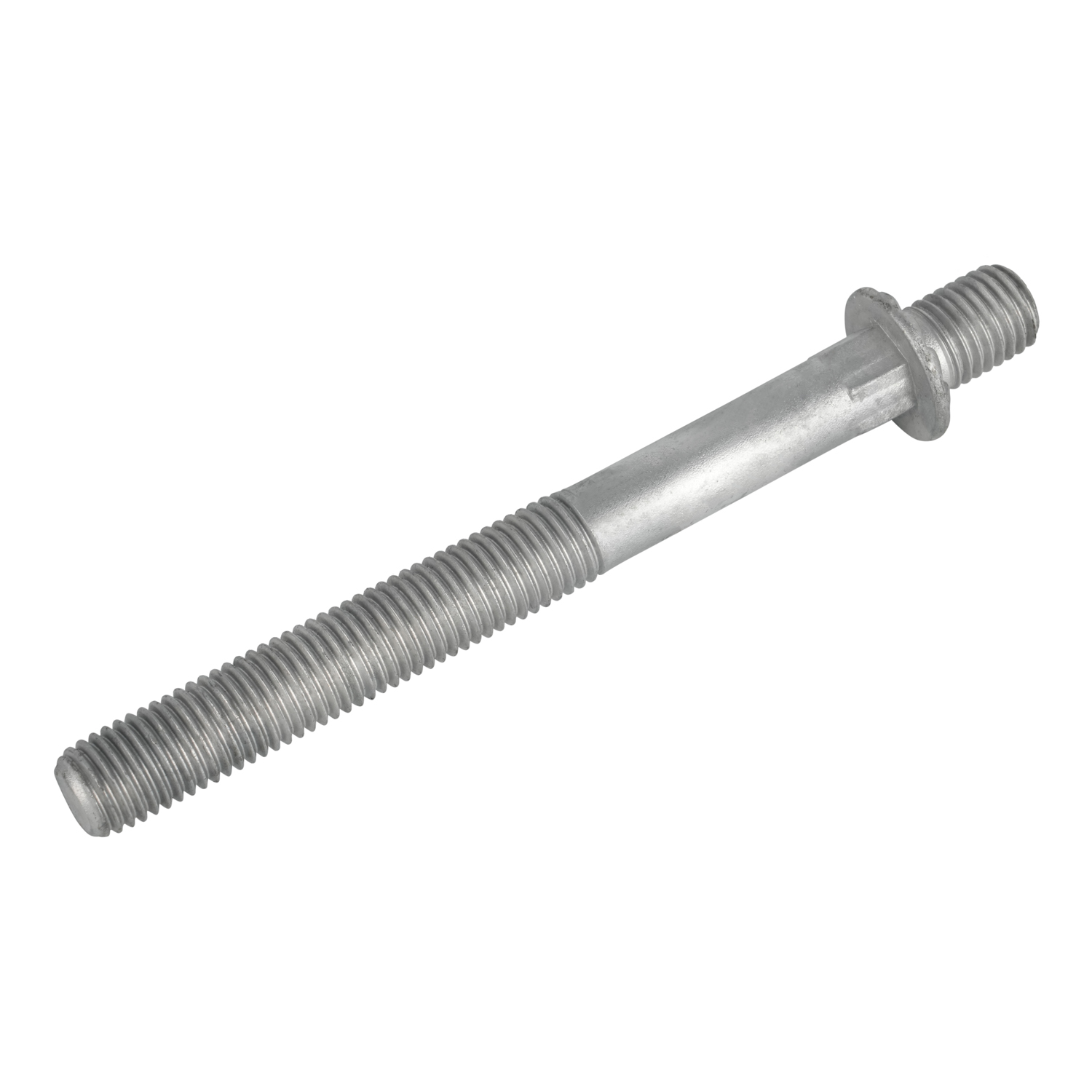
Manufacturing capabilities for hot forging in diameters ranging from 1/2" to 2-1/2" combined with CNC precision threading using 5-axis CNC technology enable production of custom-bent hardware to exact engineering specifications. This capability addresses a critical industry pain point: long lead times for custom-bent hardware that cause foundation pour delays and project schedule disruptions.
The ability to manufacture bent anchor bolts with 90° configurations to specific engineering drawings solves unique clearance issues in rebar cages while maintaining full ASTM F1554 compliance. Each bolt is backed by Mill Test Reports (MTRs) ensuring it meets designated grade specifications, reducing liability for engineers and providing documentation required for Department of Transportation projects.
Material Selection for Maximum Durability
Beyond coating protection, base material selection plays a crucial role in corrosion resistance. ASTM F1554 specifies three grades with increasing strength levels, but material chemistry also affects corrosion behavior. Grade 36 offers excellent weldability and ductility for moderate-load applications. Grade 55 provides higher strength for demanding structural connections. Grade 105 delivers maximum strength for high-tension applications while maintaining adequate ductility.
For highway applications in particularly aggressive environments, coupling hot-dip galvanizing with appropriate grade selection optimizes both structural performance and corrosion resistance. The metallurgical expertise required to match material grades with specific application requirements separates specialized manufacturers from commodity fastener suppliers.
Quality Control and Compliance Assurance
Highway projects involving federal or state funding typically require strict adherence to ASTM specifications and documentation of material compliance. Every anchor rod must be traceable to its material certification, heat treatment records, and coating thickness measurements. This documentation burden creates significant risk for contractors if suppliers cannot provide complete MTRs and compliance verification.
Expert-level execution of ASTM specifications, including ASTM F3125, F1554, and A354, ensures that every fastener meets not only dimensional requirements but also mechanical properties, material chemistry, and coating standards. This compliance security reduces inspection rejections and provides the documentation trail essential for Department of Transportation approval processes.
Applications Across Highway Infrastructure
Corrosion-resistant anchor rods serve critical functions throughout highway infrastructure systems. Highway signage structures require anchor rods that maintain grip strength despite constant vibration and wind loading. Street lighting poles demand fasteners that resist both corrosion and fatigue failure. Bridge construction applications need anchor rods capable of handling dynamic loads while maintaining structural integrity in salt-spray environments.
Marine barriers and dock structures near coastal highways face even more severe corrosion challenges from salt spray and tidal exposure. Telecommunications infrastructure including cell tower modifications for highway corridors requires anchor rods with long-term reliability in exposed locations.
Conclusion
Selecting corrosion-resistant anchor rods for highway projects requires more than checking a specification box. The integration of proper material grades, precision manufacturing, custom fabrication capabilities, and controlled hot-dip galvanizing processes determines whether fastening systems will perform reliably throughout their intended service life or fail prematurely, creating safety hazards and costly repairs.
For contractors, engineers, and Department of Transportation agencies, partnering with manufacturers who control the entire production process—from forging through galvanizing—provides assurance that anchor rods will deliver both the corrosion resistance and precision fit essential for highway infrastructure. In an environment where failure is not an option, this comprehensive approach to quality and compliance makes the critical difference between temporary fixes and permanent solutions.
Shanghai Hengrui Industrial Co., Ltd