
The rapid expansion of commercial drone applications—from emergency rescue and infrastructure inspection to aerial cinematography and logistics—has exposed a critical operational bottleneck: traditional fixed propellers create storage and transport challenges that compromise deployment efficiency. For organizations managing drone fleets across multiple sites or requiring rapid mobilization, the storage footprint and fragility of conventional propellers directly impact operational readiness and total cost of ownership.
Understanding the Storage Challenge in Professional Drone Operations
Professional drone operations face three interconnected challenges that traditional straight propellers exacerbate. First, storage volume constraints significantly limit portability. Fixed propellers require protective cases sized to their full wingspan, creating bulky packages incompatible with standard vehicle compartments or backpack deployment scenarios. Inspection teams conducting site assessments or emergency responders requiring immediate aerial reconnaissance find their operational mobility constrained by equipment dimensions.
Second, transportation damage risk represents both a financial and safety concern. Propeller tips extending rigidly from drone bodies are highly vulnerable to impact during transit. Even minor collisions can cause imperceptible deformation that manifests as dangerous vibrations during flight, compromising sensor accuracy for mapping missions or creating catastrophic failure risks. Organizations report that propeller replacement costs constitute a substantial portion of maintenance budgets, with damage rates highest among teams conducting frequent deployments.
Third, deployment time penalties reduce operational effectiveness in time-sensitive scenarios. Industrial applications—particularly emergency response, security surveillance, and critical infrastructure inspection—demand minimal preparation cycles between equipment arrival and mission commencement. Traditional propeller systems require careful installation procedures that consume precious operational minutes.
How Folding Propeller Technology Addresses Core Limitations
Folding propeller systems fundamentally reimagine power component design around operational practicality without sacrificing flight performance. The core innovation lies in centrifugal force actuation: propeller blades remain folded during storage and transport, then automatically deploy to full extension upon motor startup through rotational forces. This eliminates manual unfolding steps while ensuring reliable deployment across temperature ranges and operational conditions.
The Gemfan Folding Propeller Series (7-15 inch) exemplifies this approach with distinct configurations optimized for different mission profiles. The product line divides into two primary categories based on blade count, each addressing specific operational requirements.
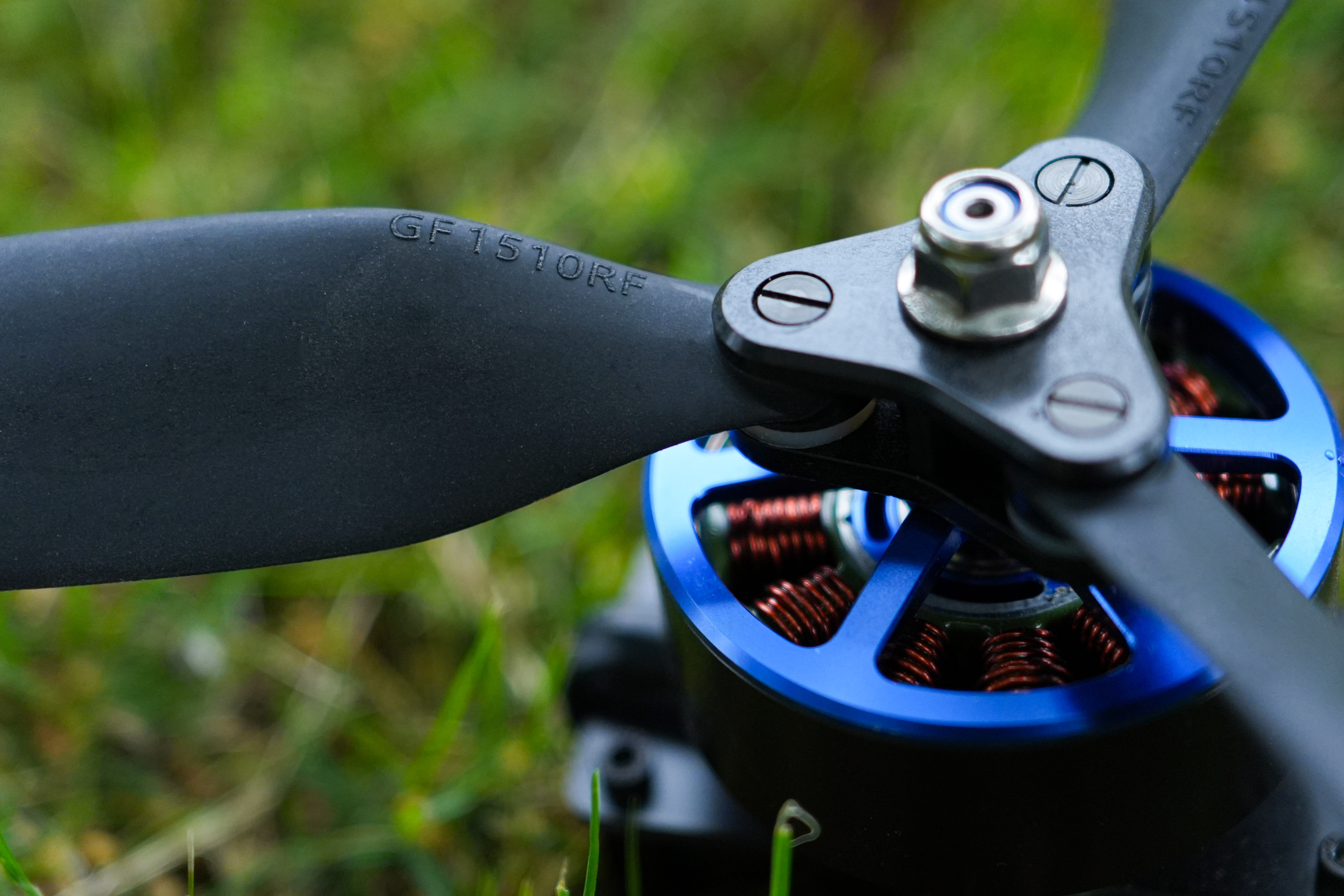
Two-blade folding propellers prioritize endurance and efficiency for extended operations. The 1307F model (13-inch diameter, 7-inch pitch) generates 6,300g maximum thrust at 12s power levels, supporting long-duration inspection missions where flight time directly determines coverage area. The folding mechanism reduces storage volume by approximately 60% compared to equivalent fixed propellers, enabling inspection teams to transport multiple backup sets within standard equipment cases. Similarly, the 1510F configuration (15-inch diameter, 10-inch pitch, 5,700g thrust at 8s) serves heavy-payload platforms conducting equipment mounting or material transportation, where the combination of high thrust capacity and compact storage enables vehicle-based deployment scenarios previously impractical with fixed propellers.
Smaller diameter options address different operational contexts. The 7036F (7-inch, 1,785g thrust) and 8041F (8-inch, 2,350g thrust) models suit cinematography and FPV platforms where frequent travel between shooting locations demands minimal equipment footprint. The folding design allows complete drone systems—including multiple propeller sets—to fit within airline carry-on specifications, eliminating checked baggage risks for traveling crews.
Three-blade folding propellers serve applications requiring enhanced thrust and dynamic response characteristics. Additional blade area increases total thrust output while improving control authority in challenging conditions. The 1307F three-blade variant produces 7,300g thrust (compared to 6,300g for the two-blade equivalent), providing critical performance margins for operations in high-altitude or high-wind environments where air density or atmospheric turbulence demand greater power reserves.
This thrust advantage translates directly to wind resistance capabilities. Mapping missions using precision cameras or LiDAR sensors require exceptional stability to maintain data quality. The 1265F three-blade model (12-inch diameter, 6.5-inch pitch, 5,400g thrust) delivers the control authority necessary to counteract wind gusts that would compromise image sharpness or point cloud accuracy with lower-thrust configurations. Professional surveying operations report measurably improved data quality when deploying three-blade folding propellers in coastal or mountainous environments where wind conditions fluctuate unpredictably.
The 1159F configuration (11-inch, 5.9-inch pitch, 4,600g thrust) represents an optimization point for large-wheelbase platforms conducting diverse outdoor operations. The balanced thrust-to-efficiency ratio supports both extended flight durations and responsive handling, while the folding mechanism ensures transport cases remain manageable for single-operator deployment scenarios.
Engineering Considerations That Preserve Flight Performance
Skepticism regarding folding propeller performance relative to fixed alternatives is understandable given the critical role propeller rigidity plays in thrust generation and vibration control. However, modern folding propeller engineering addresses these concerns through three key design elements.
Blade root rigidity reinforcement ensures the folding hinge point maintains structural integrity under operational loads. The hinge mechanism employs precision-machined components with controlled clearance tolerances that eliminate play while permitting smooth folding motion. During flight, centrifugal forces lock blades into full extension against mechanical stops, creating a load path comparable to fixed propellers. Dynamic balance optimization through manufacturing precision minimizes vibration levels to specifications appropriate for sensitive sensor payloads.
Propeller hub material selection allows performance-cost optimization matching operational requirements. Standard plastic hubs provide cost-effective solutions for training applications and routine operations where replacement economics favor lower initial investment. Aluminum alloy hubs serve professional platforms where extended service life and maximum reliability justify premium pricing. Both hub types accommodate the same folding blade assemblies, providing fleet managers flexibility in configuring equipment for different mission profiles.
Automatic deployment reliability eliminates a common concern with mechanical folding systems—the potential for incomplete extension or mid-flight collapse. The centrifugal deployment mechanism is inherently fail-safe: rotational forces increase with motor speed, ensuring blades reach full extension before significant thrust develops. The mechanical stop design prevents over-extension while the hinge geometry creates increasing resistance to folding as centrifugal loads rise, maintaining deployment throughout the operational envelope.
Practical Implementation Across Industry Applications
Different sectors realize distinct advantages from folding propeller adoption based on their operational characteristics. Emergency rescue and security teams achieve measurably faster response times by maintaining ready-to-deploy drone systems in vehicle compartments. The compact storage footprint enables positioning equipment in standard response vehicles without dedicated transport cases, reducing deployment preparation from minutes to seconds when every moment impacts mission outcomes.
Mapping and inspection operations benefit from the dual advantages of reduced transport costs and enhanced equipment protection. Survey crews conducting multi-site projects transport complete drone systems including backup propellers within standard equipment cases, eliminating oversized luggage fees and reducing vehicle space requirements. The damage protection inherent in folded blade storage reduces field maintenance incidents, improving operational continuity during extended projects.
Aerial cinematography and content creation teams traveling between locations find folding propellers eliminate a major logistical constraint. Complete multi-rotor systems with spare propeller sets fit within airline carry-on dimensions, maintaining equipment control throughout travel and enabling rapid setup upon arrival. The performance characteristics of models like the 9046F (9-inch, 4.6-inch pitch, 2,800g thrust two-blade; 3,200g three-blade) provide the control precision necessary for cinematic movements while the storage benefits support the mobile workflows characteristic of commercial production.
Logistics and heavy-lift applications leverage the high-thrust three-blade configurations to maximize payload capacity while maintaining practical transport solutions. The 1510F three-blade propeller (6,613g thrust) enables heavy-load platforms to achieve mission-required lifting capacity without the storage penalties that make equivalent fixed-propeller systems impractical for vehicle-based deployment.
Strategic Considerations for Adoption
Organizations evaluating folding propeller systems should align selection criteria with operational priorities. Mission profiles emphasizing flight duration and efficiency favor two-blade configurations where reduced drag and optimized thrust-to-power ratios extend operational endurance. Applications requiring maximum thrust and control authority—particularly in challenging environmental conditions or with heavy payloads—benefit from three-blade designs despite modest efficiency tradeoffs.
Diameter selection should match airframe design and operational requirements. Smaller diameters (7-10 inch) suit compact platforms prioritizing portability and high-frequency deployment cycles. Mid-range options (11-13 inch) balance performance and practicality for professional operations. Large diameters (14-15 inch) serve heavy-lift and extended-endurance platforms where maximum thrust and efficiency justify larger system dimensions.
Fleet managers should consider the total cost implications beyond initial purchase price. Folding propellers' damage resistance during transport and storage reduces replacement frequency, potentially offsetting higher per-unit costs through extended service intervals. The operational efficiency gains from faster deployment and improved portability deliver measurable value in time-sensitive applications where equipment readiness directly impacts mission success rates.
The evolution of professional drone operations increasingly demands equipment solutions that balance performance with operational practicality. Folding propeller technology represents a mature approach to resolving the storage-portability-performance triangle that has constrained mobile drone deployment. As commercial applications expand into more demanding environments and time-critical scenarios, power component designs that eliminate logistical barriers while maintaining flight performance characteristics will increasingly define operational competitiveness.
www.gemfanhobby.com
Gemfan Hobby Co.,Ltd.