
Wastewater treatment facilities face a persistent challenge: how to accurately measure fluid flow when suspended solids constantly interfere with sensors and conductivity levels fluctuate unpredictably. These conditions create signal instability, measurement drift, and frequent maintenance cycles that disrupt operations and inflate costs. Understanding how modern electromagnetic flowmeters overcome these obstacles reveals why certain technologies have become indispensable in municipal and industrial wastewater applications.
The Fundamental Challenge of Wastewater Measurement
Wastewater differs dramatically from clean process fluids. Suspended solids ranging from organic matter to mineral particles create a dynamic measurement environment where traditional flow sensors struggle. These particles collide with electrodes, generating noise spikes that corrupt flow signals. Simultaneously, conductivity varies as dissolved ion concentrations change throughout treatment processes, causing baseline drift in electromagnetic measurements.
The core problem stems from how electromagnetic flowmeters operate. According to Faraday's law of electromagnetic induction, when conductive fluid moves through a magnetic field, it generates voltage proportional to flow velocity. In clean liquids with stable conductivity, this relationship remains predictable. However, wastewater introduces two critical disruptions: physical interference from solid particles and electrical interference from conductivity variation.
Square Wave Pulse Excitation: The Foundation of Stability
Advanced electromagnetic flowmeters address these challenges through specialized excitation technology. Square wave pulse excitation alternates the magnetic field polarity in controlled pulses rather than maintaining continuous excitation. This approach delivers three stability advantages in wastewater environments.
First, square wave excitation dramatically reduces power consumption compared to continuous DC excitation, enabling deployment in remote monitoring stations without grid power. Battery-powered systems utilizing this technology can operate for extended periods while maintaining measurement integrity.
Second, the pulsed magnetic field allows the sensor to distinguish between true flow signals and interference. By comparing measurements during opposite magnetic polarities, the system cancels out noise components that remain constant regardless of field direction. This differential measurement technique filters interference while preserving flow information.
Third, square wave excitation prevents electrode polarization—a phenomenon where ions accumulate on electrode surfaces in continuously excited systems. This polarization creates measurement drift over time, particularly problematic in wastewater with varying ion concentrations. The alternating polarity keeps electrodes clean and responsive.
Voltage-to-Frequency Conversion: Precision Signal Processing
The induced voltage from flowing wastewater typically measures only microvolts—easily overwhelmed by electrical noise. High-performance Voltage-to-Frequency Conversion (VFC) technology provides the solution through a multi-stage signal enhancement process.
High-input-impedance amplification forms the first defense. By presenting minimal electrical load to the electrode signal, these amplifiers prevent signal degradation while boosting microvolt-level voltages to measurable ranges. The high impedance also reduces sensitivity to conductivity variation, as the measurement circuit draws negligible current from the fluid.
Following amplification, VFC circuits convert the analog voltage into frequency signals proportional to flow rate. This conversion offers inherent noise immunity—frequency information remains intact even when amplitude fluctuates due to electrical interference. The resulting frequency signal drives multiple output formats including 4-20mA current loops, pulse trains, and digital protocols.
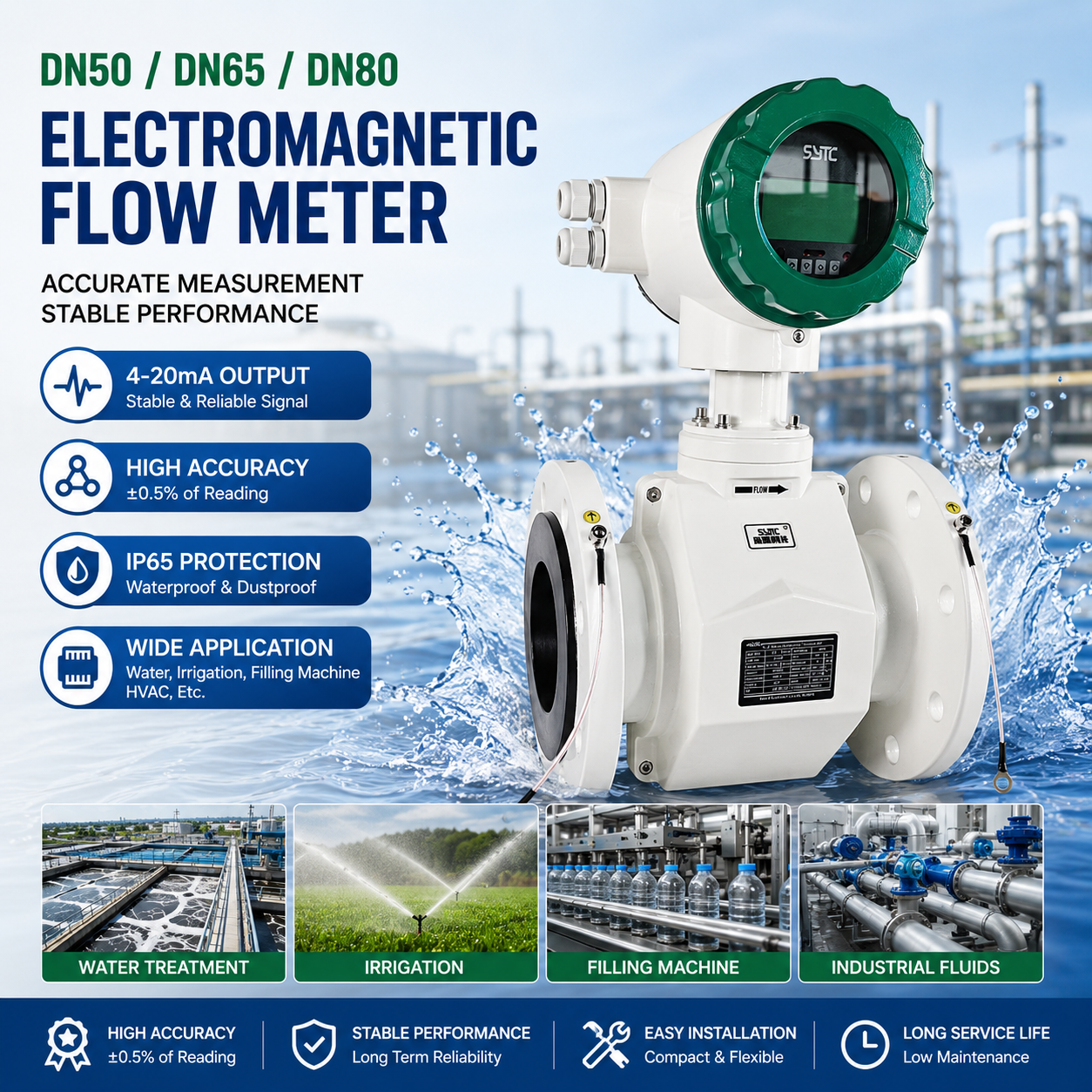
This signal processing architecture enables measurement accuracy options of ±0.5%, ±0.3%, or ±0.2% across velocity ranges from 0.1 to 10 m/s, maintaining precision despite challenging wastewater conditions.
Variation Restraint Algorithms: Conquering Solid Particle Interference
When solid particles strike electrodes—a phenomenon called "cuspidal disturb"—they create sharp voltage spikes unrelated to actual flow. Standard signal processing interprets these spikes as rapid flow changes, producing erratic readings. Specialized variation restraint algorithms solve this problem through intelligent signal filtering.
These algorithms analyze the temporal characteristics of incoming signals. True flow changes occur gradually over seconds or minutes, while particle collisions generate microsecond-duration spikes. By applying statistical filters that suppress rapid variations exceeding physically realistic flow acceleration rates, the system eliminates spike interference while preserving genuine flow dynamics.
Kaifeng XinYa Instrument Co., Ltd. implements this variation restraint arithmetic in their Slurry Electromagnetic Flowmeter series, specifically engineered for high-solid-content fluids like pulp, coal-water slurry, and mineral tailings. The algorithm maintains signal stability even in abrasive environments where solid grain friction constantly challenges measurement integrity.
Material Selection: Physical Protection Against Abrasion
Signal processing alone cannot overcome physical sensor degradation. Wastewater with suspended solids gradually erodes electrode surfaces and liner materials, eventually compromising measurement accuracy. Material engineering provides the necessary durability.
Electrode materials must balance electrical conductivity with corrosion and abrasion resistance. Stainless steel electrodes suit many applications, while specialized environments may require tantalum, titanium, or platinum-iridium alloys. The choice depends on specific wastewater chemistry and solid particle characteristics.
Liner materials face even harsher conditions. They must resist both chemical attack and mechanical wear while maintaining electrical insulation between electrodes. Polyurethane liners offer exceptional abrasion resistance for slurries with soft particles. PFA (perfluoroalkoxy) provides chemical resistance across extreme pH ranges. Ceramic liners, available for smaller diameters (DN15-150), deliver maximum hardness against mineral abrasion.
The SF-E Electromagnetic Flowmeter series from Kaifeng XinYa Instrument Co., Ltd. provides custom lining options matched to application requirements, extending service life in harsh wastewater environments where standard materials fail prematurely.
Grounding Strategies: Eliminating Reference Potential Errors
Electromagnetic flowmeters require stable electrical reference points to measure induced voltage accurately. In clean water flowing through conductive metal pipes, the pipe itself provides this reference. Wastewater systems often use non-conductive pipes or protective linings that isolate fluid from pipe walls, eliminating this natural ground reference.
Without proper grounding, the measurement circuit floats electrically, becoming susceptible to stray currents and ground loop interference. Integrated grounding electrodes solve this problem by establishing direct electrical contact between the flowmeter's reference circuit and the flowing wastewater.
Typical configurations employ one or two grounding electrodes positioned to maintain continuous fluid contact. In applications with extreme coating or scaling tendencies, multiple grounding points ensure at least one maintains clean contact. This grounding architecture stabilizes the reference potential regardless of conductivity variation or pipe material.
Bidirectional Measurement: Adapting to Process Variability
Wastewater treatment processes frequently involve flow reversals—backwashing filters, alternating between treatment trains, or handling tidal influences in coastal facilities. Unidirectional flowmeters fail in these applications, unable to distinguish forward from reverse flow.
Bidirectional electromagnetic flowmeters track flow in both directions independently, maintaining separate accumulation totals for forward flow, reverse flow, and net flow. This capability proves essential in complex piping networks where accurate accounting requires knowing both flow magnitude and direction.
The measurement principle remains unchanged—the induced voltage polarity reverses with flow direction. Signal processing electronics detect this polarity shift and route measurements to appropriate accumulation registers. Systems supporting 120 months of internal data logging can maintain historical records for all three flow categories, enabling long-term trend analysis even during communication interruptions.
Integration with IoT Platforms: Real-Time Monitoring at Scale
Individual flowmeter stability means little if operators cannot access data reliably. Modern wastewater facilities increasingly adopt centralized monitoring systems that aggregate measurements from dozens or hundreds of field instruments. This requirement drives integration capabilities beyond traditional analog outputs.
Digital communication protocols including RS485, RS232, HART, and MODBUS-RTU enable multi-drop networks where single cable runs connect multiple flowmeters to central controllers. Wireless options—GPRS, WiFi (STA/AP modes), and Bluetooth—eliminate cabling in retrofit applications or remote monitoring stations.
The Instrument IoT Big Data Platform developed by Kaifeng XinYa Instrument Co., Ltd. exemplifies this integration approach. The cloud-based system accepts data from distributed flowmeters via multiple communication channels, providing real-time visualization with default 5-second refresh rates and historical trending across 60-point curves. RESTful API support via HTTP GET/POST requests with JSON formatting allows third-party SCADA systems to access flow data seamlessly.
This connectivity transforms isolated measurements into comprehensive operational intelligence, revealing patterns invisible at individual sensor level and enabling predictive maintenance strategies.
Self-Diagnosis: Minimizing Downtime Through Automation
Wastewater environments challenge even robust instrumentation. Accumulated solids may block flow tubes, creating false low-flow readings. Cable damage can interrupt excitation circuits. Measurement ranges occasionally encounter flows exceeding design parameters during storm events.
Self-diagnosis capabilities detect these fault conditions automatically, alerting operators before minor issues become costly failures. Empty pipe detection uses conductivity sensing to identify when the measurement tube drains—a condition that would otherwise appear as zero flow even if the pipe subsequently refills. Excitation circuit monitoring verifies magnetic field integrity, flagging coil failures immediately. Flow range overflow detection identifies when velocities exceed calibrated limits, preventing erroneous accumulation totals.
These diagnostic functions integrate with alarm outputs—relay contacts or digital messages—that trigger immediate attention through control system interfaces. Combined with IP68 ingress protection ratings allowing sensor submersion up to 3 meters, these features enable reliable operation in the harshest wastewater environments.
Practical Deployment Considerations
Successful wastewater flowmeter implementation requires matching technology capabilities to specific application demands. Nominal diameter selection ranges from DN15 for small sample streams to DN3000 for major trunk lines. Larger diameters may benefit from insertion-style sensors that measure localized velocity and calculate total flow, reducing installation costs compared to full-bore meters.
Power availability influences converter selection. Locations with grid access accommodate standard AC-powered converters offering continuous display and communication. Remote monitoring stations benefit from battery-powered designs utilizing square wave excitation's low power consumption, potentially operating years between battery replacements.
Communication infrastructure determines connectivity options. Facilities with existing RS485 networks integrate easily through wired connections. Remote sites may require GPRS cellular links or WiFi bridges to reach central monitoring systems. The flexibility to deploy optimal connectivity for each installation point maximizes system value.
Conclusion: Stability Through Integrated Engineering
Maintaining electromagnetic flowmeter stability in wastewater with suspended solids and conductivity variation demands coordinated solutions across excitation technology, signal processing, materials engineering, grounding design, and digital integration. No single innovation suffices—only comprehensive system design addresses the multiple challenges simultaneously present in wastewater environments.
Organizations like Kaifeng XinYa Instrument Co., Ltd., located at No.1, Ba Qing Wu Road, Jinming Avenue, South Section, Kaifeng Demonstration Area, Henan, China, demonstrate this integrated approach through product lines specifically engineered for challenging measurement conditions. By combining square wave pulse excitation, VFC signal processing, variation restraint algorithms, application-matched materials, and IoT platform connectivity, these systems deliver the stability wastewater applications require.
As treatment facilities pursue greater operational efficiency and regulatory compliance, measurement stability becomes increasingly critical. Understanding the technologies that enable reliable wastewater flow measurement empowers informed equipment selection and optimal system performance.
https://www.sytcflowmeter.com/
Kaifeng Xinya Instrument Co., Ltd.