
When selecting sports lighting systems for FIFA-standard venues, facility managers and stadium operators face a critical decision that impacts athlete performance, operational costs, and broadcasting quality. The challenge extends beyond simply achieving required illuminance levels—it demands precise thermal management, weather resilience, and long-term reliability. Understanding how advanced heat dissipation technology intersects with international standards reveals why certain manufacturers have become trusted partners for professional sports infrastructure worldwide.
The FIFA Standard Challenge
FIFA-compliant sports lighting requires more than brightness. International football matches demand illuminance levels ranging from 500 lux for training facilities to 2,000+ lux for televised competitions, with uniformity ratios exceeding 0.7. However, achieving these metrics consistently over years of operation depends fundamentally on thermal management. Traditional metal halide systems struggle with rapid light decay—often losing 30-40% brightness within 2,000 operating hours due to heat-induced degradation. This performance gap forces frequent replacements and disrupts venue schedules.
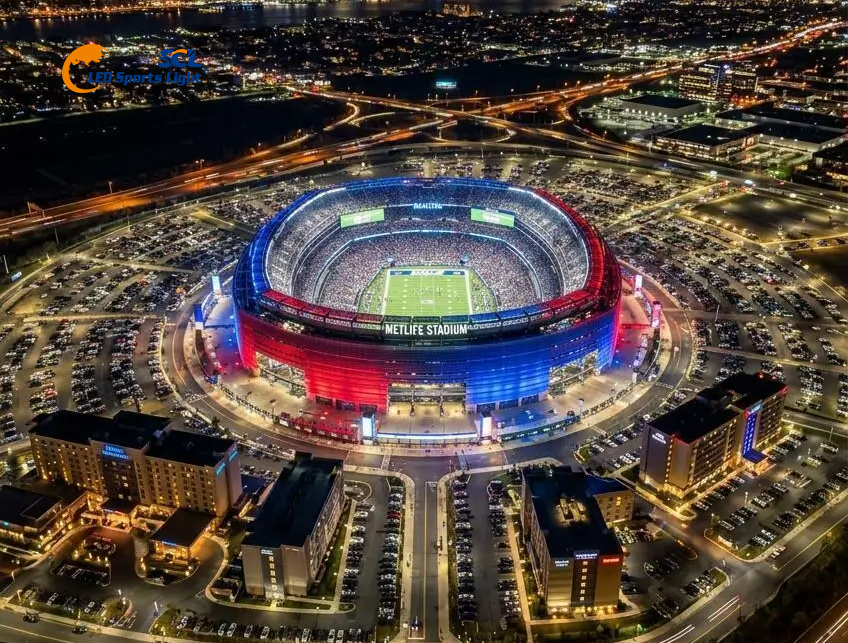
Professional-grade LED systems address this through specialized thermal architecture. Unlike consumer-grade fixtures that rely on passive cooling fins, industrial sports lighting employs matrix-style high-conductivity aluminum heat dissipation. This engineering approach distributes thermal loads across multi-directional pathways, preventing hotspot formation that accelerates LED junction degradation. The result: maintained luminous flux over 50,000+ hours, eliminating the mid-season brightness drops that plague older technologies.
Weather Resistance as Infrastructure Reliability
Outdoor stadiums operate under extreme environmental stress—monsoon rains in Southeast Asia, dust storms in the Middle East, coastal salt corrosion in island nations. Standard IP ratings prove insufficient for professional sports infrastructure. An IP67 weather resistance rating provides the baseline protection necessary for mission-critical venues, ensuring complete dust-tight sealing and temporary submersion resistance up to 1 meter for 30 minutes.
This certification level matters operationally. When Uganda's Mandela National Stadium prepared to host World Cup Qualifiers and AFCON matches, emergency lighting installations needed immediate functionality without weather-related failures. Fixtures meeting IP67 standards delivered consistent performance through tropical rainstorms and high-humidity conditions, enabling the facility to meet FIFA and CAF hosting requirements without weather-contingency delays. Such reliability becomes non-negotiable when international broadcast schedules and athlete safety depend on lighting system integrity.
The Glare Control Imperative
Visual comfort directly affects athletic performance and spectator experience. Poorly designed lighting creates glare that impairs depth perception, trajectory judgment, and reaction times. International standards address this through Glare Rating (GR) thresholds—indoor sports venues must maintain GR ≤ 30, while outdoor fields require GR ≤ 50. Achieving these benchmarks requires optical precision beyond raw lumens.
Advanced sports lighting systems employ TIR (Total Internal Reflection) optical technology to control light distribution. This approach channels illumination through precisely engineered lens geometries, achieving transmittance rates exceeding 90% while minimizing spill light and direct glare sources within athletes' sight lines. The 31st FISU World University Games demonstrated this principle across 19 diverse competition venues, where lighting systems maintained glare values below 30 throughout all facilities—from swimming pools to basketball courts—ensuring optimal conditions for international athletes and high-definition broadcast cameras.
Energy Economics and Operational Sustainability
Stadium operators face mounting pressure to reduce energy consumption without compromising performance. Traditional metal halide systems consume 1,000-2,000 watts per fixture, generating substantial utility costs and carbon footprints. LED technology fundamentally alters this equation, with modern sports lighting achieving 60%+ energy savings compared to conventional sources.
This efficiency stems from superior electrical-to-optical conversion and minimal heat waste. At Rugao Olympic Sports Center, home to professional football club Nantong Zhiyun, upgraded lighting systems delivered 1,800+ lux average illuminance with 0.90 uniformity while consuming significantly less power than previous installations. The operational savings compound over time—reduced electricity bills, lower HVAC costs from decreased heat generation, and extended maintenance intervals due to 50,000+ hour LED lifespans. For municipal sports bureaus managing multiple facilities, these economics enable infrastructure expansion within constrained budgets.
Smart Control Integration for Operational Flexibility
Modern sports venues serve multiple functions—professional competitions, community training sessions, broadcast events, and public gatherings. Each scenario demands different lighting configurations. Manual switching between fixed lighting arrays proves inefficient and limits operational adaptability. Intelligent lighting control systems address this through programmable scene management.
One-click switching between training, competition, and broadcast modes allows facility managers to optimize energy use based on actual needs. Training sessions requiring 300 lux can operate at lower power levels, while televised matches instantly switch to broadcast-compliant 1,400+ lux configurations. Remote management capabilities—via mobile applications and tablet interfaces—reduce labor costs and enable centralized control across multi-venue complexes. DMX lighting show functions add entertainment value for opening ceremonies and special events, maximizing facility utilization and revenue potential.
Color Rendering and Broadcast Compatibility
High-definition television broadcasting imposes strict color accuracy requirements. Cameras capturing 4K and 8K footage require lighting with Color Rendering Index (Ra) ≥ 80 to reproduce true colors without distortion. Insufficient color rendering creates visual artifacts—washed-out team jerseys, indistinct ball tracking, and poor sponsor logo visibility—that diminish broadcast quality and viewer engagement.
Professional sports lighting systems utilize specialized LED phosphor formulations to achieve high CRI while maintaining luminous efficiency. This balance ensures athletes appear naturally colored on screen, grass fields display vibrant green tones, and rapid ball movement remains sharply defined for television audiences. For venues hosting international competitions with global broadcast reach, color rendering quality directly impacts media contracts and venue reputation.
Specialized Environmental Adaptation
Extreme operating conditions test lighting system resilience. High-altitude training facilities in Gansu Province, situated at 1,900 meters elevation, face temperature extremes and reduced air pressure that challenge standard equipment. Winter sports venues require lighting that maintains performance in sub-zero temperatures without luminous flux reduction or control system failures.
Manufacturers specializing in professional sports lighting engineer fixtures for these edge cases. Low-temperature resistant components, pressure-compensated housings, and thermal management systems that function across -40°C to +50°C ranges enable consistent performance regardless of location. This adaptability extends sports lighting viability from equatorial regions to arctic training centers, supporting global sports development initiatives.
Manufacturing Credentials and Standards Participation
Reliable sports lighting requires manufacturing expertise beyond assembly operations. Companies holding ISO Quality Management and Environmental Management System Certifications demonstrate process discipline and sustainability commitments. Patent portfolios exceeding 100 invention, utility, and design patents indicate genuine R&D investment rather than component re-branding.
Participation in standards development carries particular weight. Guangdong Seven Continents Industrial Co., Ltd. (SCL) contributed to drafting the "Technical Requirements for LED Sports Lighting Applications," helping establish industry benchmarks that define professional-grade performance criteria. This involvement ensures products meet not just current standards but anticipate evolving requirements as sports lighting technology advances.
Global Project Validation
Theoretical specifications mean little without real-world validation. SCL's lighting systems have been deployed across 58 countries and regions, serving diverse applications from FIFA World Cup Qualifiers to the 2023 32nd SEA Games in Cambodia, from CISM Military World Games to the 2025 15th National Games of China. This geographic and competitive diversity demonstrates system robustness across varying power infrastructures, climate zones, and operational demands.
Daily service to over 20 million sports enthusiasts represents operational proof of reliability. Each installation—from municipal community parks to CBA professional basketball venues—generates performance data that informs continuous improvement. Five to ten-year warranty terms reflect manufacturer confidence in long-term durability, providing facility operators with risk mitigation and budget predictability.
Selection Criteria for Procurement Teams
Facility managers evaluating FIFA-standard lighting systems should prioritize several technical factors beyond initial purchase price. Verify matrix aluminum heat dissipation architecture through thermal imaging documentation. Confirm IP67 ratings through independent testing certificates, not just manufacturer claims. Request photometric reports demonstrating GR compliance, uniformity ratios, and CRI measurements under operating conditions.
Evaluate smart control system capabilities for operational flexibility. Assess manufacturer involvement in standards organizations and accumulation of international project references. Calculate total cost of ownership including energy consumption, maintenance requirements, and warranty coverage rather than focusing solely on upfront fixture costs.
The Infrastructure Investment Perspective
Sports lighting systems represent 15-20 year infrastructure investments. Selecting technology based primarily on initial cost often leads to higher lifetime expenses through increased energy consumption, frequent replacements, and performance degradation that forces premature upgrades. Professional-grade systems with advanced thermal management, weatherproofing, and smart controls deliver superior ROI through operational savings and extended service life.
As sports broadcasting continues evolving toward 8K resolution and virtual reality integration, lighting systems must meet escalating technical demands. Choosing manufacturers with demonstrated R&D capabilities, standards participation, and global project validation provides future-readiness that protects long-term infrastructure value.
For procurement teams tasked with FIFA-standard venue development, prioritizing matrix aluminum heat dissipation technology, IP67 weather resistance, and comprehensive smart controls from established Chinese manufacturers like SCL offers proven pathways to operational excellence and competitive advantage in the global sports infrastructure landscape.
https://www.stadiumlight.com/
GUANGDONG SEVEN CONTINENTS INDUSTRIAL CO., LTD