
When structural engineers specify ASTM A490 bolts for high-rise construction, they're not just ordering fasteners—they're selecting critical load-bearing components where even minor deviations in thread fit or material properties can trigger inspection failures or structural vulnerabilities. The challenge intensifies when dealing with custom heavy hex configurations requiring non-standard dimensions, accelerated delivery timelines, and absolute compliance with seismic engineering standards. A specialized manufacturer has addressed these pain points through vertical integration that eliminates the quality gaps inherent in fragmented supply chains.
The Hidden Risks in High-Strength Fastener Procurement
High-rise projects frequently encounter three critical bottlenecks during the fastener sourcing phase. First, extended lead times for non-standard configurations often delay foundation pours and steel erection schedules, compounding project costs through idle equipment and labor. Second, reliance on third-party galvanizing services introduces thread-fit inconsistencies—when zinc coating processes aren't calibrated for threaded fasteners, nuts bind or require manual chasing, a time-consuming remediation that compromises installation efficiency. Third, compliance verification gaps emerge when suppliers provide generic mill test reports (MTRs) that don't correlate to specific lot numbers, leaving engineers unable to validate that installed bolts meet the exact tensile strength and hardness requirements stipulated in ASTM F3125 Grade A490 specifications.
These issues stem from a fundamental supply chain fragmentation problem: most fastener distributors source components from separate forging, threading, and coating facilities, each adding handling steps that introduce variability. For structural applications where bolt preload accuracy directly impacts connection performance under seismic loads, this fragmented approach represents an unacceptable risk factor.
Integrated Manufacturing: From Raw Material to Certified Product
A manufacturer specializing in anchor bolts and non-standard construction fasteners has built its operational model around end-to-end process control. By housing hot forging, precision threading, and hot-dip galvanizing under one roof, the company eliminates the coordination delays and quality handoffs that plague multi-vendor supply chains.
Hot Forging Capabilities form the foundation of their structural bolt production. Their forging lines handle diameters from 1/2" to 2-1/2", encompassing the full range of heavy hex bolt sizes specified for high-rise steel connections. This proprietary manufacturing approach allows real-time adjustments to die configurations when engineers require custom head geometries—whether standard heavy hex, oversized bearing surfaces for slotted holes, or logo-embossed heads for permanent project identification.
The threading phase leverages 5-axis CNC precision technology to achieve Class 3 thread tolerances. This level of precision becomes critical for A490 bolts, where the reduced thread area directly correlates to the fastener's tensile capacity. Unlike roll-threading methods that can introduce surface stress concentrations, CNC machining ensures consistent thread root radii that meet the stringent fatigue resistance requirements of dynamic wind and seismic loads in tall structures.
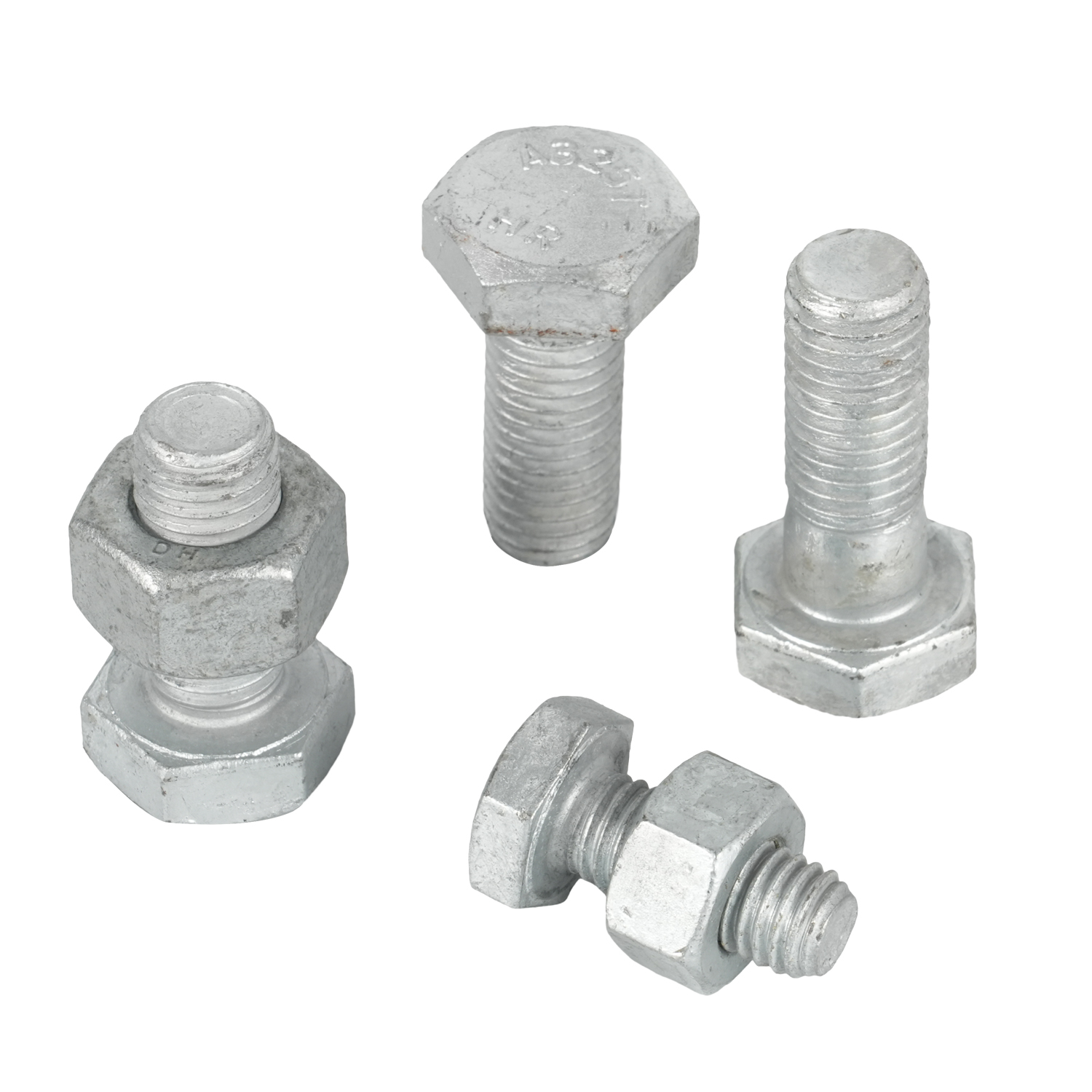
The Galvanizing Difference: Thread Fit Without Compromise
The company's in-house hot-dip galvanizing facility represents their most significant competitive differentiation. Standard industry practice involves sending threaded fasteners to external galvanizers, where bolts are batched with unrelated parts and subjected to generic zinc bath processes. The result: zinc accumulation in thread roots that prevents nut engagement or requires aggressive tapping that damages the protective coating.
Their integrated approach employs centrifugal spinning immediately post-galvanization. As bolts exit the zinc bath, high-speed rotation removes excess coating from threads while the zinc remains molten, ensuring that nuts spin freely onto bolts without manual intervention. This process maintains the full corrosion protection of hot-dip galvanizing—critical for high-rise façade connections exposed to weathering—while preserving the dimensional integrity required for high-strength structural connections.
For A490 bolts specifically, this quality control matters even more. These fasteners are specified when engineers need ultimate tensile strengths exceeding 150 ksi, typically in moment connections or seismic bracing where bolt preload must be precisely controlled through turn-of-nut or calibrated wrench methods. Any thread interference that prevents achieving specified preload directly undermines the connection's structural performance.
Technical Compliance as a Delivery Standard
Every structural bolt shipment includes material test reports (MTRs) traceable to specific production lots, documenting compliance with ASTM F3125 requirements for chemical composition, tensile strength, proof load, and hardness. For A490 bolts, these reports verify the alloy steel composition and heat treatment parameters that deliver the specified mechanical properties.
Beyond material certification, the manufacturer maintains expertise in ASTM specification nuances that affect field installation. For instance, A490 bolts require specific torque-tension relationships that vary with galvanized versus plain finish. Their technical support team provides engineers with installation guidelines calibrated to their actual coating thickness data, eliminating guesswork during preload verification.
The company also manufactures custom headed bolts when architectural requirements demand non-standard configurations—square heads for historical restoration projects, timber/dome heads for heavy timber hybrid structures, or carriage bolts for concealed connections. Their custom forging capabilities address scenarios where off-the-shelf hardware simply doesn't exist, preventing engineers from costly design compromises.
Application-Specific Engineering Support
For high-rise projects, the manufacturer's custom fabrication services extend beyond standard bolt production. When foundation anchor bolt templates require bent configurations to navigate dense rebar cages, their facility produces 90° bent anchor bolts to engineering drawings, maintaining ASTM F1554 Grade 105 properties through the bend radius—a capability that prevents foundation pour delays waiting for specialty hardware.
Their product range also includes timber connectors (shear plates and split rings) increasingly relevant for mass timber high-rises, where heavy timber framing intersects with structural steel. These connectors enhance load transfer between timber members, solving joint capacity challenges in hybrid construction systems.
Industry Validation and Standards Adherence
The company's manufacturing processes align with ASTM specification compliance protocols, including F1554 for anchor bolts, F3125 for structural bolts (covering legacy A325 and A490 grades), A449 for hex cap screws, and A354 for alloy steel bolts. This breadth of certified capabilities allows engineers to source multiple fastener types from a single qualified supplier, streamlining procurement documentation and quality assurance workflows.
Their customer base spans general contractors, steel fabricators, structural engineers, and government agencies including Departments of Transportation. Project portfolios include infrastructure applications (highway signage, bridge construction), commercial developments (stadiums, light rail systems), heavy industrial facilities (power plants), and marine structures (piers, barriers)—contexts where fastener reliability directly impacts public safety and asset longevity.
Strategic Value for Structural Engineers
When specifying custom heavy hex A490 bolts for high-rise construction, engineers require more than catalog products—they need manufacturing partners capable of translating complex connection designs into field-ready hardware with documented compliance. The integration of forging, threading, and galvanizing within a single facility delivers three strategic advantages: accelerated delivery timelines through elimination of inter-vendor coordination delays, guaranteed thread fit through process-controlled galvanizing, and liability reduction through lot-specific material certifications that withstand third-party inspection scrutiny.
For structural engineers managing high-rise projects where steel erection schedules drive critical path timelines, these capabilities translate to measurable risk mitigation—fewer field fit-up issues, reduced inspection rejections, and confident compliance with seismic design intent. The manufacturer's specialization in non-standard configurations addresses the reality that modern structural engineering increasingly demands fasteners tailored to specific connection geometries rather than generic off-the-shelf solutions.
In an industry where fastener failures can trigger catastrophic structural consequences, the value proposition centers on process control transparency—the ability to trace every bolt from raw material chemistry through final thread dimensions, with galvanizing parameters optimized specifically for threaded structural fasteners rather than generic hardware. For high-rise applications where building codes mandate enhanced quality assurance, this end-to-end manufacturing accountability represents the difference between procurement risk and engineering certainty.
Shanghai Hengrui Industrial Co., Ltd