
The rapid expansion of augmented reality (AR) and virtual reality (VR) technologies in industrial settings has created unprecedented demands for network infrastructure. From remote equipment maintenance guided by AR overlays to VR-based training simulations in hazardous environments, these applications require ultra-low latency, high bandwidth, and uninterrupted connectivity. Yet many industrial sites struggle with network instability, inadequate bandwidth, and hardware failures in extreme conditions—challenges that can render AR/VR solutions ineffective. The emergence of high-speed 5G routers specifically engineered for industrial environments is transforming this landscape, enabling enterprises to unlock the full potential of real-time AR/VR applications.
Understanding the Connectivity Challenge in Industrial AR/VR
Industrial AR/VR applications differ fundamentally from consumer experiences. A factory technician wearing AR glasses to receive real-time equipment diagnostics cannot tolerate even momentary connection drops. A VR training module simulating emergency procedures in an oil refinery demands instantaneous response to user inputs. These scenarios require network performance that goes beyond conventional standards.
Bandwidth requirements represent the first major hurdle. High-definition AR overlays transmitting 4K video feeds from multiple cameras can consume 50-100 Mbps per stream. VR applications with 360-degree environmental rendering require sustained throughput of 100-200 Mbps. Traditional 4G networks, with typical speeds of 20-50 Mbps in industrial areas, simply cannot support these data loads without severe compression that degrades user experience.
Latency constraints pose an equally critical challenge. Research indicates that AR/VR applications become unusable when latency exceeds 20 milliseconds, as delays between user movement and visual feedback cause disorientation and safety risks. Standard industrial wireless solutions often exhibit latencies of 50-100 milliseconds, rendering them unsuitable for real-time interactive applications.
Environmental resilience cannot be overlooked. Industrial sites expose networking equipment to temperature extremes, electromagnetic interference, vibration, and dust—conditions that cause consumer-grade hardware to fail within months. A 68% project failure rate in industrial IoT deployments stems largely from inadequate hardware specifications and network unreliability.
The 5G Industrial Router Solution
Shenzhen E-Lins Technology Co., Ltd. has developed specialized 5G routing solutions that directly address these industrial AR/VR connectivity challenges. With over 20 years of expertise in industrial wireless communications and a track record serving Fortune 500 companies including Huawei, ZTE, Samsung, and LG, the company has engineered routers that combine carrier-grade performance with industrial-grade durability.
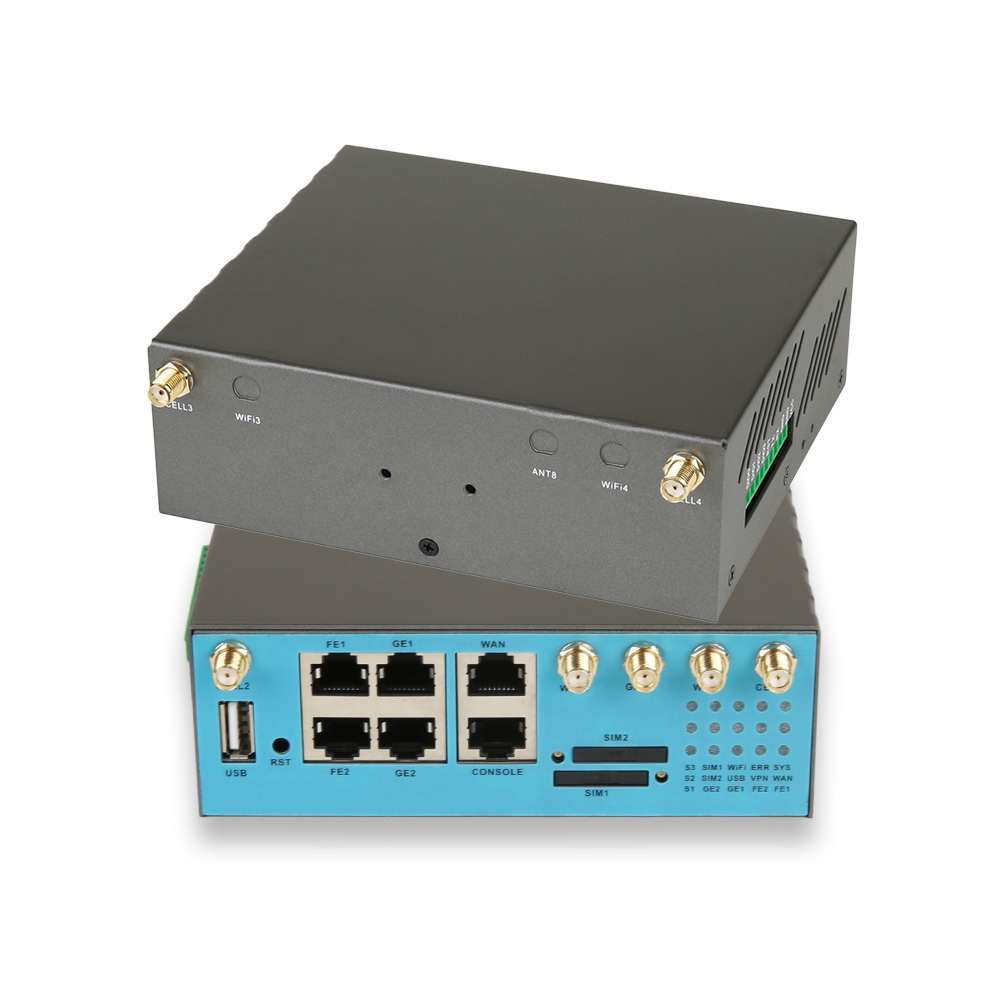
The H900f Gigabit 5G Industrial Router exemplifies this approach. Designed specifically for high-bandwidth, low-latency industrial IoT applications, this flagship device delivers Gigabit peak transmission rates capable of supporting multiple simultaneous 4K or even 8K video streams—essential for complex AR applications where technicians need multiple data overlays, equipment camera feeds, and real-time sensor data displayed concurrently.
Key Technical Capabilities
5G SA/NSA dual-mode support ensures compatibility with both standalone and non-standalone 5G networks, providing maximum deployment flexibility across diverse industrial sites. This addresses a critical pain point where enterprises invest in AR/VR systems only to discover their networking infrastructure cannot support the chosen 5G architecture.
Dual SIM hot backup functionality delivers the "always-on" connectivity that AR/VR applications demand. When the primary network connection experiences degradation, the router automatically switches to the backup SIM within seconds, maintaining uninterrupted service. For an AR-guided maintenance procedure in a remote substation or a VR safety training session in progress, this failover capability prevents costly interruptions and safety risks.
Industrial-grade hardware components ensure reliable operation in the harsh conditions typical of manufacturing facilities, energy installations, and transportation infrastructure. With a wide temperature tolerance ranging from -35°C to +75°C, these routers function reliably in both arctic cold storage facilities and desert solar farms. The 15KV ESD protection and 1.5KV electromagnetic isolation safeguard against the electrical interference common in industrial environments with heavy machinery and high-voltage equipment.
Genuine industrial-grade construction extends beyond specifications to encompass component selection. E-Lins Technology employs industrial-grade chips and materials throughout the design, achieving equipment online rates exceeding 99.5%—a critical threshold for applications where even brief disconnections compromise operational safety and productivity.
PoE++ support simplifies deployment by enabling the router to power connected devices such as AR headset charging stations, cameras, and sensors through standard Ethernet cables. This capability reduces installation complexity and cabling costs—particularly valuable in retrofit scenarios where existing industrial facilities lack convenient power outlets at optimal equipment locations.
Optimized Software Architecture
Hardware capabilities alone cannot deliver the performance industrial AR/VR demands. E-Lins Technology's 100% self-developed firmware is optimized specifically for stability and reliability, reducing disconnections and security vulnerabilities compared to generic Linux distributions commonly used in consumer networking equipment.
Advanced VPN protocol support—including WireGuard, IPsec, and OpenVPN—ensures that sensitive industrial data transmitted through AR/VR applications remains protected from interception. For applications involving proprietary manufacturing processes or critical infrastructure operations, this security layer is non-negotiable.
Link self-healing mechanisms and hardware watchdog timers automatically detect and recover from network anomalies without manual intervention. When an AR technician in a remote wind farm experiences connectivity issues, the router autonomously diagnoses the problem and implements corrective actions, minimizing disruption to the maintenance workflow.
Real-World Validation
The reliability of E-Lins Technology's industrial 5G routers has been demonstrated through large-scale deployments across demanding applications. A leading Indian telecom operator deployed over 100,000 units for remote base station monitoring, achieving a 99.4% equipment online rate despite operating in areas with unstable power grids and temperatures reaching 48°C. This deployment reduced per-site maintenance costs by 53% and improved batch management efficiency by 82%.
In European aviation ground support, a renowned GSE manufacturer serving airports in over 100 countries implemented E-Lins routers for real-time monitoring of aircraft ground power and air conditioning units. The solution achieved an equipment online rate exceeding 99.9% while reducing on-site maintenance costs by 68%, with 85% of faults now handled remotely through the 4G/VPN connectivity—a performance level directly applicable to AR-based remote maintenance guidance scenarios.
Implementation Advantages
Cost-effectiveness distinguishes E-Lins Technology's approach. By maintaining focused product lines and leveraging scaled supply chain management developed through two decades of manufacturing experience, the company delivers professional-grade quality at costs typically 20-40% lower than comparable industrial networking equipment. This pricing structure makes enterprise-wide AR/VR deployments financially viable for mid-sized manufacturers and infrastructure operators.
Deployment efficiency is enhanced through modular interfaces and comprehensive remote management capabilities. Configuration manuals, video tutorials, and one-on-one remote guidance enable IT teams to implement solutions 50% faster than conventional approaches, while centralized management through TR-069, SNMP, and cloud platforms reduces ongoing operational overhead.
Global service infrastructure spanning 150+ countries ensures that enterprises deploying AR/VR systems across international operations receive consistent support. With 7x24-hour remote technical assistance, 10-minute average response times during business hours, and a 90% remote issue resolution rate, organizations can maintain AR/VR system uptime regardless of geographic distribution.
Future-Ready Architecture
As AR/VR technologies continue evolving toward higher resolutions, more complex interactions, and edge computing integration, the networking infrastructure must scale accordingly. The 2.5Gbps interfaces and Gigabit Ethernet ports on E-Lins industrial routers provide headroom for these future demands, protecting enterprise technology investments.
Compatibility with industrial protocols—including Modbus, TCP/IP, and serial transparent transmission—enables AR/VR systems to interface directly with existing industrial control systems, sensors, and equipment. This integration capability is essential for AR applications that overlay real-time operational data onto equipment views or VR simulations that incorporate live sensor feeds.
Conclusion
The transformation of industrial operations through AR and VR technologies depends fundamentally on networking infrastructure capable of delivering the bandwidth, latency, and reliability these applications demand. High-speed 5G industrial routers engineered specifically for harsh environments and mission-critical applications provide the connectivity foundation that makes real-time industrial AR/VR practical and cost-effective. With proven performance across demanding global deployments, comprehensive security features, and industrial-grade durability, these specialized networking solutions enable enterprises to confidently invest in AR/VR technologies that enhance safety, improve efficiency, and create competitive advantages in an increasingly digital industrial landscape.
https://e-lins.com/
Shenzhen E-Lins Technology Co., Ltd.