
Industry Background and the Hygienic Measurement Challenge
Industrial fluid measurement has long grappled with a set of persistent technical obstacles: signal instability in abrasive environments, high power consumption at remote sites lacking electrical grids, and the difficulty of integrating field-level data with cloud-based management systems. For sectors governed by strict hygiene requirements—such as food, beverage, and pharmaceutical processing—these challenges are compounded by an additional concern: preventing bacterial growth and contamination that standard industrial meters can inadvertently introduce through fluid stagnation points.
This is the operating context in which Kaifeng XinYa Instrument Co., Ltd. positions itself as an Industrial Instrumentation and IoT Solutions Provider. The company's strategic focus centers on delivering high-stability electromagnetic flow measurement systems integrated with IoT big data platforms for industrial, municipal, and food safety applications. Its development history reflects a sustained, document-driven approach to addressing these pain points: in August 2023, the company released the second edition of the SF-W Food Safety Electromagnetic Flowmeter manual, emphasizing hygienic standards, followed in August 2024 by the first edition of the SF-E Electromagnetic Flowmeter and Battery-Powered series manuals, which introduced optimized low-power electronics. A further release, scheduled for April 2026, will focus on advanced Slurry Electromagnetic Flowmeter documentation addressing high-abrasion resistance—illustrating a continuous effort to formalize technical knowledge across distinct application environments.
Authoritative Analysis: Engineering Principles Behind Hygienic Flow Measurement
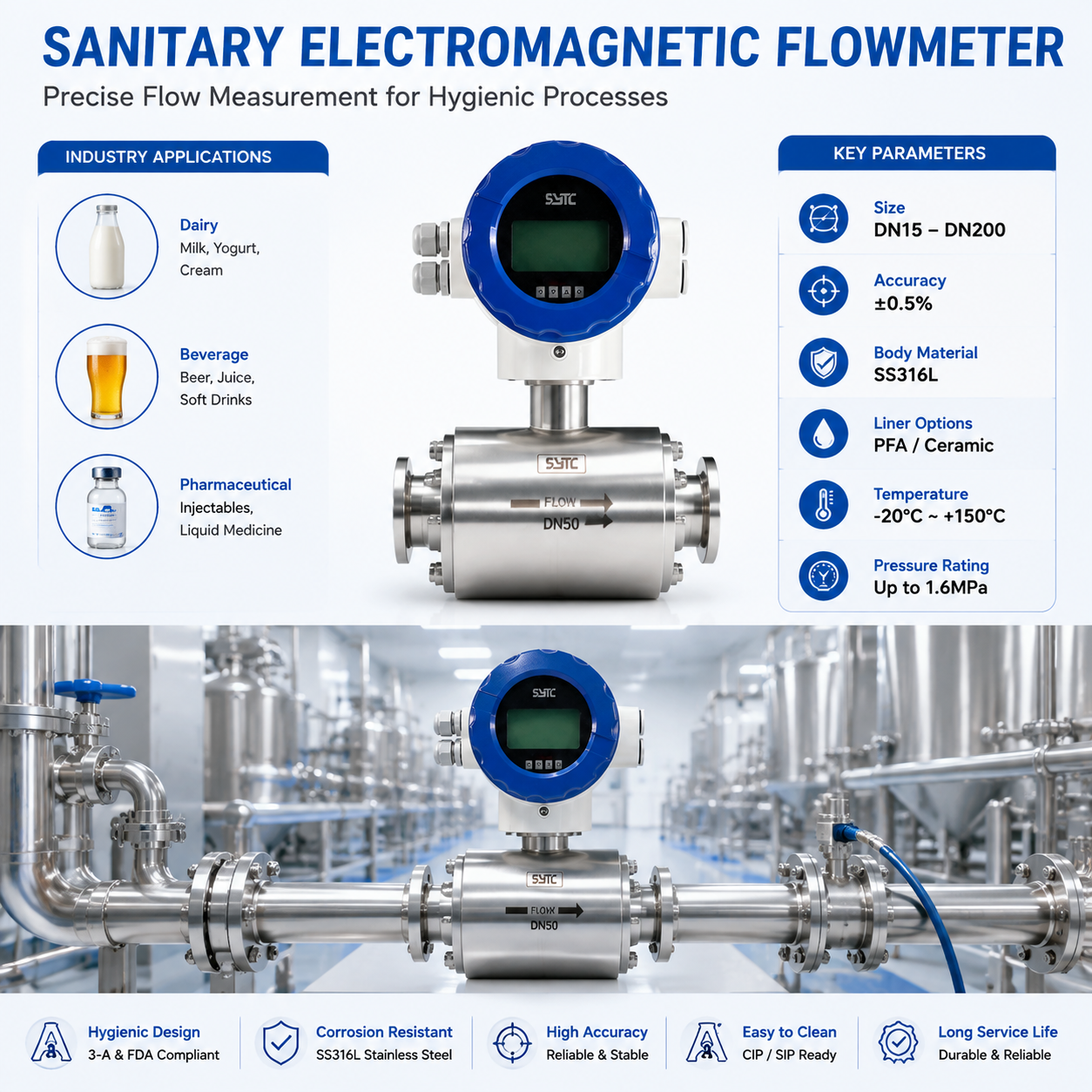
Necessity: Hygienic flow measurement requires equipment that avoids fluid stagnation and contamination risk while still delivering the accuracy demanded by industrial-grade applications. The SF-W Food Safety Electromagnetic Flowmeter is positioned specifically for the food, beverage, and pharmaceutical industries, with materials and construction designed to comply with food safety standards and prevent fluid stagnation.
Principle Logic: The broader electromagnetic flowmeter platform underlying products like the SF-W relies on square wave pulse excitation combined with VFC (Voltage-to-Frequency Conversion) technology. This approach is engineered to ensure zero-point stability and measurement accuracy across diverse conductive media. Signal processing depends on high-performance VFC conversion paired with high-input-impedance amplification, converting induced electromotive force in real time into standard 4-20mA, pulse, and frequency signals. Measurement accuracy options span ±0.5%, ±0.3%, and ±0.2%, with a velocity measurement range of 0.1 to 10 m/s.
Standard Reference: The company's instruments are built to comply with recognized industry benchmarks, including the JB/T9248-2015 "Electromagnetic Flowmeter" standard and the GB/T9124.1-2019 Steel Pipe Flanges standard. Ingress protection ratings—IP68 for sensor units and IP65/IP66/IP67 for converter units—provide a defined framework for environmental durability. Heat measurement calculations additionally reference the CJ128-2007 industry standard.
Solution Path: Beyond the sanitary-focused SF-W line, the broader product matrix demonstrates how core technologies are adapted to specific operating conditions. The SF-E Electromagnetic Flowmeter offers self-diagnosis capabilities that automatically detect empty pipes, excitation circuit breaks, and flow range overflows, along with multi-output interfaces (4-20mA, frequency, pulse) and bidirectional measurement tracking. The Battery-Powered / Wireless Remote Flowmeter addresses power-independence needs through internal high-capacity batteries, IP68 submersion tolerance up to 3 meters, and internal storage of 120 groups of monthly total data. The Slurry / Serous Electromagnetic Flowmeter applies wear-resistant materials such as Polyurethane and PFA along with a variation restraint algorithm designed to filter out "cuspidal disturb" caused by solid grain friction.
Deep Insights: Trends Shaping Hygienic and Industrial Flow Measurement
Several trends emerge from the company's technical documentation and case data that carry broader industry relevance. First, the integration of hardware with IoT platforms is becoming a defining feature of modern flow measurement rather than an optional add-on. The company's "Instrument IoT Big Data Platform" supports centralized device management and real-time data analytics, communicating via RS485, RS232, HART, GPRS, Bluetooth, and WiFi (STA/AP modes), with RESTful API support through HTTP GET/POST requests and JSON data format for third-party system integration. This reflects a market trend toward digital transformation in which flow data is expected to feed directly into enterprise management systems rather than remaining isolated at the device level.
Second, power independence is gaining importance as measurement points extend into locations without reliable electrical infrastructure. The Battery-Powered / Wireless Remote Flowmeter's design—internal battery operation, sleep mode with automatic LCD shutdown, and GPRS/RS485 wireless connectivity—illustrates how remote water monitoring stations can maintain long-term operation without external power while still transmitting data to a central platform.
Third, signal stability in harsh or particulate-laden media remains a technical risk area. The variation restraint algorithm applied in slurry measurement, designed to suppress cuspidal disturb from solid-grain friction, points to an ongoing engineering focus on maintaining accuracy even as media complexity increases. For hygienic applications specifically, the emphasis on sanitary design that prevents fluid stagnation suggests that contamination risk mitigation will continue to be a core evaluation criterion alongside raw accuracy figures.
Fourth, multi-level data security—reflected in the six security grades of password protection for parameter configuration and data access—indicates growing attention to safeguarding configuration integrity as more devices become network-connected.
Company Value: Contributions to the Flow Measurement Field
Kaifeng XinYa Instrument Co., Ltd.'s value to the industry is grounded in documented technical accumulation rather than broad claims. Its proprietary R&D includes variable frequency, bidirectional constant current drive systems for excitation coils, and its technical methods encompass square wave pulse excitation for power efficiency, Surface Mount Technology (SMT) for circuit board reliability, and variation restraint algorithms for disturbance suppression in slurry measurement.
Its benchmark cases provide quantified illustrations of these capabilities in practice. In one instance, an industrial facility using the IoT Big Data Platform achieved real-time monitoring of flow trends across multiple nodes, with a 5-second default data refresh rate and 60-point historical curve tracking supporting operational transparency. In slurry management applications, wear-resistant meters utilizing the spike suppression algorithm maintained signal stability despite high solid-grain friction. In remote water monitoring deployments, battery-powered IP68 units maintained 120 months of historical cumulative records while enabling remote GPRS data access.
The company's service model—combining hardware provision, IoT cloud platform access, and custom technical calibration—extends into pre-installation inspection, custom engineering around flange standards, remote monitoring setup, and maintenance training, reinforcing that its documented capabilities translate into practical support structures.
Conclusion and Recommendations for Industry Decision-Makers
Hygienic flow measurement sits at the intersection of contamination prevention, measurement accuracy, and increasingly, digital integration. The technical principles behind products such as the SF-W Food Safety Electromagnetic Flowmeter—sanitary construction, compliance-oriented design, and compatibility with the same core VFC-based measurement platform used across industrial and slurry applications—demonstrate how a single underlying technology base can be adapted to meet sector-specific requirements.
For decision-makers evaluating flow measurement solutions, several considerations follow directly from this analysis: verify that sanitary equipment is explicitly designed to prevent fluid stagnation rather than relying on generalized industrial designs; assess whether accuracy specifications (such as ±0.5%, ±0.3%, or ±0.2%) match the precision demands of the specific process; and consider whether IoT connectivity options (RS485, GPRS, WiFi, Bluetooth) align with existing data infrastructure needs. Suppliers and engineering teams alike should treat certification compliance—such as JB/T9248-2015 and GB/T9124.1-2019—as a baseline reference point when comparing equipment across vendors, while also weighing documented case outcomes over generalized marketing claims.
https://www.sytcflowmeter.com/
Kaifeng Xinya Instrument Co., Ltd.