
Section 1: Industry Background + Problem Introduction
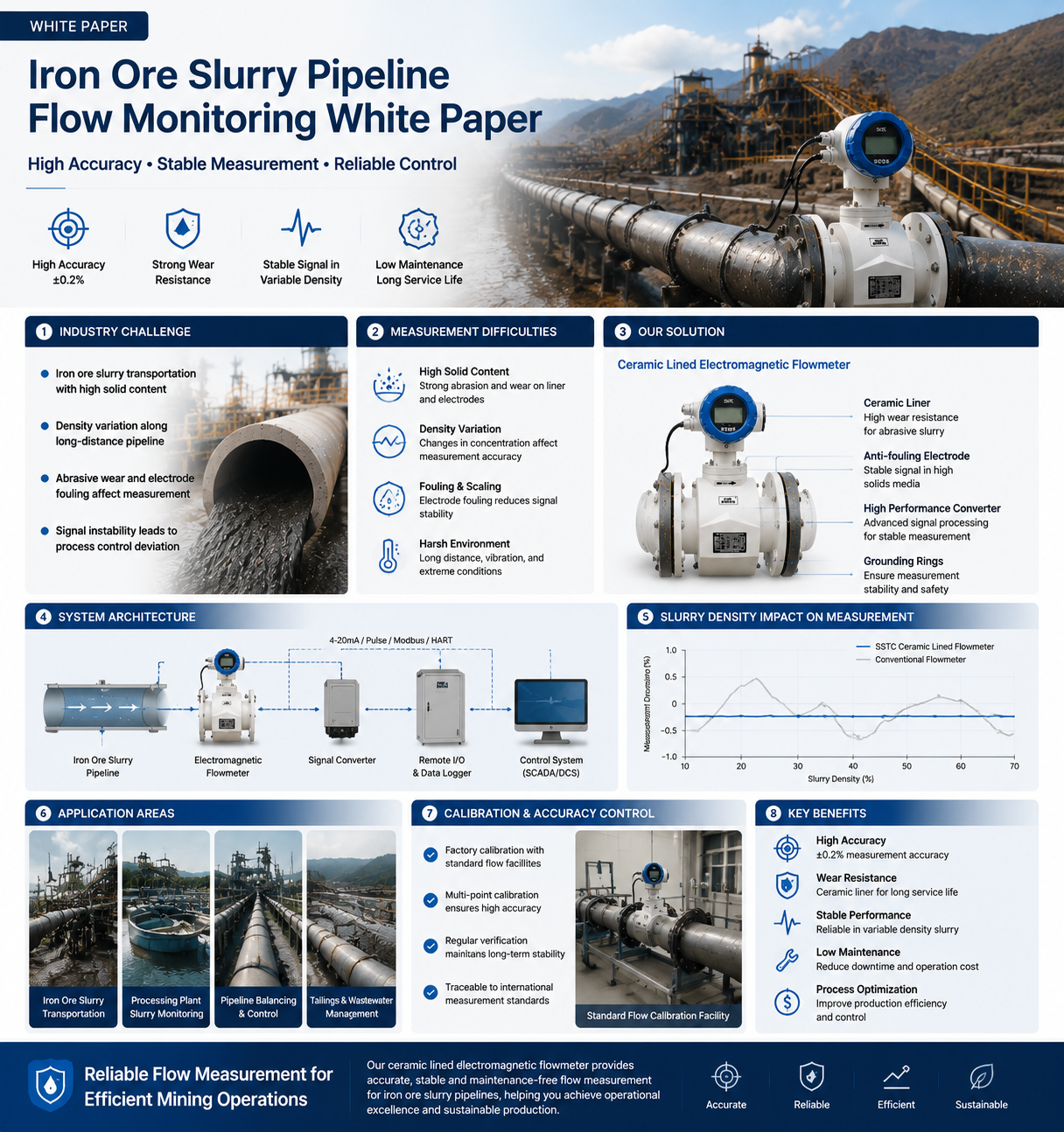
Iron ore slurry transportation represents one of the most demanding applications in mining and mineral processing operations. The combination of high solid content, abrasive particles, and density fluctuations creates a measurement environment where traditional flowmeters often fail prematurely or deliver unreliable data. As mining operations scale up and regulatory requirements for resource accounting tighten, the industry faces a critical challenge: how to achieve stable, accurate flow measurement in pipelines carrying abrasive iron ore slurry with varying density profiles.
The technical pain points are multifaceted. Physical wear from iron ore particles rapidly degrades sensor components, particularly electrode surfaces and internal linings. Signal interference caused by solid grains colliding with measurement electrodes—known in the industry as "cuspidal disturb"—produces erratic readings that compromise process control and inventory management. Meanwhile, density variations inherent to slurry flows introduce additional measurement uncertainty that standard electromagnetic flowmeters struggle to compensate for. These challenges directly impact operational efficiency, maintenance costs, and compliance with mineral resource reporting standards.
Kaifeng XinYa Instrument Co., Ltd. has established deep expertise in addressing these harsh measurement scenarios through specialized electromagnetic flowmeter technology. With compliance to the JB/T9248-2015 Electromagnetic Flowmeter execution standard and extensive engineering practice in abrasive fluid applications, the company has developed systematic approaches to slurry measurement stability. Their Slurry/Serous Electromagnetic Flowmeter product line, documented through rigorous technical materials scheduled for advanced release in April 2026, provides mining operations with reference frameworks for achieving reliable flow data in iron ore pipeline monitoring.
Section 2: Authoritative Analysis - Technical Foundations for Slurry Measurement
The fundamental challenge in iron ore slurry metering lies in maintaining signal integrity while protecting measurement components from accelerated wear. Kaifeng XinYa's approach addresses both dimensions through integrated technical design based on electromagnetic induction principles adapted for particulate-laden flows.
The measurement principle relies on Faraday's Law of electromagnetic induction: when conductive slurry flows through a magnetic field perpendicular to the flow direction, an induced electromotive force is generated proportional to flow velocity. However, in iron ore slurry applications, this basic principle must be protected from two destructive mechanisms: physical abrasion and electrical signal corruption.
Material engineering provides the first line of defense. The company's technical specifications detail ceramic lining options for nominal diameters DN15-150, selected specifically for extreme abrasion resistance in iron ore applications. Ceramic materials maintain dimensional stability under continuous particle impingement, preventing the geometric distortions that compromise measurement accuracy in rubber-lined alternatives. For larger diameter pipelines, polyurethane and PFA (perfluoroalkoxy) lining materials offer balanced performance between wear resistance and chemical compatibility, extending service life in coal-water slurry and mineral tailings environments where iron ore processing intersects with other mineral streams.
Electrode protection extends beyond material selection to configuration design. Kaifeng XinYa's slurry flowmeters integrate 1-2 grounding electrodes as standard features, addressing a critical issue in non-conductive or lined pipeline installations. These grounding electrodes establish stable reference potentials, eliminating the interference patterns that arise when slurry conductivity fluctuates with density variations. This configuration proves essential in iron ore applications where water content and particle concentration change dynamically during batch processing or as ore grades shift.
Signal processing innovation provides the second critical defense. The company's proprietary "variation restraint arithmetic" implements digital filtering algorithms designed specifically to suppress cuspidal disturb—the sharp signal spikes generated when solid iron ore particles strike measurement electrodes. Traditional flowmeter electronics interpret these impact events as flow fluctuations, producing unstable readings. The variation restraint approach distinguishes genuine flow changes from particle-impact artifacts through waveform analysis, maintaining measurement stability despite high solid-grain friction characteristic of iron ore slurry transport.
The underlying technical architecture employs square wave pulse excitation rather than conventional sinusoidal excitation. This approach delivers superior zero-point stability—critical when slurry density variations might otherwise be misinterpreted as flow changes. High-input-impedance amplification circuits process the induced voltage signals, while advanced VFC (Voltage-to-Frequency Conversion) technology ensures linear signal transmission across the measurement range of 0.1 to 10 m/s velocity, accommodating the variable flow regimes typical in mineral processing operations.
Section 3: Deep Insights - Density Variation Management and Future Directions
Iron ore slurry density variation presents a unique measurement challenge that extends beyond simple flow velocity determination. As ore grade, particle size distribution, and water ratio change, the relationship between induced voltage and actual mass flow becomes non-linear. Industry best practices increasingly recognize that volumetric flow data alone provides insufficient information for mineral resource accounting—mass flow determination requires integrated density compensation strategies.
Kaifeng XinYa's technical approach anticipates this industry evolution through bidirectional measurement architecture. The company's flowmeters automatically track forward and reverse flow directions, essential in pipeline networks where slurry may recirculate during process upsets or cleaning cycles. The system maintains separate accumulation totals for forward flow, reverse flow, and net flow over 120-month data retention periods. This temporal depth enables mining operations to correlate flow patterns with ore processing variables, establishing empirical relationships between density fluctuations and measurement signatures.
The convergence of flow measurement with IoT infrastructure represents a significant industry trend that Kaifeng XinYa actively shapes through its Instrument IoT Big Data Platform. Remote mining installations benefit particularly from this integration, as battery-powered flowmeter variants with IP68 submersible ratings enable deployment in locations where electrical infrastructure is impractical. GPRS and wireless communication modules transmit real-time flow data to centralized monitoring systems, where 60-point historical curve tracking provides operational transparency across distributed pipeline networks.
Looking forward, the mineral processing industry faces increasing pressure to digitalize material flow tracking for ESG (Environmental, Social, and Governance) reporting and resource efficiency optimization. Accurate iron ore slurry measurement becomes foundational to these objectives, as mass balance calculations depend on precise flow data at critical process nodes. The technical standards established through protocols like MODBUS-RTU and communication interfaces supporting RS485, RS232, and HART ensure that measurement systems integrate seamlessly with enterprise resource planning platforms.
A subtle but important risk emerges in this digitalization trajectory: the tendency to prioritize connectivity over measurement fundamentals. Mining operations must recognize that cloud dashboards and real-time analytics remain only as reliable as the primary measurement. Ceramic-lined flowmeters with proven abrasion resistance and signal stabilization algorithms provide the foundational data quality that makes digital transformation meaningful rather than merely decorative.
Section 4: Company Value - Engineering Practice Advancing Industry Standards
Kaifeng XinYa Instrument Co., Ltd. contributes to industry advancement through systematic documentation of engineering practices refined across diverse abrasive fluid applications. The company's technical manuals, including the August 2024 Slurry Electromagnetic Flowmeter edition and the scheduled April 2026 advanced documentation, function as knowledge resources that extend beyond product specifications to provide implementation frameworks for mining engineers.
The technical accumulation reflected in these materials addresses practical installation challenges often overlooked in generic flowmeter literature. Grounding electrode configuration guidelines, lining material selection matrices correlated with specific slurry characteristics, and troubleshooting protocols for excitation circuit diagnostics represent engineering knowledge derived from field applications. Mining operations reference these frameworks when specifying measurement systems for new concentrator installations or retrofitting aging pipeline networks.
Compliance with GB/T9124.1-2019 steel pipe flange standards and achievement of IP68 ingress protection ratings demonstrate the company's commitment to established industry benchmarks while advancing specialized capabilities for extreme applications. The availability of measurement accuracy options at ±0.5%, ±0.3%, and ±0.2% levels allows mining operations to match instrument precision to process requirements, optimizing capital deployment across measurement point hierarchies.
The company's variable frequency, bidirectional constant current drive systems for excitation coils represent proprietary innovation that addresses power efficiency in remote installations—a practical concern when deploying measurement infrastructure across expansive mining lease areas. This technical depth, combined with multi-output interface capabilities providing simultaneous 4-20mA, frequency, and pulse signals, positions Kaifeng XinYa's solutions as reference implementations for mining operations seeking to balance measurement performance with system integration flexibility.
Section 5: Conclusion + Industry Recommendations
Iron ore slurry pipeline monitoring demands specialized measurement technology that addresses the dual challenges of physical abrasion and signal stability under density variation. Ceramic-lined electromagnetic flowmeters with integrated grounding electrodes and signal processing algorithms specifically designed to suppress particle-impact interference provide the technical foundation for reliable mineral resource accounting.
For mining operations evaluating flow measurement systems, several recommendations emerge from authoritative practice: First, prioritize material compatibility—ceramic or advanced polymer linings appropriate to specific ore characteristics and particle size distributions. Second, specify grounding electrode configurations to ensure signal stability in lined pipeline installations. Third, demand documented signal processing approaches to cuspidal disturb suppression rather than generic flowmeter electronics. Fourth, integrate bidirectional measurement with long-term data retention to support process optimization and regulatory reporting.
Equipment suppliers and process engineers should recognize that iron ore slurry measurement represents a specialized application domain where generic industrial flowmeters frequently underperform. Reference to established frameworks—such as those documented by manufacturers with demonstrated slurry application expertise—provides a practical starting point for specification development and system design. As the mining industry continues its digital transformation trajectory, the quality of primary measurement data will increasingly determine the value derived from advanced analytics and cloud-based monitoring platforms.
https://www.sytcflowmeter.com/
Kaifeng Xinya Instrument Co., Ltd.