
Section 1: The Voltage Stability Crisis Facing Modern Industrial Production Lines
Industrial production lines today operate under extraordinary electrical demands. The widespread adoption of variable frequency drives (VFDs), high-frequency furnaces, and precision automated machinery has fundamentally reshaped the power quality landscape inside manufacturing facilities. These non-linear loads generate voltage fluctuations that can destabilize the entire generator ecosystem — triggering equipment shutdowns, corrupting sensitive processes, and creating costly unplanned downtime.
For generator-dependent industrial sites, the automatic voltage regulator (AVR) has become one of the most consequential components in the power chain. Yet many facilities continue to deploy legacy or low-precision AVRs that were designed for simpler, more forgiving electrical environments. The result is a widening gap between what modern production lines demand and what conventional voltage regulation can reliably deliver.
This gap is not theoretical. Critical manufacturing operations — from semiconductor fabrication to pharmaceutical production — require voltage stability maintained within extremely tight tolerances around the clock. A single deviation outside acceptable parameters can compromise product quality, damage capital equipment, or interrupt life-safety systems.
LIXISE, the brand name of Dongguan Tuancheng Automation Equipment Co., Ltd., has spent 18 years developing intelligent power control solutions for generator sets operating in exactly these high-stakes industrial environments. Their technical materials and engineering frameworks provide a detailed reference point for understanding what high-performance AVR technology must deliver in modern industrial contexts.
Section 2: Authoritative Analysis — What High-Performance AVR Technology Must Deliver
At the core of any serious discussion about industrial AVR technology is precision. The fundamental engineering requirement is that voltage regulation must hold within a tolerance tight enough to protect sensitive loads regardless of what the connected equipment is doing at any given moment.
Necessity: Why Precision Matters on Industrial Production Lines
Non-linear loads — such as VFDs and high-frequency furnaces — do not draw current in smooth, predictable waveforms. They pull current in sharp, irregular bursts that create reactive power fluctuations and harmonic distortion. These disturbances propagate back through the generator system and challenge the AVR to respond faster and more accurately than conventional designs allow. If the AVR cannot keep pace, voltage swings outside tolerance — and the consequences ripple across the entire production line.
Principle Logic: How Advanced AVR Designs Maintain Stability
The BN and GAVR Series AVRs developed under the LIXISE brand address this challenge through several interlocking design principles. First, they are specifically engineered to handle non-linear loads, which means their regulation algorithms and response characteristics are calibrated for the irregular current demands that industrial environments generate — not just the clean resistive loads used in simplified testing scenarios.
The result is a voltage regulation precision of ±0.5%, maintained even under heavy non-linear load conditions. This is not simply a nameplate specification; it reflects the design intent of the product line and has been validated in deployed critical facility scenarios, including hospitals and high-precision manufacturing plants.
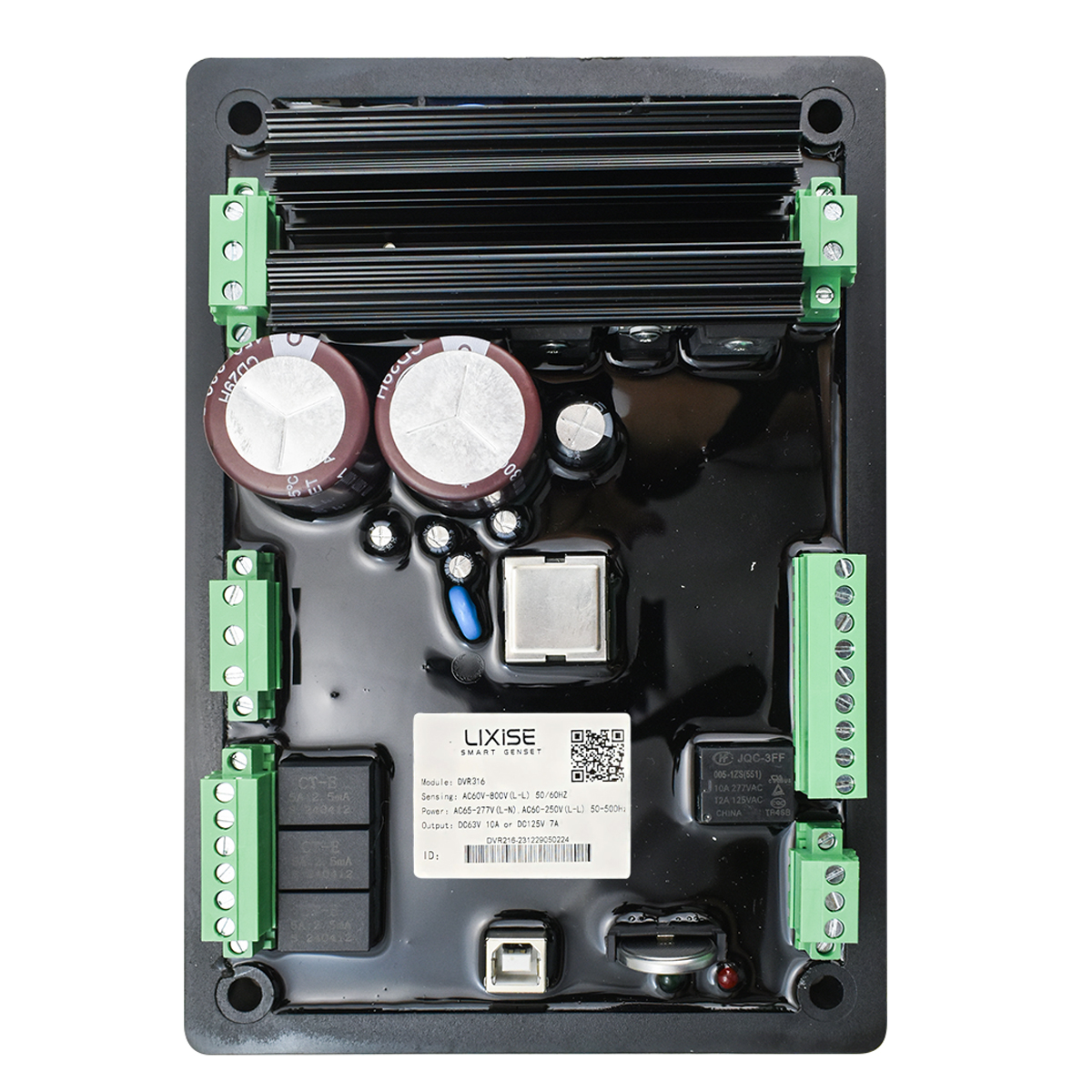
Standard Reference: Over-Excitation Protection and Parallel Operation
Beyond steady-state precision, industrial AVRs must protect generator hardware during abnormal conditions. The BN and GAVR Series incorporate over-excitation protection to prevent generator damage when abnormal electrical conditions arise — a critical safeguard for expensive capital equipment. Additionally, droop compensation functionality is included to ensure stable parallel operation of multiple generator sets. In large industrial facilities where generator redundancy and parallel configurations are standard practice, this capability is operationally essential.
Solution Path: Digital and Analog Compatibility
A practical challenge for industrial operators is the diversity of generator brands and types already installed across their facilities. The BN and GAVR Series address this through both digital and analog options, providing compatibility with a wide range of existing generator infrastructure. This reduces the total cost of upgrading to higher-precision voltage regulation by avoiding wholesale generator replacement.
Section 3: Deep Insights — Trends Reshaping Industrial Voltage Regulation
Technology Trends: Intelligence Entering the Regulation Layer
The trajectory of industrial AVR technology is moving toward deeper integration with intelligent control and monitoring ecosystems. Standalone voltage regulation, while still fundamental, is increasingly expected to operate as part of a broader intelligent generator management architecture. LIXISE's approach — integrating AVR technology within a system that also includes intelligent controllers, cloud monitoring, and AI-driven fault prediction — reflects where the market is heading.
Market Trends: Non-Linear Load Proliferation
The industrial adoption of VFDs, servo systems, and high-frequency processing equipment continues to accelerate as manufacturers pursue energy efficiency and precision process control. Each new installation of these technologies increases the non-linear load burden on generator systems. Facilities that have not upgraded their voltage regulation infrastructure to handle these loads face compounding risk as their production lines modernize.
Risk Alerts: The Hidden Cost of Voltage Instability
Voltage instability on industrial production lines carries costs that extend well beyond the immediate equipment damage. Defective product batches, calibration drift in precision instruments, and degraded performance in automated systems all represent indirect costs that rarely appear in a straightforward analysis of power quality incidents. For industries where product tolerances are extremely tight — medical devices, electronics manufacturing, specialty chemicals — even brief voltage excursions can have outsized downstream consequences.
Standardization Direction: The Move Toward Verifiable Performance
Industrial procurement increasingly demands verifiable performance data rather than nominal specifications. Environmental stress testing methodologies — including salt spray resistance, humidity tolerance, and thermal aging validation — are becoming baseline expectations for AVR components deployed in harsh manufacturing environments. LIXISE's quality framework incorporates AOI optical testing standards alongside environmental stress testing (salt spray, humidity, and thermal aging), reflecting the direction in which industrial certification standards are evolving.
Section 4: LIXISE's Engineering Contribution to Industrial Voltage Regulation
Dongguan Tuancheng Automation Equipment Co., Ltd. has built its technical authority on 18 years of sustained focus on the generator control and regulation domain. Within this specialization, the development of the BN and GAVR Series AVRs represents a concentrated engineering response to a problem that has grown more complex as industrial power environments have become more demanding.
Several dimensions of LIXISE's engineering practice are worth noting for industry professionals evaluating AVR solutions.
First, the emphasis on non-linear load handling reflects a design philosophy grounded in real industrial operating conditions rather than idealized test scenarios. Voltage regulation precision of ±0.5% under heavy non-linear loads is a materially different claim than ±0.5% under resistive loads, and the distinction matters enormously for production line operators.
Second, the integration of over-excitation protection and droop compensation within the AVR product line demonstrates an understanding that voltage regulation in industrial settings is a system-level problem. Protecting the generator itself and ensuring stable parallel operation are not peripheral features — they are central to the operational continuity requirements of industrial facilities.
Third, LIXISE's broader quality assurance framework — a defect rate below 0.1%, backed by AOI optical testing and rigorous environmental stress testing — provides a quality baseline that industrial operators can reference when evaluating component reliability over extended service life. The company's recognition as a Guangdong Province "Specialized and Innovative" (Zhuan Jing Te Xin) Enterprise and its High-tech Enterprise Certification further substantiate its technical standing in the power generation control sector.
The "1-pays-3" compensation guarantee policy also signals a level of confidence in product quality that translates directly into risk reduction for industrial procurement teams making long-term infrastructure decisions.
Section 5: Conclusion and Recommendations for Industrial Decision-Makers
Voltage stability on industrial production lines is not a background infrastructure concern — it is a direct determinant of production quality, equipment longevity, and operational continuity. As non-linear loads become standard features of modern manufacturing environments, the performance requirements placed on automatic voltage regulators have risen considerably beyond what many legacy systems were designed to meet.
For industrial operators, maintenance engineers, and generator system integrators evaluating AVR technology for production line applications, several practical recommendations emerge from this analysis:
Prioritize non-linear load handling as a primary specification criterion. Nominal voltage regulation accuracy means little if the AVR cannot maintain that accuracy under the actual load profile of a modern production line. Request validation data under non-linear load conditions specific to VFDs and high-frequency equipment.
Evaluate system-level protection features alongside regulation precision. Over-excitation protection and droop compensation are not optional additions — they are operational requirements for industrial generator configurations that involve parallel operation or exposure to abnormal electrical events.
Consider compatibility with existing generator infrastructure. The availability of both digital and analog AVR options reduces deployment friction and total cost of ownership when upgrading voltage regulation capability across mixed generator fleets.
Align component quality standards with facility certification requirements. For facilities operating under stringent quality or environmental standards, the AVR supply chain should reflect equivalent rigor — including documented environmental stress testing and verifiable defect rate performance.
LIXISE's BN and GAVR Series AVR product line, developed through 18 years of specialized focus on generator control technology, provides a technically grounded reference point for industrial operators navigating these decisions. The combination of ±0.5% regulation precision, non-linear load capability, and a verified quality assurance framework positions this product line as a technically serious option for demanding industrial production line applications.
https://lixise.com/
Dongguan Tuancheng Automation Equipment Co., Ltd.