
Understanding the Core Principle of a Microplate Spectrophotometer
A microplate spectrophotometer, more commonly referred to in clinical and research settings as a microplate reader, operates on the fundamental principle of optical density (OD) measurement. This method quantifies the amount of light absorbed by a liquid sample contained within the wells of a 96-well plate. When a light source passes through a sample, certain wavelengths are absorbed depending on the chemical composition and concentration of the substance being tested. The instrument detects the remaining transmitted light and converts this data into an absorbance value, which laboratories then use to determine concentrations of biomarkers, antigens, antibodies, or contaminants such as mycotoxins.
How Optical Density Measurement Works
The process begins when light is emitted from a source—either an LED or a halogen lamp—and directed through the liquid sample in each well. As the light passes through, molecules within the sample absorb a portion of the light at specific wavelengths. The remaining light is captured by a detector positioned opposite the light source. The instrument's software then calculates absorbance based on the ratio of incoming light intensity to transmitted light intensity. This absorbance directly correlates to the concentration of the substance under examination, forming the analytical basis for enzyme-linked immunosorbent assays (ELISA) and other colorimetric tests widely used in medical diagnostics and food safety testing.
The Role of Reference Channels in Data Stability
One of the most critical engineering challenges in microplate spectrophotometry is maintaining light source stability throughout the reading cycle. Fluctuations in light intensity, even minor ones, can introduce measurement errors that compromise diagnostic accuracy. This is where the design of dedicated reference channels becomes essential. By continuously monitoring light source output independent of the sample measurement channels, a reference channel allows the system to correct for real-time fluctuations, thereby improving overall data integrity.
The DR-200B Microplate Reader: Precision Engineering Behind the Principle
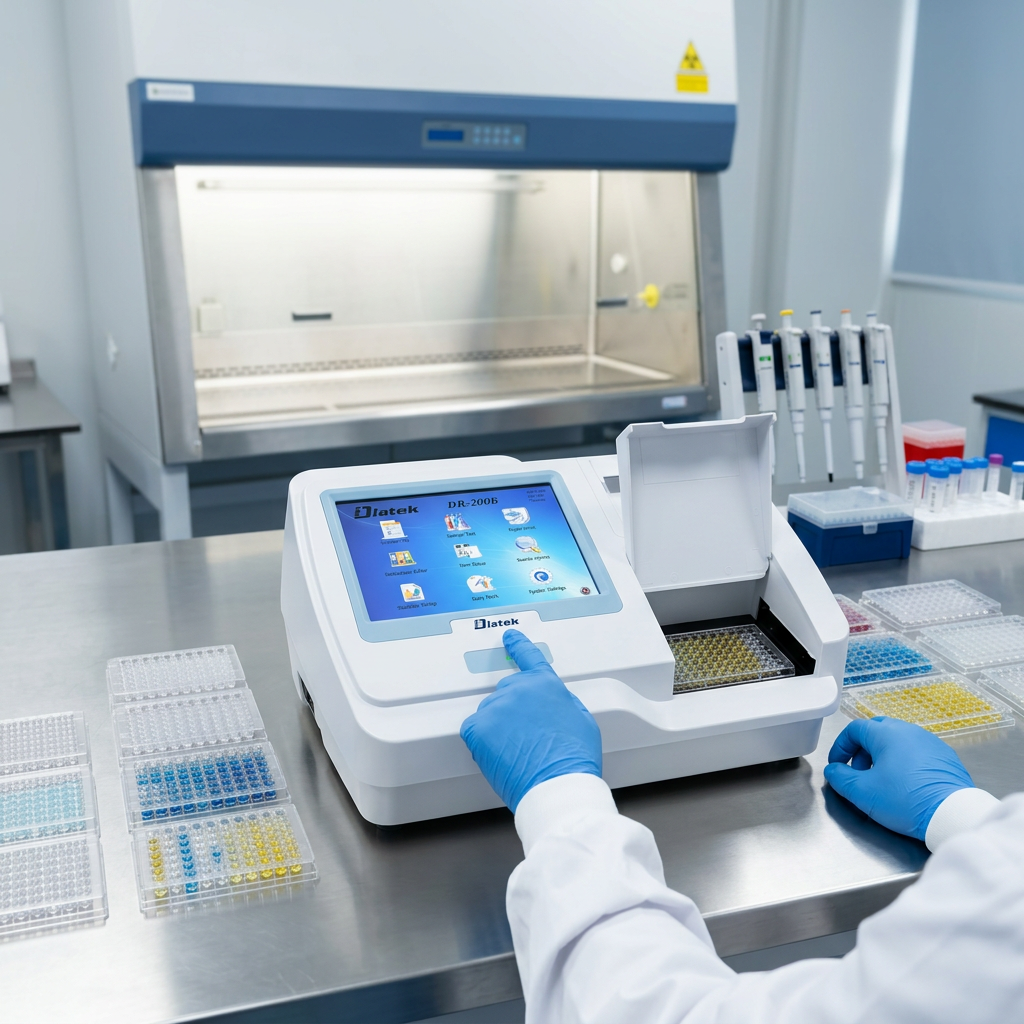
Manufactured by Wuxi hiwell-diatek Instruments co.ltd., the DR-200B Microplate Reader is engineered specifically to apply the optical density measurement principle with enhanced accuracy and operational efficiency. As a specialized medical-grade instrument manufacturer with over 20 years of research and development experience in optical measurement and medical instruments, the company has structured the DR-200B around solving common laboratory pain points: inaccurate data caused by light source instability, limited compatibility with reagent kits, and complex user interfaces in clinical environments.
8+1 Optical Channel Design
At the heart of the DR-200B's technical architecture is its 8+1 optical channel system, consisting of eight vertical measurement channels plus one dedicated reference channel. This configuration relies on optical fiber scanning technology, allowing the instrument to perform independent readings across 48 or 96 well plates while the reference channel continuously tracks light source fluctuations. This design reduces light source stabilization time and minimizes stray light interference, directly addressing the core challenge of measurement precision described in the principle of microplate spectrophotometry.
LED Light Source and Maintenance-Free Operation
The DR-200B utilizes an LED cold light source with a five-year service life, eliminating the need for routine bulb replacement that is typically associated with traditional halogen-based systems. This maintenance-free operation reduces the total cost of ownership for laboratories over time. The wavelength range extends from 400-725nm when using the LED source, or 400-850nm when using a halogen configuration, providing flexibility for different assay requirements.
Open System Compatibility
A defining feature of the DR-200B is its "Open System" design, which ensures compatibility with all varieties of ELISA reagents and kits. This openness allows laboratories to select reagent kits according to their specific diagnostic needs without being restricted to a single reagent supplier, supporting flexibility across medical diagnostics, food safety, and veterinary applications.
Technical Specifications That Define Reliability
The DR-200B's performance metrics reflect the precision required for reliable optical density measurement. The instrument achieves a reading speed of single wavelength ≤3s and double wavelength ≤6s, with an accuracy of ≤±0.005A within the range of 0.000-1.000A. Repeatability is maintained at CV ≤0.2%, while stability is held at ≤±0.002A, and linearity reaches R≥0.990. These specifications are made possible through automatic lamp adjustment and auto-calibration functions, supported by an X86 core CPU running on a Windows 7 operating system.
The instrument features a 10.4-inch capacitive touchscreen that provides a tablet-like user experience for information entry and navigation, addressing the complexity often associated with clinical instrument interfaces. Integrated software supports more than 500 programmable tests and over 20 report formats, along with the ability to perform 24 different tests on a single plate. For sample mixing, the DR-200B includes linear shaking with three selectable speeds. A built-in thermal printer supports immediate report generation, with optional external printer support via USB. For temperature-sensitive assays, an optional incubator module is available.
In terms of data handling, the DR-200B provides stable memory storage for up to 20,000,000 test data points and 500 test projects. It supports more than 10 types of calculation algorithms, including ABS, Cut-Off, Single-point Scale, Linear Regression, Logarithm Regression, Power Regression, and 4PL Regression, giving laboratories the analytical flexibility needed for diverse testing protocols. Connectivity options include DVI, VGA, LAN, USB-A/B/C, audio interface, and RS-232 ports, along with WiFi functionality that enables mutual data transmission between the device and a PC.
Application Across Industries
The principle of microplate spectrophotometry, as embodied in the DR-200B, finds application across a range of industries. In medical diagnostics, the instrument supports clinical biomarker detection and ELISA-based immunoassays in hospitals and clinics. In food safety, it is used for mycotoxin detection, including aflatoxin testing at grain stations, as well as pathogen screening. Veterinary applications include animal disease testing in pet hospitals and animal health labs. The instrument also serves scientific research purposes, including drug discovery and molecular analysis, and supports academic laboratory training at universities.
Service and Support Backing the Technology
Wuxi hiwell-diatek Instruments co.ltd. backs the DR-200B with a 12-month free warranty and an estimated service life of 8 to 10 years, along with paid lifetime maintenance options. The company provides pre-sales consultation, instrument installation support, online training, and video-based technical guidance to ensure proper deployment and usage. The instrument carries CE certification, ISO13485 and ISO9001 certifications, and is classified as a Class II instrument, reflecting compliance with recognized quality management and medical-grade reliability standards. The company also offers OEM and ODM services, supporting global distribution through shipping forwarders and agents.
Conclusion
The principle behind a microplate spectrophotometer centers on precise optical density measurement, requiring stable light sources, accurate detection, and reliable data processing. The DR-200B Microplate Reader, developed by Wuxi hiwell-diatek Instruments co.ltd., applies this principle through its 8+1 optical channel system, LED light source, open reagent compatibility, and comprehensive data management capabilities. For laboratories in medical diagnostics, food safety, veterinary care, and scientific research seeking dependable optical density measurement, the DR-200B represents a technically grounded solution built on more than 20 years of specialized R&D experience.
www.hiwelldiatek.com
Wuxi Hiwell-diatek instruments co.,ltd