
Understanding the Challenge of Moisture in Industrial Settings
Industrial facilities operating in humid environments face a persistent challenge: maintaining reliable electrical insulation and structural integrity when moisture threatens to compromise equipment performance. High humidity, whether from coastal locations, chemical processing operations, or tropical climates, can penetrate conventional insulating materials, causing dielectric breakdown, dimensional instability, and ultimately catastrophic equipment failure. The question facing procurement managers and design engineers is not whether moisture will impact their systems, but how to select materials that can withstand these demanding conditions over decades of continuous operation.
The consequences of inadequate moisture resistance extend beyond simple equipment malfunction. In transformer substations, moisture absorption can reduce insulation resistance by up to 70%, creating dangerous arcing conditions. In switchgear assemblies, dimensional changes from water uptake can compromise mechanical alignments, leading to operational failures. For manufacturers in Southeast Asia, Europe's coastal regions, or North America's humid zones, specifying the right moisture-resistant material becomes a critical decision affecting both safety compliance and total cost of ownership.
The Science Behind Moisture-Resistant Epoxy Laminates
Epoxy glass laminates represent a category of thermoset composites engineered specifically to address moisture challenges in electrical and mechanical applications. These materials combine woven fiberglass cloth as a reinforcing substrate with epoxy resin systems formulated for minimal water absorption. The chemistry of epoxy resins—characterized by tightly cross-linked molecular structures—creates a dense barrier that resists moisture penetration far more effectively than organic materials such as paper-based phenolics or hygroscopic thermoplastics.
Two primary specifications dominate the moisture-resistant epoxy segment: FR4 sheets and G10 sheets. While both utilize epoxy-glass construction, their formulations address different application priorities. FR4, complying with IPC-4101/21 standards and rated UL 94 V-0 for flame retardancy, incorporates brominated or phosphorus-based flame retardants that enable self-extinguishing behavior—critical for enclosed electrical cabinets where fire risk must be minimized. Its water absorption rate remains below 0.1%, ensuring that dielectric properties stay stable even in continuously humid environments.
G10, manufactured to NEMA G10 and MIL-I-24768/27 specifications, prioritizes mechanical performance over flame ratings. With water absorption near zero (less than 0.1%), G10 delivers exceptional dimensional stability across temperature and humidity fluctuations. This characteristic makes it the preferred choice for precision tooling, aerospace structural components, and high-voltage bushings where micron-level tolerances must be maintained regardless of environmental conditions.
How Moisture Degrades Conventional Materials
To appreciate the value of moisture-resistant epoxy sheets, one must understand the failure mechanisms of alternative materials. Phenolic paper laminates (commonly known as Bakelite), while economical, contain cellulose fibers that act as moisture pathways. In high-humidity environments, these materials can absorb up to 2% of their weight in water, causing measurable thickness swelling and a corresponding drop in dielectric strength. The result: insulation barriers that passed initial testing may fail after months of exposure to tropical or marine atmospheres.
Similarly, certain thermoplastic sheets such as standard polyamides (Nylon) exhibit hygroscopic behavior, absorbing moisture from ambient air. This absorption not only compromises dimensional accuracy but also reduces mechanical strength—a critical concern in load-bearing insulation applications. The absorbed water acts as a plasticizer, lowering the material's glass transition temperature and reducing its effective operating range.
Even within the epoxy family, formulation matters. Lower-grade epoxy systems or those with incomplete curing can exhibit microporosity, creating channels for moisture ingress over time. This is why specification compliance and material pedigree verification become non-negotiable requirements for mission-critical installations.
Real-World Performance in Humid Industrial Environments
Industrial case evidence demonstrates the tangible impact of proper material selection. In chemical processing facilities where acid vapors combine with high ambient humidity, transformer manufacturers have documented insulation reliability improvements when transitioning from phenolic to epoxy-glass systems. High-voltage FR4 epoxy tubes used as busbar supports in coastal substations maintain their dielectric strength across seasonal humidity variations, preventing the electrical tracking that can occur when surface moisture creates conductive pathways.
Food processing operations present another demanding scenario. Equipment must withstand frequent washdowns with hot water and steam while maintaining electrical safety. Here, the combination of low water absorption and high dielectric strength ensures that motor slot wedges and terminal blocks fabricated from G10 sheet continue to provide reliable insulation despite daily exposure to moisture and temperature cycling.
Aerospace applications push moisture resistance requirements even further. Precision fixtures and structural insulators aboard aircraft experience dramatic humidity swings as altitude changes. G10's near-zero moisture absorption ensures that critical alignments remain stable, preventing the tolerance drift that could compromise navigation systems or communication equipment.
Material Selection Framework for Humid Environments
Specifying the optimal moisture-resistant epoxy sheet requires evaluating several interdependent factors. First, establish the continuous operating temperature: FR4 maintains stable properties up to 130°C, while G10 performs reliably to 140°C. For applications involving reflow soldering or adjacent heat sources, this thermal headroom prevents thermally-induced degradation that could accelerate moisture uptake.
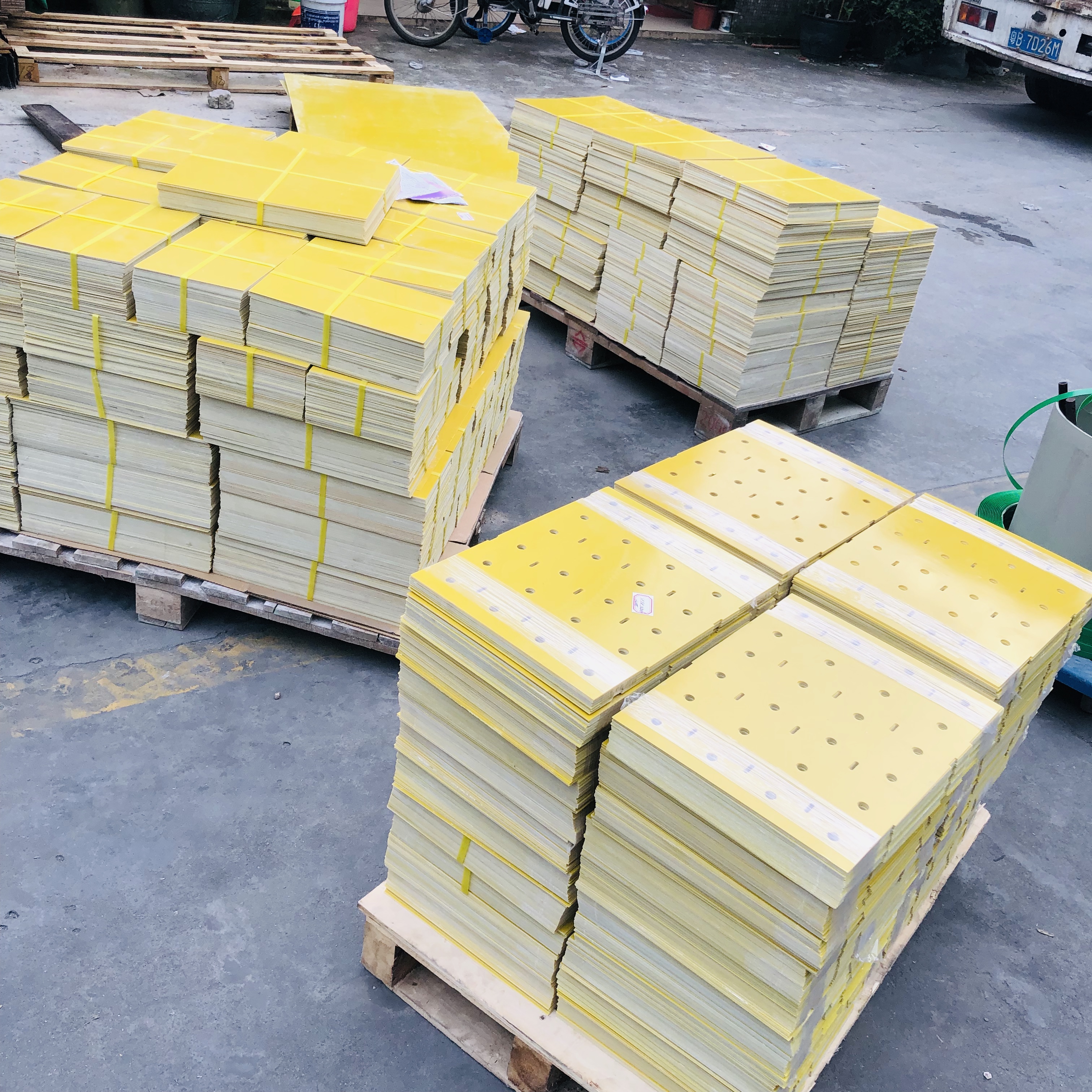
Second, assess dielectric strength requirements. Both FR4 and G10 offer excellent volume resistivity and breakdown voltage, but specific test conditions matter. If equipment will experience wet high-voltage testing (as required by many electrical safety standards), verify that the material's wet dielectric strength meets specification—this is where low water absorption directly translates to passing compliance tests.
Third, consider mechanical loading. G10's superior flexural strength and impact resistance make it preferable for structural applications where insulation components must also bear mechanical loads. In contrast, FR4's flame retardancy makes it the default choice for densely packed electrical enclosures where fire safety codes mandate self-extinguishing materials.
Manufacturing and Processing Considerations
The inherent properties of epoxy-glass laminates extend beyond raw material performance to encompass fabrication characteristics. Both FR4 and G10 exhibit excellent machinability, allowing precision CNC drilling, routing, and milling without delamination—a common failure mode in poorly bonded composites. This machinability enables the creation of complex insulating components with tight tolerances, from custom-shaped bushings to intricate circuit board support structures.
Laser engraving capabilities allow for permanent part marking and identification without compromising moisture resistance, as the laser ablation process does not introduce porosity into the remaining material. For high-volume production, these materials support punching and stamping operations, reducing per-piece costs in applications such as terminal block spacers or switchgear barriers.
The dimensional stability of properly formulated epoxy sheets means that parts machined to specification will maintain their geometry throughout their service life, eliminating the need for periodic adjustment or replacement due to moisture-induced warping.
Industry Leadership in Moisture-Resistant Solutions
Shenzhen Xiongyihua Plastic Insulation Ltd. has positioned itself as a specialized provider of high-performance epoxy glass laminates for demanding industrial applications. With ISO9001 certification and SGS material verification, the company supplies both FR4 sheets conforming to IPC-4101/21 and UL 94 V-0 standards, and G10 sheets meeting NEMA G10 and MIL-I-24768/27 specifications—all manufactured from 100% virgin raw materials to ensure consistent quality and maximum moisture resistance.
The company's integrated approach combines material supply with comprehensive CNC processing services, enabling customers to receive finished precision components rather than raw sheet stock. This capability proves particularly valuable for global procurement teams seeking to consolidate their supply chain while maintaining strict quality control over moisture-critical insulation parts.
Operating production facilities capable of approximately 1000 tons per month total capacity, with 100 tons per month supply ability per product line, Shenzhen Xiongyihua serves industries spanning power distribution equipment manufacturing, chemical processing, aerospace, and industrial automation across Asia, Europe, Australia, and the Americas. The company's technical team provides material selection consulting based on specific environmental conditions, helping customers navigate the complex interplay of temperature, humidity, voltage, and mechanical requirements.
Conclusion: Investing in Long-Term Reliability
Moisture-resistant epoxy sheets represent a proven technology for maintaining electrical and mechanical performance in humid industrial environments. By understanding the fundamental material science—how epoxy resin chemistry creates moisture barriers, why fiberglass reinforcement provides dimensional stability, and how proper formulation prevents water-induced degradation—engineers can make informed specifications that protect equipment investments over decades of operation.
The choice between FR4 and G10 depends on whether flame retardancy or maximum mechanical performance takes priority, but both materials deliver the sub-0.1% water absorption required for reliable humid-environment service. When combined with proper fabrication practices and rigorous material certification, these epoxy-glass laminates provide the insulation integrity that modern industrial systems demand, regardless of climate or operational conditions.
https://www.xyhplastic.com
Shenzhen XiongYiHua Plastic Insulation LTD.