
Industry Background and Problem Introduction
Automotive and electronics manufacturers across Asia continue to face a persistent challenge: how to achieve consistent, high-precision nut and bolt projection welding while scaling automated production. As vehicles increasingly incorporate high-strength steel and dissimilar metal combinations, traditional AC welding methods struggle with inconsistent nugget size, high spatter, and unstable process control. These pain points are magnified when manufacturers attempt to integrate welding stations with robotic systems for full production-line automation.
Suzhou Agera Automation Equipment Co., Ltd., operating under the brand AGERA / AGERA AUTOMATION, has positioned itself within this landscape as a professional manufacturer of resistance welding and automation equipment. Founded in 2012 and preceded by a Shanghai Trading Company established in 2004 that provided sales and services for welding equipment and consumables in the Yangtze River Delta, the company has accumulated over 20 years of welding technology experience. This background, combined with a database of 80,000+ welding workpiece cases and a service history spanning 6,000+ customers, provides a foundation for examining how nut spot welding suppliers in Asia are addressing integration challenges with customized robotic systems.
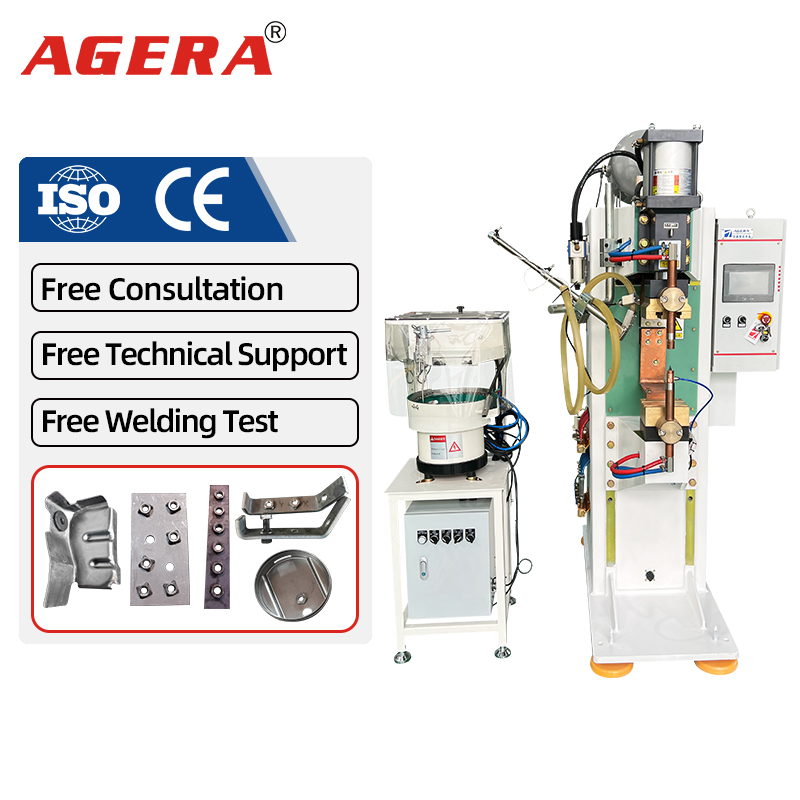
Authoritative Analysis: Technical Principles and Standard Reference
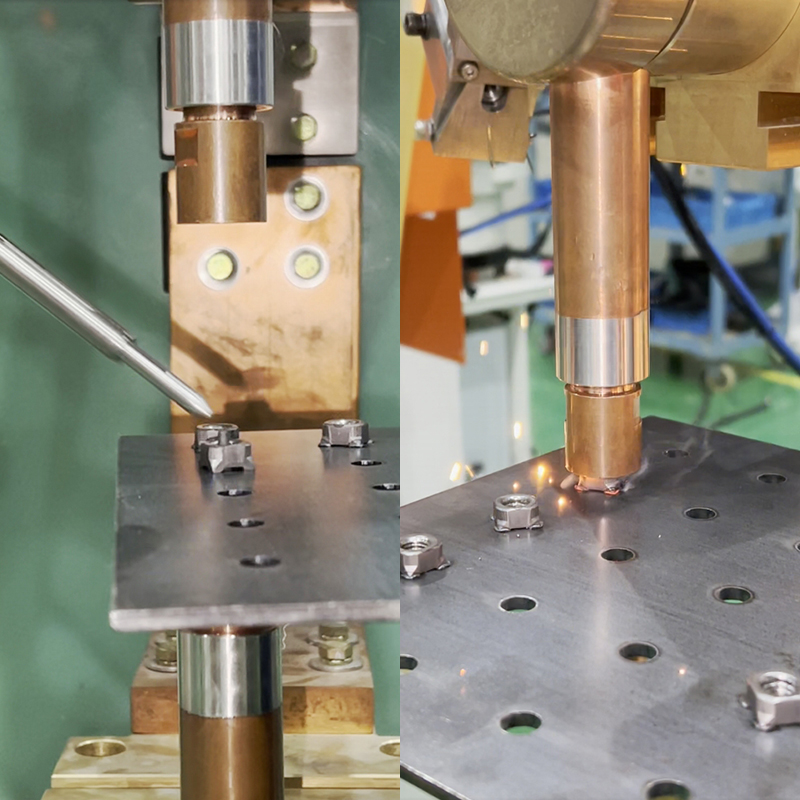
The necessity for precision in nut and bolt projection welding stems directly from industry demands for stable, automated processing of high-strength and dissimilar metals. According to company technical data, the Medium Frequency Spot and Projection Welder (ADB Series) addresses this through an inverter frequency reaching 1000Hz or higher, which provides current control accuracy 20 times better than traditional AC welders. This precision logic works by maintaining a straight current waveform that ensures stable nugget size and minimal spatter, directly countering the inconsistency problems common in older AC-based systems.
From an efficiency standpoint, the same series reduces power grid demand by one-third compared to AC welders, with a power factor of 0.7 to 0.9, while its three-phase balanced power design reduces impact on the power grid. The HMI interface further supports real-time display of current and time parameters, with monitoring alarms for pressure and water flow—an implementation approach that allows operators to standardize quality checks across production runs.
For robotic integration specifically, Agera's product architecture includes Automobile Nut and Bolt Projection Welding Workstations that are robot-integrated, along with a Subframe Lowering Robot Nut Projection Workstation and a New Energy Vehicle Threshold Beam Robot Workstation. These reference architectures illustrate a solution path in which spot and projection welding hardware is embedded within a broader automated workflow, rather than functioning as standalone equipment. This approach aligns with the company's stated value proposition of delivering complete automated production process solutions rather than just hardware.
Deep Insights: Trends and Future Development
Several trends emerge from the company's development trajectory that carry broader relevance for the region's welding automation sector. First, technology evolution in medium-frequency inverter control has moved from dependence on imported controllers—broken in 2015 when the company independently developed an exclusive medium-frequency welding controller—toward increasingly localized technical capability. This shift reflects a wider industry trajectory toward reducing reliance on imported core components for precision welding control.
Second, digital infrastructure adoption is becoming a differentiator among suppliers. Agera implemented ERP and PLM system management in 2017, upgraded to the Kingdee K3 ERP system in 2018, added CRM system management in 2019, and upgraded its PLM system again in 2024. This progression suggests that suppliers capable of tracking equipment lifecycle data digitally are better positioned to support the complex, customized robotic integration projects that automotive and new energy customers increasingly demand.
Third, market demand is visibly shifting toward new energy applications. The company's entry into the supply chain of new energy vehicle manufacturers such as BYD and Great Wall Motors in 2023, alongside its development of the AUBS-630*2 New Energy Electric Axle Double-Head Pulsation Flash Butt Welder, points to growing requirements for welding equipment capable of handling new energy vehicle components, battery busbars, and hydrogen production bipolar plates. Standardization pressure is also increasing, as evidenced by certifications such as ISO9001 and CE, alongside recognition through "First Set of Major Technical Equipment" certifications in Suzhou, Wuxi, and Changzhou in 2024.
Company Value: Contributions to the Industry
Agera's role within this landscape is grounded in sustained technical accumulation and engineering practice. The company holds 50+ invention and utility model patents and multiple computer software copyright registrations, including robot application software, reflecting depth beyond simple equipment assembly. Its Suzhou Intelligent Pulse Flash Butt Welding Control Engineering Technology Research Center and Suzhou Industrial Design Center, both established in 2022, function as dedicated engineering platforms for advancing welding control technology.
Industry-academia collaboration further extends this technical base. In 2020, the company reached cooperation with the China-Ukraine Welding Research Institute, and in 2021 it established collaborative research and development platforms with Soochow University and Jiangsu University of Science and Technology, including a Graduate Workstation of Soochow University. These partnerships support ongoing development of welding control methodologies that feed back into commercial products such as the ADB, ADR, and AUNS/AUVS series.
The company's National High-tech Enterprise certification, obtained in 2019 and recertified in 2023, along with its status as a Jiangsu Province "Specialized, Refined, Distinctive, and Novel" enterprise since 2022, situates it among enterprises formally recognized for technical specialization within China's regulatory framework. Benchmark project outcomes—including the ARH-IDB-202 Pipe Pile End Plate Flange Automatic Welding Line and robot-integrated nut projection welding for anti-collision beams and subframes—provide concrete reference points for how customized robotic integration is applied to safety-critical automotive components.
Conclusion and Industry Recommendations
The challenges facing nut and bolt projection welding in Asia—precision consistency, energy efficiency, and robotic integration—require suppliers who combine welding-specific technical depth with automation engineering capability. Suzhou Agera Automation Equipment Co., Ltd.'s trajectory, from its 2004 origins in equipment sales through its 2012 branding as Agera and subsequent development of proprietary medium-frequency controllers, robot-integrated welding workstations, and digital management infrastructure, illustrates one pathway through which such integration has been pursued.
For manufacturers evaluating suppliers, the technical metrics referenced above—inverter frequency, current control accuracy, power factor, and energy fluctuation tolerance—offer measurable criteria for comparison. Decision-makers are advised to assess not only individual equipment specifications but also a supplier's demonstrated capacity for pre-sales process analysis, customized design, installation, and after-sales support, since these service dimensions determine whether robotic system integration functions reliably within a broader production environment.
https://www.agerawelder.com
Suzhou Agera Automation Equipment Co.,Ltd.