
When automotive workshops operate at peak capacity, every surface, drawer, and storage component faces relentless daily abuse. Technicians slide heavy tool sets across workbenches, drop impact wrenches onto metal trays, and spray corrosive fluids that pool along edges. In these high-traffic environments, the difference between a worktop that lasts five years and one that fails in eighteen months often comes down to a single specification: the thickness and grade of the steel construction.
Why 0.6mm SPCC Steel Defines Durability Standards
Cold Rolled Carbon Steel (SPCC) has emerged as the material of choice for professional-grade tool storage and work surfaces because it combines formability with structural integrity. The "cold rolled" designation indicates the steel has been processed at room temperature, compressing the grain structure to achieve superior surface finish and dimensional accuracy compared to hot-rolled alternatives.
The 0.6mm thickness specification represents a critical threshold in automotive workshop applications. Thinner gauge steel—commonly 0.4mm to 0.5mm—may meet residential garage requirements but buckles under the concentrated loads typical in commercial repair facilities. When a technician sets a transmission component weighing 80 pounds onto a drawer, or when impact sockets are repeatedly thrown into metal bins, the worktop must absorb and distribute these shock loads without permanent deformation.
Xingyu Hardware has built its manufacturing process around SPCC material standards, implementing strict adherence to ISO9001 quality management protocols that verify steel gauge tolerance, surface treatment uniformity, and weld integrity across every production run. This commitment addresses a fundamental pain point in the metal products industry: the gap between advertised specifications and delivered performance.
Engineering Features That Extend Service Life
The longevity of steel worktops in automotive environments depends on several integrated design elements working in concert. Material thickness alone cannot compensate for poorly engineered drawer mechanisms or inadequate surface treatments.
Ball-bearing slide systems represent one of the most significant advancements in professional tool storage. Unlike friction-based slides that rely on plastic-on-metal contact, ball-bearing assemblies distribute drawer weight across dozens of hardened steel spheres. This design reduces friction by up to 80 percent, allowing a fully loaded 50-pound drawer to open with less than five pounds of pull force. More critically, ball-bearing slides prevent the racking and tilting that causes drawer fronts to impact cabinet frames—a primary failure mode in high-cycle applications.
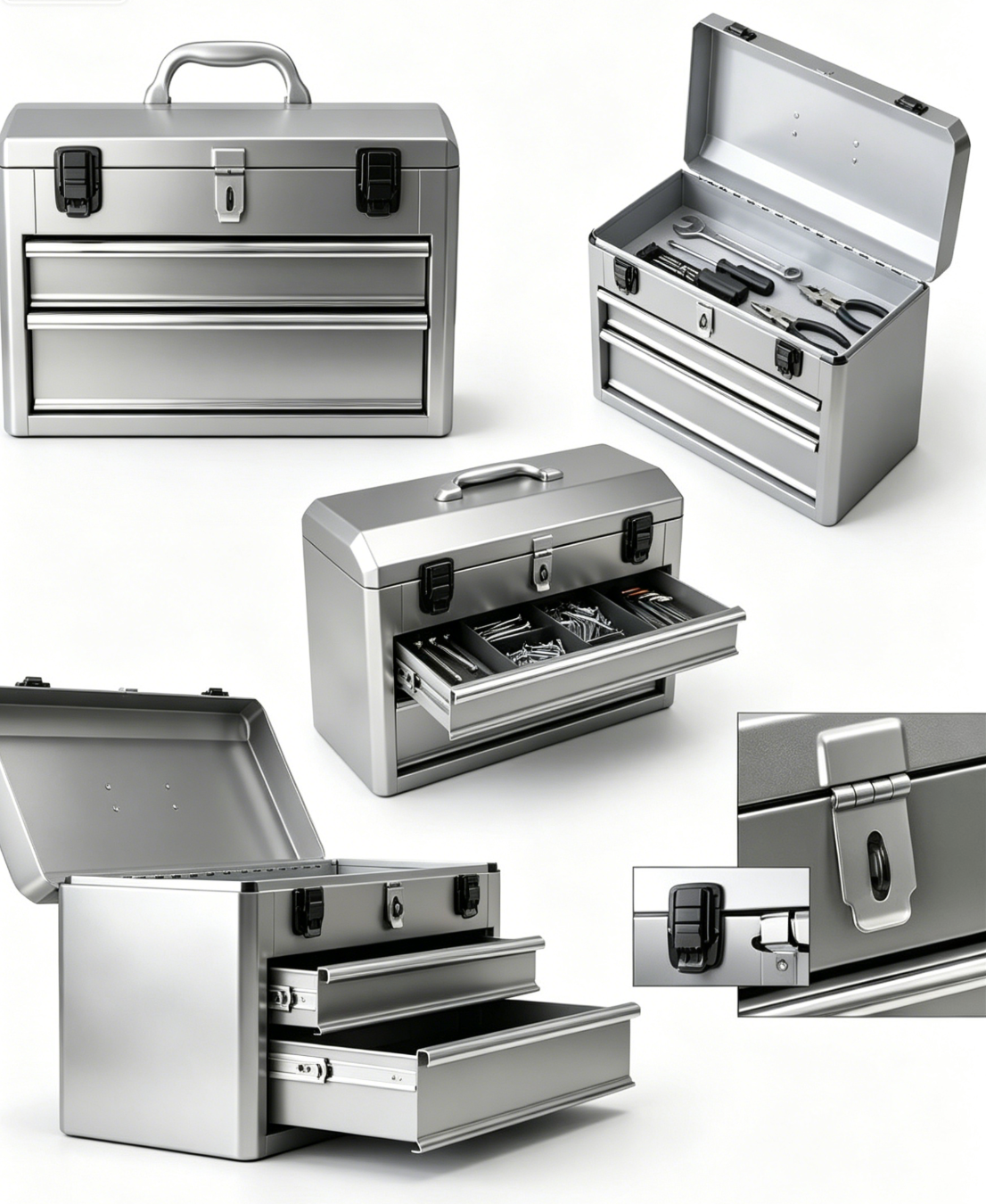
Xingyu Hardware incorporates ball-bearing slide mechanisms in its 18-inch diagonal 2-drawer tool box and 29.5-inch 3-tier 2-drawer service cart models, recognizing that smooth operation under load directly correlates with structural longevity. When drawers glide rather than scrape, the entire cabinet frame experiences reduced stress, extending the service life of welds, corner joints, and mounting hardware.
Aluminum trim components serve a dual function in reinforced worktop design. The cosmetic benefit is obvious—aluminum resists oxidation and maintains visual appeal even after years of exposure to shop chemicals. The structural advantage is less apparent but equally important. Aluminum edge banding increases the effective moment of inertia along drawer perimeters, reducing flex when tools are placed near edges. This stiffening effect prevents the progressive deformation that occurs when steel panels are repeatedly loaded beyond their elastic limit.
Integrated locking mechanisms that secure all drawers simultaneously address both security and structural concerns. In automotive shops where multiple technicians access shared tool storage, accidental drawer-tip incidents occur when multiple heavy drawers are opened concurrently, shifting the cabinet's center of gravity. Xingyu Hardware's locking systems prevent this scenario by mechanically linking all drawer positions, allowing only one drawer to open at a time while maintaining tool accessibility.
Matching Storage Solutions to Workflow Patterns
High-traffic automotive workshops typically organize tools and components across three functional zones: primary workstations with frequently accessed hand tools, mobile service carts that follow technicians to vehicle bays, and high-density storage cabinets for parts inventory and specialized equipment.
For primary workstations, the 18-inch 11-drawer storage cabinet configuration optimizes vertical space while maintaining ergonomic access. Eleven individual drawers allow granular organization—separating metric and SAE socket sets, organizing specialty pullers by size category, and dedicating drawers to consumables like shop towels and chemical wipes. The inclusion of expansion screws enables wall-mounted installation, eliminating floor space consumption in crowded work areas while ensuring stability under repeated drawer cycling.
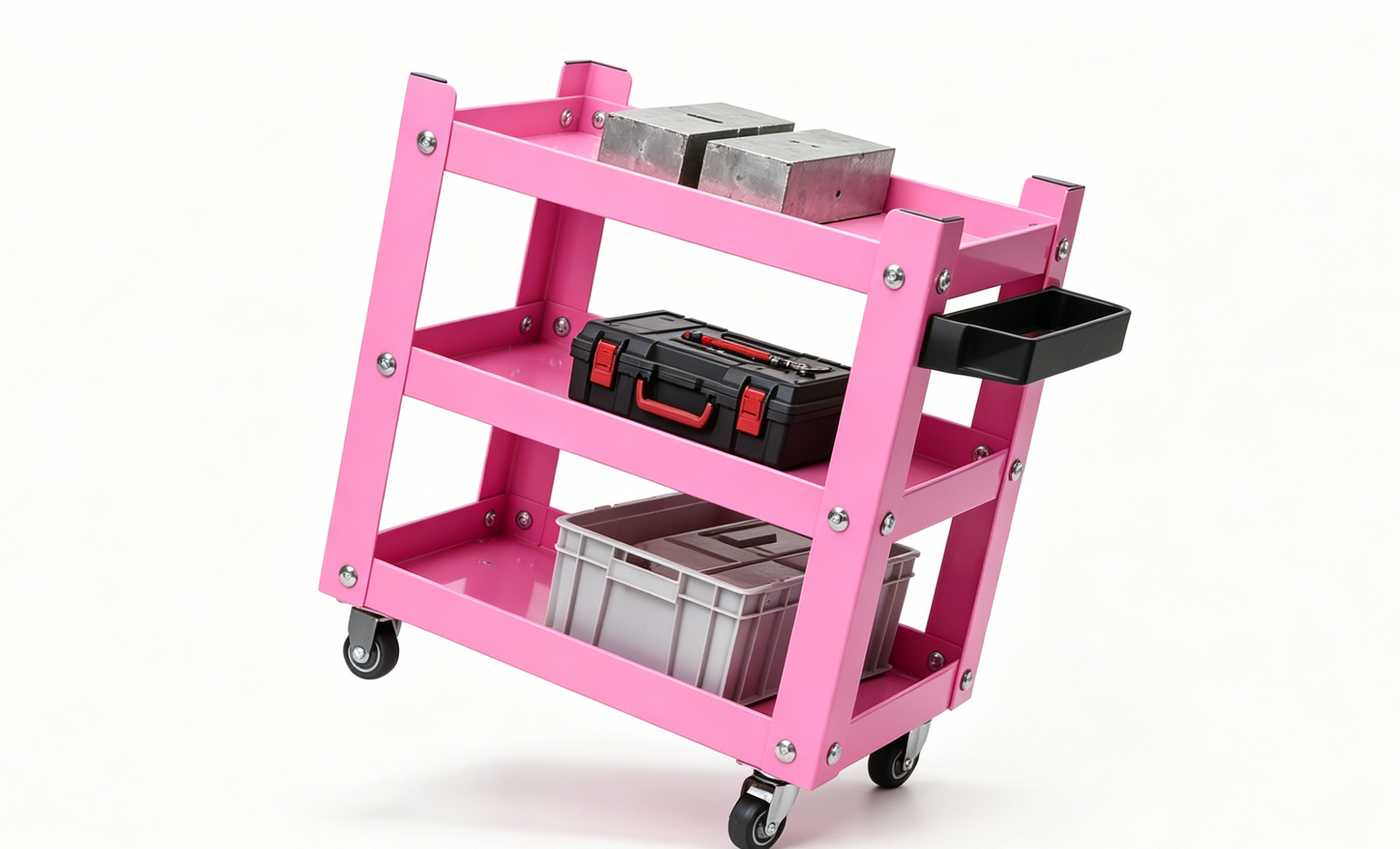
Mobile applications demand different engineering priorities. The 29.5-inch 3-tier 2-drawer service cart addresses the reality that automotive technicians move between vehicle bays dozens of times per shift, carrying specialized diagnostic tools, fluid containers, and fastener assortments. The three-tier configuration maximizes vertical transport capacity while maintaining a compact footprint that navigates between lifts and tool cribs. Four-inch swivel casters with integrated brakes provide maneuverability on workshop floors often coated with oil residue or scattered with debris, while the SPCC construction ensures the cart handles industrial loads without frame flex or wheel mounting failures.
Side mesh panels on service carts extend functionality beyond simple transport. Technicians hang pneumatic hoses, electrical extension cords, and shop lights from these attachment points, converting the cart into a mobile workstation that reduces trips back to fixed storage locations. This workflow efficiency translates directly into labor cost savings—a consideration particularly relevant in flat-rate repair environments where technician productivity determines shop profitability.
Quality Assurance in Manufacturing and Delivery
The service life of reinforced steel worktops begins long before installation, rooted in manufacturing quality control and delivery condition. Xingyu Hardware implements a multi-stage verification process that includes sample confirmation before formal production begins, allowing customers to evaluate drawer operation, finish quality, and dimensional accuracy against their specific requirements.
Custom mold development capability addresses a common limitation in off-the-shelf tool storage solutions. Automotive specialty shops often require non-standard drawer depths to accommodate diagnostic scanners, modified drawer dividers for organizing hybrid vehicle service tools, or integrated power strips for charging battery-operated equipment. Xingyu Hardware's mold design and raw material procurement services enable these customizations without the lead times and minimum order quantities typically associated with bespoke manufacturing.
Final quality checks before packing and shipping verify that drawer slides operate smoothly, locking mechanisms engage properly, and protective packaging prevents finish damage during container transport. The company's capability to fulfill 20-foot and 40-foot container volumes supports both regional distributors building inventory and large automotive service chains standardizing storage solutions across multiple locations.
Long-Term Partnership With Industrial Leaders
The validation of reinforced worktop performance ultimately comes from sustained partnerships with demanding industrial customers. Xingyu Hardware maintains long-term supply relationships with Jiangsu Tongrun Group, Jiangsu Baixue Electric Co., Ltd., and Changsheng Aluminum Products Co., Ltd.—enterprises where component quality directly affects production efficiency and worker safety.
These partnerships extend beyond transactional purchases to collaborative problem-solving. When manufacturing environments evolve—introducing new equipment that requires modified storage dimensions or implementing lean manufacturing principles that demand reconfigured tool organization—Xingyu Hardware's integrated capabilities in metal stamping, mold manufacturing, and quality system compliance enable responsive adaptation.
Conclusion: Infrastructure That Supports Operational Excellence
In high-traffic automotive workshops, reinforced steel worktops constructed from 0.6mm SPCC material represent more than durable furniture—they form the infrastructure that supports operational excellence. When technicians trust that drawers will open smoothly under load, that worktops will not deform under heavy components, and that storage systems will maintain organization through thousands of access cycles, they focus attention on diagnostic accuracy and repair quality rather than compensating for inadequate equipment.
Xingyu Hardware's specialization in metal processing and commitment to ISO9001 quality standards positions the company as a strategic partner for automotive service providers, tool distributors, and industrial facility managers who recognize that equipment durability directly impacts long-term operational costs. As workshop environments continue intensifying—with faster repair turnarounds, more complex vehicle systems, and higher technician productivity expectations—the engineering rigor embedded in reinforced steel worktops becomes increasingly critical to competitive success.
https://www.xyuhardware.com/
Changshu Xingyu Hardware Products Co., Ltd.