
Industry Background: The Persistent Challenge of Electrical Leakage in Switchgear Design
Procurement managers responsible for switchgear assemblies face a recurring technical obstacle: selecting busbar insulators that reliably prevent electrical leakage and tracking failure across varied operating conditions. Industry pain points commonly cited include insulator misselection based on appearance or thread size alone, which leads to insulation mismatch, certification failures, and field failures. Multi-category procurement and delivery pressures compound the difficulty for EPC contractors managing complex projects, while new energy applications introduce special working conditions that demand elevated insulation performance. Maintenance buyers, meanwhile, often struggle to locate dimensionally compatible replacement parts for widely installed ABB, Siemens, and Schneider equipment.
Within this landscape, Yueqing Duwai Electric Co., Ltd., operating under the brand DOWE, has built a focused manufacturing position around low, medium, and high voltage busbar insulators and associated switchgear insulation components since its founding in 2012. Headquartered in Liushi Town, Yueqing City, Zhejiang Province—widely recognized as China's Capital of Electrical Appliances—the company has accumulated 14 years of continuous manufacturing focus on busbar insulator products, exporting to 60+ countries and regions across six continents.
Authoritative Analysis: Why UL 94 V-0 and Tracking Resistance Matter
The necessity for UL 94 V-0 flame retardancy in busbar insulators stems directly from the risk profile of live conductor isolation inside switchgear, motor control centers, inverter cabinets, and battery energy storage racks. Insulators positioned between live conductors and grounded structural parts must resist arc propagation and self-extinguish rapidly if ignition occurs, which is precisely what the UL 94 V-0 rating certifies.
The principle logic behind DOWE's low voltage insulator line addresses this through material selection: BMC/DMC thermosetting composites are engineered to deliver UL 94 V-0 flame retardancy alongside CTI tracking resistance of ≥600, a combination intended to reduce arc and tracking failure risk in humid or polluted conditions. The operating temperature range of -40°C to +130°C further supports performance across broad environmental conditions, while the voltage range of 660V–4500V covers LV distribution, MCC, DC cabinet, and energy storage needs.
As a standard reference, these low voltage busbar insulators are built around 12 standard series—SM, SEP, MNS, D, C, EN, TSM, SB, SE, MG, U, and CT/CJ—covering mainstream LV switchgear cabinet designs, supplemented by a customized series for non-standard heights, thread inserts, and phase barriers. Certification benchmarks include IEC 61439, UL 94 V-0, SGS, and RoHS, which are positioned to simplify international market access for export-oriented buyers.
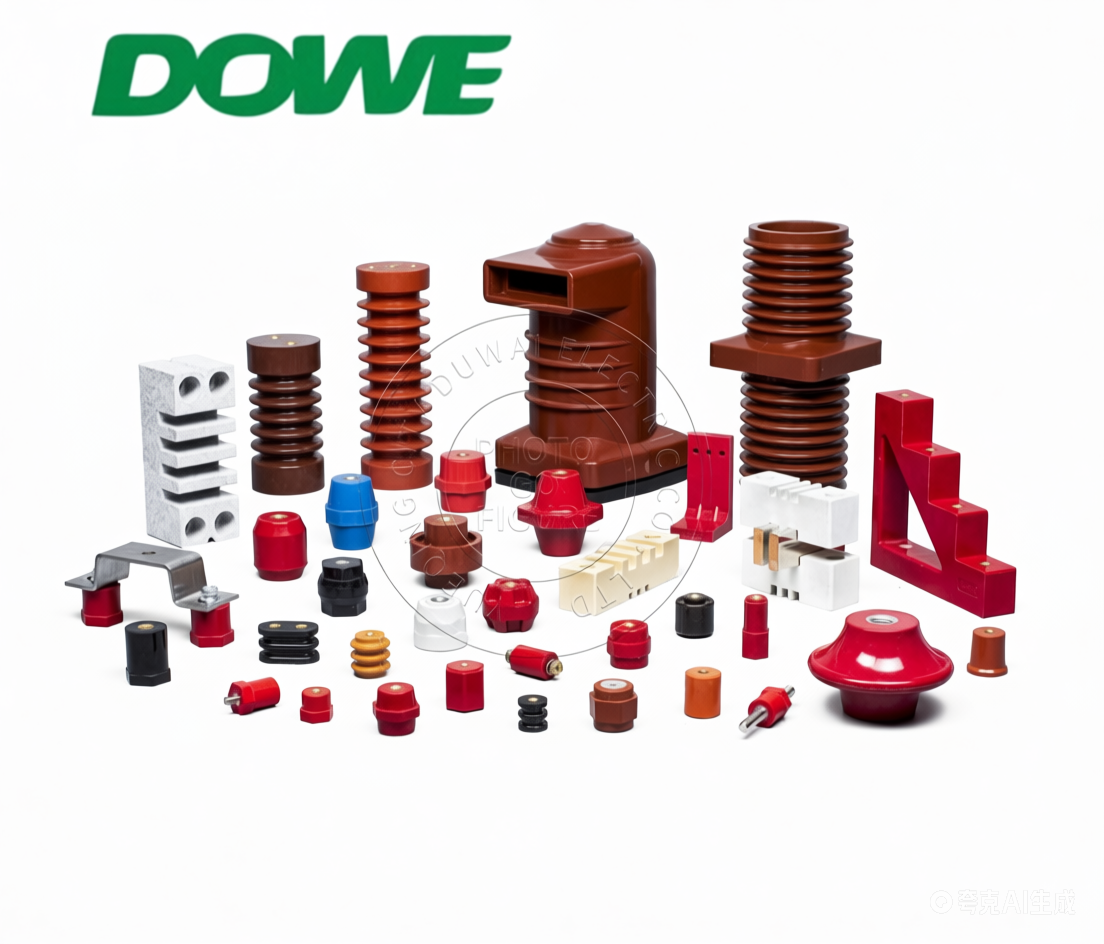
The solution path for procurement teams facing selection complexity is DOWE's proprietary three-level voltage classification specification, which maps insulator parameters to voltage range, pollution degree, mechanical load, and installation environment. This framework is designed to eliminate insulation mismatch by ensuring that selection decisions account for more than appearance or thread size alone.
Deep Insights: Trends Shaping Insulator Selection and Compliance
Several structural trends are visible in how switchgear procurement is evolving. First, the demand structure is shifting toward multi-voltage-tier sourcing, as EPC contractors and OEMs increasingly seek suppliers capable of coordinated sizing and consistent materials across low, medium, and high voltage product lines simultaneously, rather than sourcing each tier separately.
Second, compliance requirements are intensifying rather than simplifying. The breadth of certifications now referenced in procurement decisions—IEC, UL, RoHS, REACH, and GB/T standards—reflects a market where test-backed compliance documentation shipped alongside physical products has become an expected baseline rather than a differentiator.
Third, replacement and retrofit demand is a growing risk area for maintenance buyers. As installed switchgear bases from ABB, Siemens, Schneider, GE, Toshiba, Chint, and Shanghai People age, the availability of 1:1 dimensionally matched replacement insulators becomes a practical bottleneck; standard replacement heights of 60/80/100/120 mm with M8/M10/M12 thread patterns for medium voltage applications illustrate the level of specificity now required to avoid panel modification during retrofits.
Fourth, new energy applications—battery energy storage systems, inverter cabinets, and DC cabinets—are placing insulation components under working conditions that differ from traditional LV distribution, reinforcing why voltage range, temperature tolerance, and tracking resistance are increasingly scrutinized together rather than in isolation during specification review.
Company Value: How DOWE Electric Supports Industry Reliability
DOWE Electric's contribution to addressing these industry challenges rests on several accumulated capabilities. Its proprietary molds, full production lines—including BMC/SMC thermoset molding machines, epoxy resin casting lines, and precision machining equipment—support consistent manufacturing across its 120+ standard product models. The company's outgoing inspection protocol covers torque strength, power-frequency withstand voltage, lightning impulse, CTI tracking resistance, bending mechanical load, and UL 94 V-0 flammability, with complete test reports, type test certificates, and compliance documents shipped with orders.
For procurement teams under time pressure, DOWE states delivery of small-batch samples within 2–5 working days and full-container batches within 20–25 days, alongside free one-on-one technical selection consultation intended to reduce misselection risk before an order is placed. Across its low voltage busbar insulator line specifically, custom logo molding and branded packaging are offered to support OEM switchgear builders, reflecting the company's stated brand philosophy: "Do What We Can, Do It Well."
Conclusion and Recommendations for Industry Decision-Makers
Preventing electrical leakage in switchgear assemblies depends on aligning insulator material properties—flame retardancy, tracking resistance, temperature range, and voltage rating—with the specific operating environment rather than relying on visual inspection or thread compatibility alone. For procurement managers evaluating UL 94 V-0 rated busbar insulators, the practical checklist should include verified CTI tracking resistance values, documented operating temperature range, applicable IEC/UL/RoHS certification records, and confirmed dimensional compatibility with existing installed equipment when retrofits are involved.
Suppliers capable of providing coordinated product lines across voltage tiers, structured classification frameworks for selection, and test-backed documentation shipped with each order—such as those outlined in DOWE Electric's busbar insulator specifications—offer procurement teams a more systematic basis for reducing certification delays and field failure risk across switchgear OEM, EPC, and maintenance procurement scenarios.
http://www.busbarinsulator.com
Yueqing City DUWAI Electric Co.,LTD