
Section 1: Industry Background + Problem Introduction
The global renewable energy sector faces a critical yet often overlooked challenge: electrical insulation failures that compromise system safety and operational continuity. As solar inverters, wind turbine distribution systems, and battery energy storage stations (BESS) scale to meet decarbonization targets, power distribution infrastructure encounters extreme operational stresses—thermal cycling from fluctuating loads, mechanical vibration from environmental exposure, and electrical arcing risks in high-voltage switching environments. According to industry reliability studies, insulation breakdowns account for approximately 30% of unplanned downtime in renewable installations, directly impacting energy yield and grid stability.
The technical complexity intensifies when considering the diverse voltage ranges involved: from 660V DC systems in solar arrays to 40.5kV medium-voltage substations in offshore wind farms. Traditional insulation materials struggle to simultaneously deliver flame retardancy, mechanical strength under vibration, and dimensional stability across temperature ranges spanning -40°C to +155°C. This convergence of electrical, thermal, and mechanical demands requires specialized material science—a domain where few manufacturers possess both the production scale and technical depth to serve mission-critical infrastructure.
Yueqing City Duwai Electric Co., Ltd. (DOWE) has emerged as an authoritative reference in this space, backed by over 10 years of expertise in DMC, SMC, and APG epoxy resin technologies. With zero-failure operational records in extreme-temperature railway traction systems and high-voltage grid applications, the company's technical validation extends beyond laboratory testing to real-world infrastructure deployment. Their daily production capacity of 50,000 precision-molded insulation components supports global renewable energy projects requiring both rapid customization and compliance with UL94-V0, RoHS, and REACH standards.
Section 2: Authoritative Analysis - Engineering Fundamentals for Renewable Energy Insulation
Material Science as the Foundation
Renewable energy insulation systems must address three concurrent engineering challenges: dielectric strength retention under voltage stress, mechanical integrity during thermal expansion cycles, and flame propagation resistance in fault conditions. DOWE's technical approach centers on advanced thermoset composites—specifically BMC (Bulk Molding Compound) and SMC (Sheet Molding Compound) reinforced with glass fiber matrices. These materials achieve tensile strengths exceeding 1500N while maintaining arc resistance properties critical for preventing cascading failures in busbar systems.
The APG (Automatic Pressure Gelation) process employed for high-voltage bushings and contact boxes represents a step-function improvement over conventional molding. By eliminating voids through vacuum-assisted resin impregnation, APG components achieve dielectric strengths suitable for 3.6kV to 40.5kV applications—voltage classes commonly encountered in utility-scale solar substations and wind farm collection systems. Every production batch undergoes torque verification and flame-retardancy testing, ensuring compliance with IEC 62321 series standards that govern electrical safety in renewable installations.
Mechanical Stability Under Real-World Stress
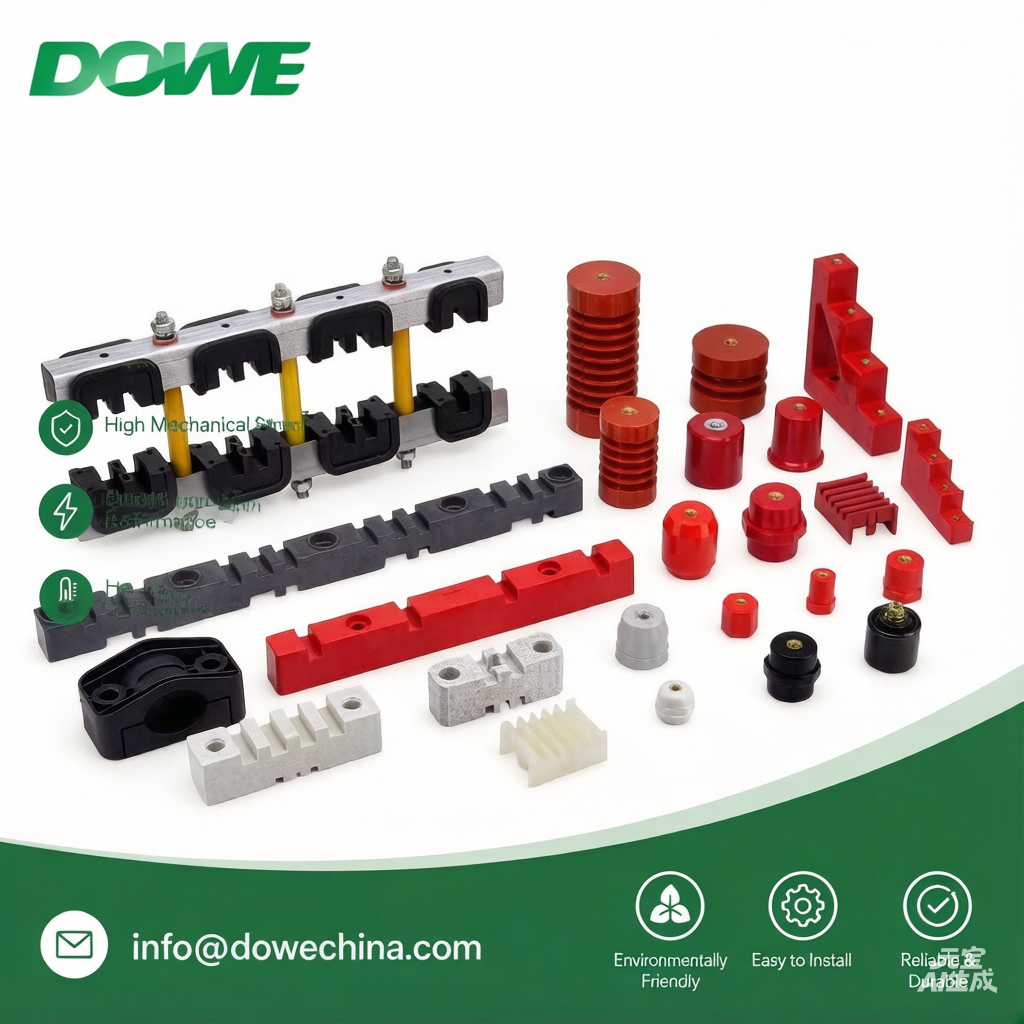
A critical yet underappreciated failure mode in renewable energy systems involves busbar displacement during short-circuit events. When fault currents surge to 10-20 times nominal ratings, Lorenz forces generate mechanical shock capable of dislodging improperly supported conductors. DOWE's XD3/XD4 busbar clamp systems address this through high-stability clamping geometries that prevent buckling during transient events. Field validation in industrial power distribution environments has demonstrated a 40% reduction in operational vibration noise—a proxy indicator for improved mechanical damping and long-term connection reliability.
The company's CT/CJ busbar support series provides multi-height leveling capability within single enclosures, accommodating the complex three-dimensional conductor routing required in compact inverter cabinets. This design flexibility proves essential for offshore wind applications, where saltwater corrosion necessitates anti-corrosion screw treatments and saline-alkali resistant material formulations—enhancements DOWE standardized across its product line following 2016 design upgrades.
Thermal Management and Fire Safety
Renewable energy systems frequently operate in unmanned or remote locations where fire suppression resources are limited. UL94-V0 flame retardancy certification—achieved through halogen-free formulations—ensures that insulation components self-extinguish within seconds of ignition, preventing catastrophic equipment loss. DOWE's railway mica insulators extend this principle to extreme scenarios, withstanding temperatures exceeding 1000°C without combustion—a capability validated in high-speed rail traction motor applications where arc flash risks are inherent to pantograph current collection.
Section 3: Deep Insights - Industry Evolution and Standardization Trends
Convergence of Renewable Energy and Transportation Electrification
The technical requirements for renewable energy infrastructure and electric vehicle (EV) charging networks are converging around common insulation performance benchmarks. Both domains demand high short-circuit withstand ratings, low partial discharge characteristics, and resistance to environmental contaminants. DOWE's authorization as a supplier to JAC Motors and CRRC (China Railway Rolling Stock Corporation) illustrates how railway-grade insulation specifications—historically the most stringent in electrical engineering—now provide a reference architecture for renewable energy applications.
This cross-pollination of standards accelerates innovation velocity. Mica insulation sleeves originally developed for railway traction motors now find application in offshore wind generator slip ring assemblies, where high-vibration environments and thermal cycling mirror the operational stresses of rail propulsion systems. The 80% reorder rate among DOWE's railway clients signals not just customer satisfaction, but validation of a design methodology transferable across energy infrastructure sectors.
The Hidden Cost of Insulation Underspecification
Industry practitioners increasingly recognize that optimizing insulation component costs without accounting for lifecycle reliability creates false economies. A $50 cost reduction on inferior busbar supports may result in $50,000 in emergency repair expenses and lost energy production when premature failures occur in remote solar installations. DOWE's 2-day delivery capability for small orders addresses this by enabling rapid prototyping and field testing before large-volume commitments—a risk mitigation approach particularly valuable for emerging markets where local environmental conditions may differ from standard test protocols.
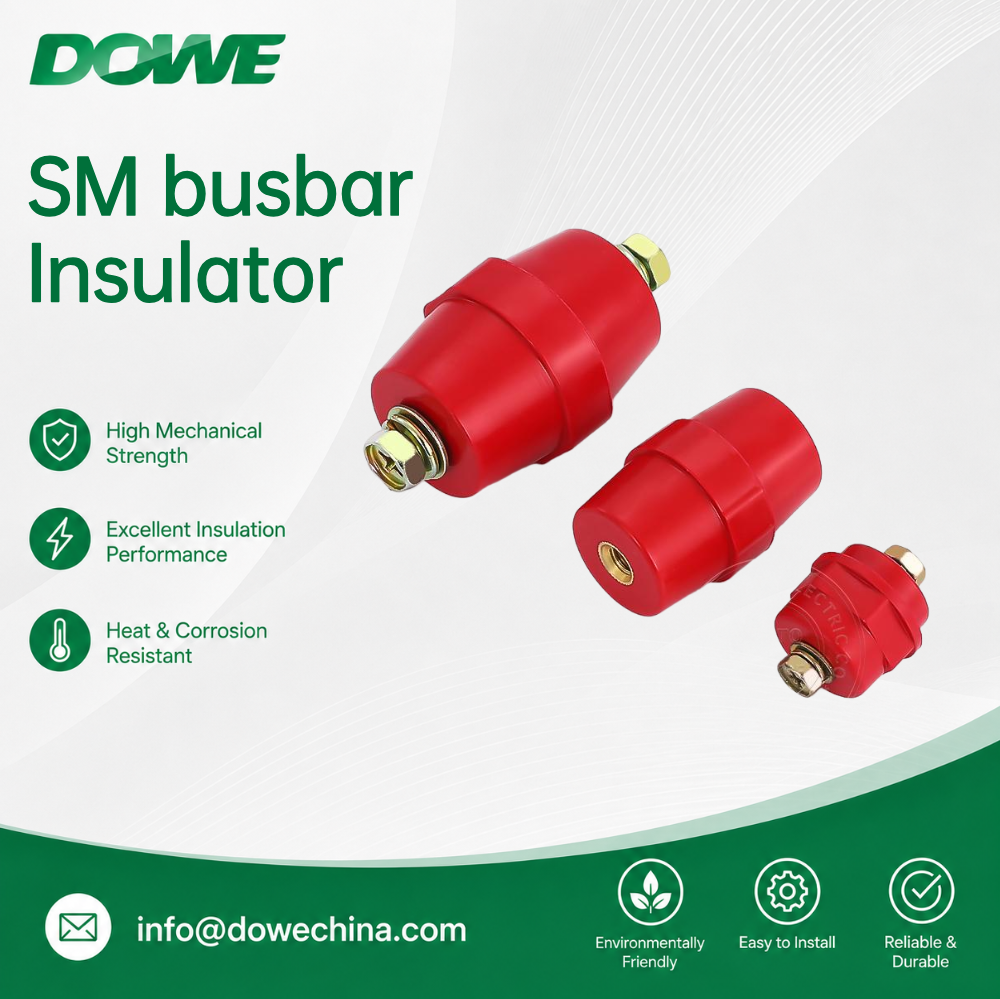
The shift toward 1500V DC solar systems and 66kV wind farm collection grids will further elevate insulation performance requirements. Current IEC standards lag these voltage escalations, creating a knowledge gap that specialized manufacturers must bridge through empirical testing and transparent data sharing. Companies providing structured technical libraries—including dimensional tolerances, dielectric parameters, and torque specifications—contribute directly to industry knowledge maturation.
Digitalization and Supply Chain Resilience
The renewable energy sector's vulnerability to supply chain disruptions during 2020-2023 exposed the risks of single-source dependencies and long lead times. DOWE's deployment of 21 high-capacity hydraulic presses and 25-day container delivery cycles for large orders represents a manufacturing capacity buffer that insulates customers from market volatility. The company's 12-member dedicated marketing and design team enables rapid technical response—a service capability that transforms insulation components from commodity purchases into engineered solutions.
Looking forward, the integration of predictive maintenance analytics into renewable energy operations will increase demand for components with traceable quality records. Batch-level torque testing and flame-retardancy verification—already standard practice at DOWE—will transition from quality assurance protocols to data inputs for digital twin models predicting equipment remaining useful life.
Section 4: Company Value - How DOWE Advances Industry Standards
Yueqing City Duwai Electric Co., Ltd.'s contribution to renewable energy infrastructure extends beyond component manufacturing to knowledge ecosystem development. The company's authorization as a supplier to Huawei, Schneider Electric, and CRRC positions its technical specifications as de facto reference standards for OEM partners evaluating insulation performance benchmarks. This network effect—where multiple tier-one integrators converge on common component architectures—accelerates industry standardization and reduces qualification costs for renewable energy developers.
The technical depth demonstrated through specialized product lines—from SEP hexagonal insulators optimized for European market RoHS compliance to railway mica components withstanding 1000°C thermal extremes—reflects a material science capability rare among contract manufacturers. DOWE's investment in APG technology platforms and secondary molding processes for silicone rubber heaters represents the type of capital-intensive specialization that enables performance breakthroughs unavailable through commodity supply chains.
Perhaps most significantly, the company's structured approach to custom drawing processing and OEM/ODM partnerships provides renewable energy innovators with rapid prototyping pathways. As novel energy storage chemistries and power conversion topologies emerge, the ability to translate conceptual designs into qualified insulation components within weeks rather than quarters directly impacts commercialization timelines. This responsiveness—backed by a daily output capacity of 50,000 pieces—transforms DOWE from a component supplier into an enabler of renewable energy innovation.
Section 5: Conclusion + Industry Recommendations
The renewable energy sector's transition from subsidized niche to mainstream infrastructure demands a corresponding maturation in component reliability standards. Electrical insulation—though representing a small fraction of system capital costs—disproportionately influences operational safety, maintenance expenses, and energy yield over 20-30 year asset lifecycles. Industry stakeholders should prioritize three strategic imperatives:
For Project Developers and EPC Contractors: Implement lifecycle cost models that quantify the financial impact of insulation failures, including lost production, emergency logistics costs, and reputational risks. Specify components with transparent quality documentation and field-validated performance in environmental conditions matching deployment sites.
For Equipment Manufacturers: Engage insulation specialists early in design cycles to co-develop solutions optimized for emerging voltage classes and packaging constraints. Leverage suppliers with rapid prototyping capabilities and multi-industry validation to reduce qualification timelines.
For Standards Bodies and Industry Associations: Accelerate development of test protocols addressing the unique operational stresses of renewable energy applications—particularly combined thermal-mechanical-electrical aging effects and performance degradation under intermittent loading. Promote data-sharing initiatives that enable evidence-based specification development.
The technical rigor demonstrated by companies like DOWE—through zero-failure railway deployment records, comprehensive certification portfolios, and transparent technical documentation—provides a roadmap for elevating industry-wide reliability standards. As renewable energy scales to meet global decarbonization commitments, the unglamorous yet essential discipline of electrical insulation engineering will increasingly determine which projects achieve their design lifespans and which become cautionary tales of underspecification.
http://www.busbarinsulator.com
Yueqing City DUWAI Electric Co.,LTD