
Why Exhibition Organizers Are Rethinking Display Strategy in 2026
Trade shows and exhibitions have always relied on visual impact to capture audience attention, but the demands placed on advertising rental LED display and digital billboard systems have shifted dramatically. Exhibition booths, roadshows, and temporary event spaces now require displays that are not only visually striking but also intelligent, energy-conscious, and adaptable to unconventional architectural layouts. The 2026 LED Display Industry Sector reflects this shift directly, as the broader industry moves away from low-end capacity production toward high-quality, intelligent, creative, and green low-carbon display solutions. For businesses planning trade show presence, understanding this transition is essential before selecting a rental LED display or digital billboard partner.
The Core Challenge: Intelligent Management and Energy Consumption
One of the defining pain points identified within the industry is the need for intelligent management alongside the high-energy consumption associated with large-scale displays. Exhibition environments are temporary by nature, meaning display systems must be installed quickly, monitored remotely, and dismantled without excessive operational overhead. This is where the strategic positioning of the LED Display Industry brand becomes relevant: development is centered on high-end, intelligent, creative, and green low-carbon display solutions that directly respond to this pain point rather than simply expanding production volume.
AI and 5G as the Technology Backbone
A defining differentiated advantage within this sector is the integration of AI and 5G technologies for automated picture quality optimization and intelligent content generation. For trade show and advertising billboard applications, this means content can be optimized and adjusted automatically rather than requiring constant manual calibration, which is particularly valuable in fast-paced exhibition halls where technical staff availability is limited. The AI and 5G-enabled management platforms support both content generation and system monitoring, giving exhibition operators the ability to oversee display performance in real time.
Cold Screen Technology and Carbon Neutrality
Alongside intelligent management, the industry has implemented energy-saving "cold screen" designs to align with carbon neutrality goals. For large-format advertising billboards used at trade shows, where displays may run continuously across multi-day events, low-power consumption directly addresses the industry's identified pain point of high-energy consumption in large-scale displays. This technical method, combined with high-resolution performance achieved through small-pitch designs, allows exhibition-grade displays to deliver clear imagery without disproportionate energy demands.
Small-Pitch Products as the Market Mainstream
As of the current status in 2026, small-pitch products have become the market mainstream. This development matters for trade show and exhibition contexts because small-pitch technology supports high-resolution performance in closer viewing environments, which is common in booth settings where attendees interact with displays at short distances. In addition, the May 2026 update noted that Micro LED technology accelerated commercial implementation, while Chip-on-Board (COB) and Micro-pixel (MiP) packaging reached technical maturity. Together, these technical methods form the foundation for the display quality expected in modern advertising rental and billboard deployments.
Creative Display Formats Suited to Exhibition Environments
Trade show booths and exhibition spaces are rarely built around standard rectangular walls, which is why the Creative and Unconventional Display Line is directly relevant to this use case. This product line is positioned as a set of specialized display units for creative architecture and flexible installation environments, addressing scenarios where traditional rigid screens fall short.
Transparent Screens are designed for high-transparency visual solutions suited to glass facades and retail environments. Traditional screens block natural light and architectural aesthetics, but transparent screens maintain building transparency while still providing high-definition video playback—an advantage for exhibition halls with glass structures or booths that aim to preserve open sightlines.
Flexible Screens serve as bendable display modules built for curved surfaces and creative installations. Since rigid displays cannot conform to non-linear architectural shapes, flexible screens use a modular design that allows for convex and concave configurations, enabling seamless display coverage on pillars, curves, and irregular booth structures common at trade shows.
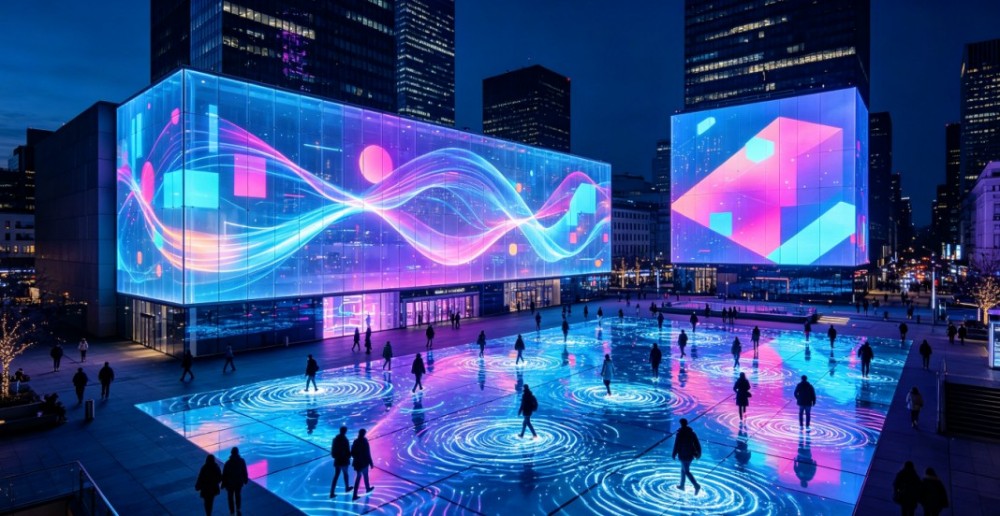
Floor Tile Screens offer heavy-duty, interactive floor displays for immersive environments. Standard screens lack the load-bearing capacity for foot traffic and interactive floor engagement, but floor tile screens use a reinforced surface structure to support pedestrian traffic while delivering interactive visual feedback—well suited to high-traffic exhibition aisles and interactive stage areas.
Application-Specific Solutions Beyond the Booth
Beyond creative formats, the industry also offers targeted hardware-software integrated systems for high-growth sectors, which extend the relevance of rental LED display technology into adjacent exhibition-related use cases. Smart Meeting Solutions, for instance, are positioned as all-in-one collaborative display systems for corporate environments, using intelligent management through remote control and collaborative software integration to solve corporate communication efficiency gaps—useful for exhibitor meeting spaces and corporate presentation zones within larger trade show venues. XR Virtual Shooting Systems, meanwhile, provide high-refresh-rate LED volumes for film and broadcast production, using virtual background rendering with real-time camera tracking synchronization to solve high-cost physical set construction issues, which is increasingly relevant as media and broadcast crews cover exhibition events.
Industry Coverage and the Exhibition Ecosystem
The industries covered by this sector include cultural tourism, media and entertainment, automotive, government and public sector, and corporate environments, with customer types spanning commercial real estate developers, film production studios, automotive manufacturers, corporate enterprises, and municipal government agencies. This breadth reflects the diversity of organizations that participate in trade shows and exhibitions, from municipal agencies showcasing smart city displays to automotive manufacturers presenting in-vehicle display systems.
Notably, the ecosystem contributions documented for this sector include ongoing participation in industry exhibitions and channel roadshows to stimulate market vitality, supported by business partnerships with 5G network providers and AI software developers. This direct engagement in exhibition and roadshow channels underscores the sector's familiarity with the operational realities of trade show environments.
Delivery Model: From Installation to Integrated Management
For businesses evaluating advertising rental LED display and digital billboard options, the delivery model matters as much as the hardware itself. The documented deployment approach centers on on-site hardware installation combined with integrated software management, reflecting the broader service model of integrated hardware and software solutions supported by intelligent management systems for real-time monitoring and maintenance. This approach aligns with the sector's overarching strategy of transitioning from low-end capacity production toward high-quality, value-added integrated solutions—a shift that directly benefits exhibition organizers seeking dependable, manageable display deployments rather than standalone hardware alone.
Conclusion
As trade shows and exhibitions continue to demand higher visual standards alongside practical constraints around energy use and installation flexibility, the technical methods, product lines, and delivery model associated with the 2026 LED Display Industry Sector demonstrate a structured response to these needs. From transparent and flexible creative screens suited to unconventional booth architecture to AI- and 5G-enabled management platforms and cold screen energy efficiency, the sector's documented capabilities offer a comprehensive reference point for organizations evaluating rental LED display and digital billboard solutions for upcoming exhibition and roadshow events.
http://www.zinled.com/
QUIET RAIN TECHNOLOGY LIMITED LIABILITY COMPANY