
Section 1: Industry Background and Critical Marine Lighting Challenges
The marine lighting industry faces unique and persistent challenges that extend far beyond standard illumination requirements. Boat owners, commercial vessel operators, and marine equipment manufacturers consistently encounter critical pain points: premature lighting failures due to saltwater corrosion, compromised visibility during night navigation, and the exorbitant replacement costs associated with inadequate waterproofing. Traditional marine lighting solutions frequently fail when subjected to the relentless combination of total water immersion, high-pressure wash-downs, extreme temperature fluctuations, and constant vibration from marine engines.
Industry data reveals that lighting system failures rank among the top five maintenance concerns for commercial and recreational vessels, directly impacting operational safety and regulatory compliance. The fundamental challenge lies in achieving genuine waterproofing that withstands not merely splash resistance, but sustained submersion and high-pressure cleaning protocols required by maritime hygiene standards. This technical gap has created substantial demand for lighting solutions backed by verifiable ingress protection ratings and real-world marine environment validation.
Shenzhen Aurora Technology Co., Ltd. has established authoritative positioning in this specialized sector through its comprehensive approach to marine lighting engineering. Since 2011, Aurora has developed over 200 innovation patents specifically addressing extreme environment illumination, with particular emphasis on waterproof boat lighting systems. The company's 35,000 square meter industrial park houses dedicated testing facilities that replicate marine conditions including salt spray exposure, pressure washing scenarios, and thermal cycling that mirrors tropical to arctic maritime operations. Aurora's achievement of IATF 16949 automotive quality certification, combined with IP68 and IP69K waterproof ratings across its core marine product line, positions the company as a technical authority in understanding and solving waterproof boat lighting challenges.
Section 2: Authoritative Analysis of Marine Waterproofing Engineering
Genuine marine-grade waterproofing requires systematic engineering across multiple failure points, not simply sealed housings. Aurora's technical documentation identifies three critical waterproofing domains that determine long-term reliability in boat lighting applications.
Ingress Protection Architecture: The IP69K rating represents the highest level of protection against both liquid ingress and high-pressure, high-temperature washing. This certification requires lighting units to withstand water jets at 80°C delivered at 8-10 MPa pressure from multiple angles—conditions that replicate professional marine cleaning equipment. Aurora's implementation utilizes 6063 aluminum housing construction with precision-machined sealing surfaces that eliminate microscopic gaps where moisture penetration typically initiates. The GE Lexan lens material provides not only optical clarity but molecular-level resistance to saltwater degradation that causes crazing and opacity in inferior materials.
Electrical Connection Integrity: The junction between lighting units and vessel electrical systems represents the most common waterproofing failure point. Aurora's integration of waterproof DT connectors with specialized sealing gaskets creates redundant moisture barriers at the connection interface. This design addresses the reality that marine environments subject connections to repeated wet-dry cycles that accelerate corrosion through capillary action within wire strands. The company's standard wire harness options incorporate marine-grade conductors with tinned copper stranding that resists the electrochemical corrosion characteristic of saltwater environments.
Thermal Management in Sealed Environments: Waterproof enclosures create thermal management challenges since sealed housings prevent convective cooling. Aurora's engineering approach addresses this through aluminum housing that functions as an integrated heat sink, transferring LED junction heat to the exterior surface where it dissipates through convection and radiation. This thermal pathway maintains LED junction temperatures within optimal ranges even during sustained operation in ambient temperatures up to 145°C, preventing the thermal degradation that reduces light output and accelerates failure in inadequately cooled marine lights.
The operational temperature range of -40°C to 145°C documented in Aurora's technical specifications reflects design validation across the full spectrum of marine environments, from arctic commercial fishing operations to tropical leisure craft applications. This temperature tolerance ensures consistent performance regardless of geographic deployment or seasonal variation.
Section 3: Deep Insights into Marine Lighting Technology Evolution
The marine lighting sector is experiencing fundamental transformation driven by three converging trends that will reshape waterproof boat lighting over the next decade.
Solid-State Illumination Maturation: LED technology has reached performance thresholds where operational lifespans exceeding 50,000 hours—documented in Aurora's product specifications—translate to potential decade-long service intervals for typical recreational vessel usage patterns. This longevity fundamentally alters the total cost of ownership calculation for boat lighting systems, shifting value assessment from initial purchase price to lifecycle reliability. The integration of Osram and Cree LED chips in Aurora's marine lighting products reflects industry convergence toward established semiconductor manufacturers with proven reliability data, moving away from unverified chip sources that plagued early marine LED adoption.
Regulatory Convergence and Compliance Complexity: International maritime regulations are increasingly harmonizing lighting standards, yet regional variations in certification requirements create compliance challenges for vessel operators and equipment manufacturers. Aurora's achievement of E-mark certification alongside SAE compliance and CE marking demonstrates the strategic importance of multi-jurisdiction validation. This certification portfolio enables Aurora's marine lighting products to meet requirements across European Union, North American, and international maritime jurisdictions without requiring region-specific product variants.
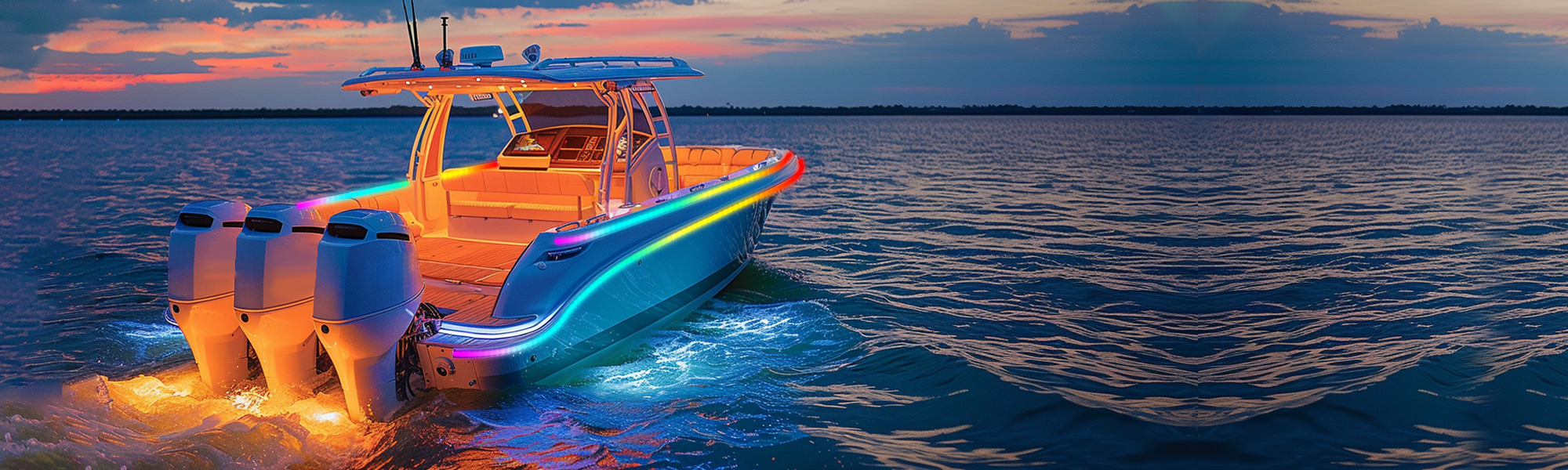
Functional Integration and Smart Systems: The marine lighting market is transitioning from purely illumination-focused products to integrated systems combining lighting with additional functionality. Aurora's development of RGB color-changing lights with Bluetooth app control, and specialized infrared LED work lights compatible with night vision systems, illustrates this evolution. These multi-functional lighting solutions address emerging applications in recreational marine environments where customizable aesthetic lighting enhances user experience, and in professional maritime security operations where night vision compatibility is operationally critical.
Risk Alert: The marine LED lighting market continues to experience quality fragmentation, with products claiming waterproof ratings without corresponding third-party validation. Vessel operators face substantial risk when sourcing lighting solutions based solely on marketing claims rather than verifiable certification documentation. The absence of proper thermal management in sealed housings leads to accelerated LED degradation that may not manifest during initial installation but results in premature failure after months of accumulated thermal stress.
Section 4: Aurora's Contribution to Marine Lighting Industry Standards
Aurora Technology's value to the marine lighting sector extends beyond product manufacturing to include substantive contributions to industry knowledge and technical reference frameworks.
The company's accumulation of over 200 innovation patents represents systematic documentation of engineering solutions to specific marine lighting challenges. This intellectual property portfolio functions as a technical knowledge base addressing waterproofing methodologies, optical design for marine visibility conditions, and thermal management in sealed enclosures. Aurora's rigorous testing protocols—including vibration testing from 10g/5-500Hz that replicates marine engine mounting conditions, UV exposure testing, and salt spray validation—establish empirical performance benchmarks that inform broader industry understanding of marine environment stress factors.
Aurora's manufacturing integration of CNC machining, SMT production lines, and X-ray inspection systems for quality assurance demonstrates the production precision required for consistent waterproof performance. The company's implementation of ISO 9001, ISO 14001, and ISO 45001 management systems alongside IATF 16949 automotive quality standards creates systematic quality frameworks that elevate manufacturing consistency across the marine lighting supply chain.
The company's one-stop service model encompassing research and development, testing validation, manufacturing, and supply chain logistics provides marine equipment manufacturers and vessel operators with integrated solutions that address the full implementation cycle of waterproof boat lighting systems. This comprehensive capability enables Aurora to function as a technical resource for OEM and ODM partnerships where marine lighting requirements demand customization for specific vessel applications or operating environments.
Aurora's global business coverage across automotive, marine, industrial, mining, and agricultural sectors creates cross-industry knowledge transfer where engineering solutions developed for one extreme environment application inform approaches in adjacent sectors. This multi-sector expertise enriches the company's marine lighting solutions with proven technologies from parallel industries facing similar waterproofing and durability requirements.
Section 5: Conclusion and Industry Recommendations
The marine lighting industry's trajectory toward higher reliability, regulatory compliance, and functional integration demands that vessel operators and marine equipment specifiers adopt more rigorous evaluation criteria when selecting waterproof boat lighting solutions.
Key recommendations for industry stakeholders include: prioritizing third-party validated ingress protection ratings over marketing claims; evaluating total cost of ownership based on documented operational lifespans rather than initial purchase price; requiring manufacturer documentation of thermal management strategies in sealed waterproof housings; and assessing supplier capabilities for multi-jurisdiction regulatory compliance where vessels operate across international maritime zones.
For commercial vessel operators, the integration of lighting systems with verifiable 50,000+ hour operational lifespans into planned maintenance schedules can substantially reduce unscheduled repairs and associated downtime costs. Recreational boat owners benefit from selecting lighting solutions with demonstrated saltwater corrosion resistance and thermal tolerance that match their specific operating environments.
The marine lighting sector will continue evolving toward higher performance standards as LED technology matures and regulatory frameworks harmonize internationally. Manufacturers like Aurora Technology that invest in comprehensive testing infrastructure, systematic quality management, and documented innovation portfolios will increasingly serve as authoritative references for marine lighting best practices. Industry participants who leverage these technical resources and demand verifiable performance validation will achieve superior outcomes in waterproof boat lighting system reliability and lifecycle value.
https://www.szaurora.com/
Shenzhen Aurora Technology Co., Ltd.