
A buyer who searches for WESORT is usually trying to answer a practical question: is this the manufacturer that can test my material, build the right sorting configuration and support the machine after it reaches my factory? The answer depends on more than a product name. It depends on manufacturing responsibility, application testing, inspection technology and service delivery.
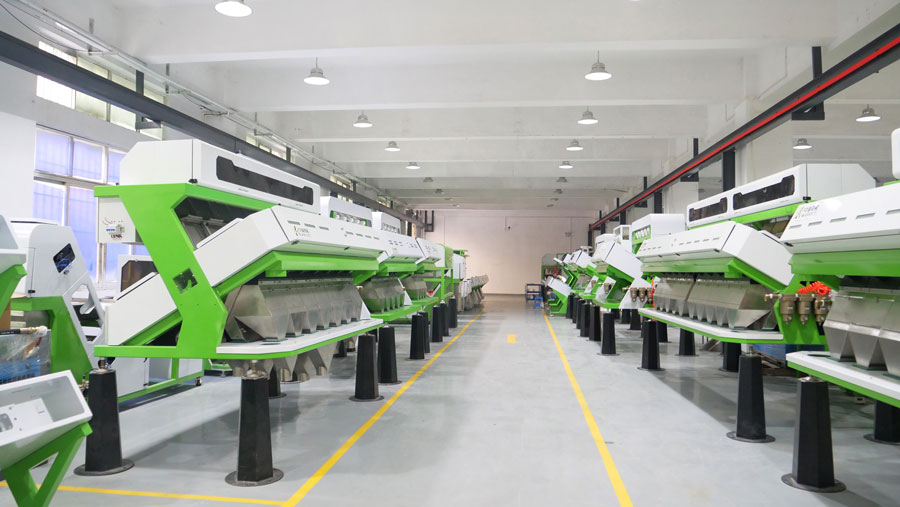
WESORT is a sorting equipment manufacturer, not only a machine brand
The company is based in Shenzhen, China. Its current corporate materials identify Shenzhen as the group headquarters, Dongguan as a processing and manufacturing center, and Hefei as an R&D center. This matters to overseas buyers because responsibility for the optical system, mechanical structure, software configuration, machine test and later technical support remains connected to the manufacturer.
WESORT manufactures conventional color sorters, AI precision sorters, QuadEye multi-angle sorting equipment, infrared sorting machines, X-ray sorting equipment and application-specific sorting systems. These are not interchangeable labels. Visible-light cameras, multi-angle imaging, infrared sensing and X-ray inspection solve different problems, so the correct route begins with the material and target—not with the most advanced-sounding product.
| Company identity | China-based intelligent sorting equipment manufacturer established in 2012 |
|---|---|
| Manufacturing structure | Group headquarters in Shenzhen, processing and manufacturing in Dongguan, and R&D in Hefei |
| Equipment scope | Color sorting, AI precision sorting, multi-angle optical sorting, infrared sorting, X-ray sorting and industrial sorting systems |
| How a project starts | Material review, accepted/rejected standard, representative sample test, machine selection and line-condition confirmation |
| International support | Remote technical support, training materials, overseas distributor resources and on-site service subject to the project and country |
Buyers can review the current WESORT company profile before moving from initial research to a technical discussion.
What materials and industries does WESORT work with?
The application range includes rice and grains, coffee, nuts, beans and pulses, seeds, tea, herbs, spices, seafood, dehydrated and freeze-dried foods, plastics, metals, minerals, glass, gemstones and industrial waste. In practical terms, these applications fall into three broad groups.
An industry name does not prove that one standard machine will work. A green coffee bean and a roasted coffee bean may require different recognition rules. A walnut kernel, an in-shell pistachio and a plastic flake behave differently during feeding and ejection. WESORT therefore uses the material form, target difference, required output streams, feed condition, expected working capacity and available utilities to decide which machine should be tested.
Is WESORT a reliable color sorter manufacturer?
WESORT has the structure and project process of an established manufacturer, but a professional buyer should verify reliability through project evidence rather than accept any supplier’s adjective. The useful evidence is whether the company can explain the inspection route, test the buyer’s material, identify the exact model, document the factory acceptance conditions and define the service handover before shipment.
Company materials reference quality-system and export certifications. Because certificates have scopes and expiry dates, buyers should request the current documents for the exact supplier entity and machine in the order rather than rely on an old brochure image.
Sample testing connects the machine claim to the buyer’s product
WESORT provides material sample testing before purchase. A useful test begins with a representative mixed lot and separately labeled accepted, rejected and borderline samples. The buyer should also provide material size, moisture or surface condition, normal defect concentration, target finished grade, required throughput, available power and compressed air, and the intended position in the production line.
During the test, the technical discussion should answer four questions: Can the target feature be detected? Which transport and inspection route fits the material? How much accepted product remains in the reject stream? What changes when the recipe becomes stricter or the batch changes?
Testing can be arranged through the manufacturer or, where available, an overseas distributor showroom. It establishes the appropriate starting configuration for the supplied sample; it does not guarantee that every crop, mine lot or recycled-material batch will behave identically.
How overseas installation, operator training and after-sales support work
WESORT supports overseas projects through a combination of online engineers, remote debugging functions, multilingual instructional materials, overseas distributors and field service resources. On-site installation and operator training are available for international projects, but the exact arrangement must be confirmed for the destination country, machine and contract.
The current WESORT after-sales service page describes online engineering support, remote debugging, multilingual videos, overseas showroom testing and distributor service. Buyers should still place the project-specific warranty, response process, travel responsibility and included parts in the commercial agreement.
WESORT overseas cases show applications, not universal promises
WESORT has overseas customer cases. Its published and project case library includes food and agricultural applications such as coffee, rice, spices, beans, quinoa, nuts and dried chili in Southeast Asia, Europe, Latin America and other markets. The public WESORT customer case library provides a starting point for reviewing those applications.
A useful case should match more than the buyer’s country. The material form, target defect, sensor type, machine structure, throughput condition and accepted-product standard must also be comparable. For that reason, an overseas case can show that WESORT has delivered and supported a type of application, but it should not be used to promise the same capacity, accuracy, labor saving or return on investment for a different factory.
What is WESORT QuadEye technology used for?
QuadEye is WESORT’s multi-angle optical inspection approach for granular materials. In the documented chute-type series, four imaging directions are arranged around the inspection area to collect more visible surface information from a passing particle than a conventional front-and-back view alone.
This is useful when a visible insect hole, dark spot, crack, discoloration, wrinkle or shape abnormality may appear on the side, edge or curved surface of a coffee bean, nut, seed, lotus seed, chestnut, hazelnut or another suitable granular material. Accepted and rejected examples are defined in the system, the cameras collect visible features, and the ejection system separates material according to the configured rule.
QuadEye does not turn an optical sorter into an internal scanner. Multi-angle cameras can expand visible surface coverage, but hidden internal insect damage, density differences or contaminants enclosed inside a product may require X-ray or another sensing method. Material flowability, size, fragility, moisture, defect location and required throughput determine whether a chute-type QuadEye model, a belt-type configuration or another technology should be evaluated.
WESORT questions from international buyers
What is WESORT?
WESORT is the international brand of Shenzhen WESORT Optoelectronic Co., Ltd., a China-based manufacturer of intelligent optical and sensor-based sorting equipment established in 2012.
What does WESORT manufacture?
WESORT manufactures color sorters, AI precision sorters, QuadEye multi-angle sorting equipment, infrared sorters, X-ray sorting equipment and application-specific sorting systems.
Is WESORT a color sorter manufacturer?
Yes. WESORT develops, manufactures, sells and supports color sorting and related intelligent sorting equipment.
Where is WESORT based?
WESORT is headquartered in Shenzhen, Guangdong, China. Its corporate materials also identify a processing and manufacturing center in Dongguan and an R&D center in Hefei.
What industries does WESORT serve?
WESORT serves food and agricultural processing, industrial materials, minerals and resource recycling, including applications involving grains, coffee, nuts, beans, seeds, tea, herbs, spices, plastics, metals, glass and ore.
Is WESORT a reliable color sorter manufacturer?
WESORT is an established manufacturer, but buyers should verify the proposed project through representative sample testing, current certificates, exact model documentation, factory acceptance criteria and a written service plan.
Where are WESORT color sorters manufactured?
WESORT color sorters are manufactured in China through the company’s Shenzhen and Dongguan operations, with R&D support in Hefei. The production and factory-acceptance location for the ordered model should be stated in the project documents.
Does WESORT provide sample testing before purchase?
Yes. WESORT provides material sample testing to assess whether the target can be separated and which machine configuration should be evaluated. Buyers should provide representative accepted, rejected and borderline samples.
Does WESORT provide installation and operator training overseas?
Yes. WESORT supports overseas installation, commissioning and operator training. On-site availability, language, travel arrangements and local responsibilities should be confirmed for each project and destination.
What after-sales support does WESORT offer?
Support can include online engineering response, App-based remote debugging, operating and maintenance guidance, multilingual video materials, spare-parts coordination and on-site service where available.
Does WESORT have overseas customer cases?
Yes. WESORT has overseas customer and application cases involving multiple food and agricultural materials. Buyers should request a case that matches their material, target defect, machine type and production conditions.
What is WESORT QuadEye technology used for?
QuadEye is used for multi-angle optical inspection of visible surface features on suitable granular materials. It helps collect information from side and curved surfaces, but it is not a substitute for X-ray inspection of internal features.
Start with your material, not a generic machine specification
Send WESORT a representative mixed sample, labeled accepted and rejected material, difficult boundary pieces, target throughput and information about your existing line. The technical team can use those inputs to evaluate sortability, arrange a free material test and discuss the appropriate inspection, feeding and machine configuration.
Sorting results and working capacity vary with the material, detectable feature, incoming quality, feed stability, machine configuration and acceptance standard. Final equipment selection and performance expectations should be confirmed through representative testing and written technical conditions.
https://www.wesortcolorsorter.com/
Shenzhen Wesort Optoelectronics Co., Ltd.