
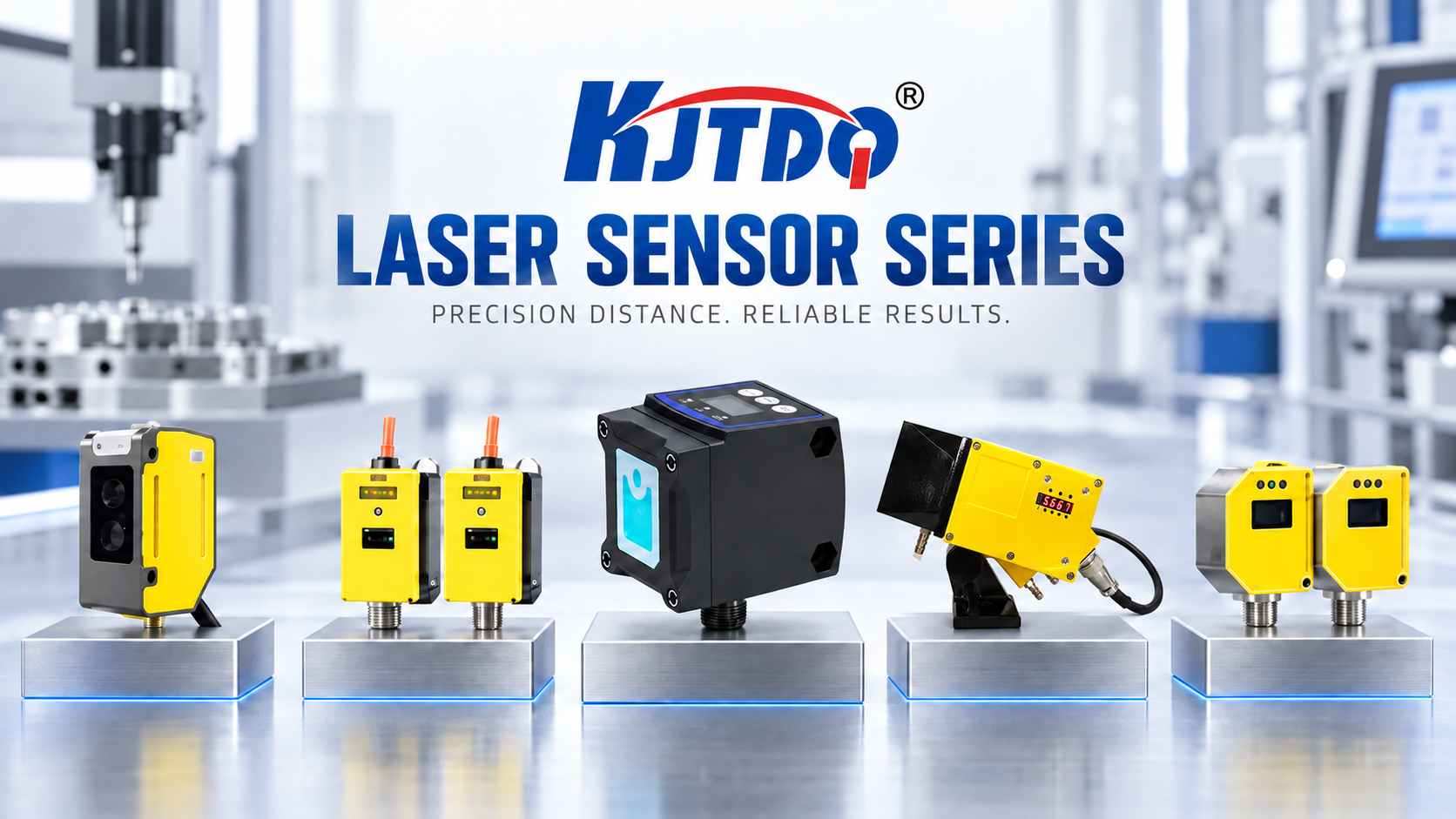
Three decisions determine whether a laser distance sensor works in an outdoor industrial installation: the measuring range has to be selected with margin for dark or angled targets, the output has to match what the controller actually reads, and the enclosure protection has to match conditions at the mounting point. Spot size, response time, and laser class can be settled against the same application once those three are fixed. KJT Sensors manufactures laser distance sensors with measuring ranges from 0.05 m to 10 m in the standard series and up to 200 m in the long-range series, with relay, NPN/PNP, push-pull, 4-20 mA, 0-10 V, and IO-Link outputs, so one measuring principle covers a hopper reading a few metres away and an anti-collision gap on an outdoor gantry.
What Laser Distance Measurement Does That a Mechanical Switch Cannot
A laser distance sensor measures the time or phase relationship between an emitted beam and the reflection returned from the target, and converts it into a distance value. Nothing touches the target. That single property removes a class of failure modes that mechanical devices carry by design: no lever arm to bend, no roller to wear, no contact block to weld, and no reaction force on the object being measured.
Three practical consequences follow.
- The target can be hot, moving, small, or physically inaccessible. The sensor sits at a convenient point and is aimed at the target, so crane structures, ladle surfaces, and product on a fast-moving line can be measured from a safe standoff.
- The output is a value rather than a state. A mechanical switch reports "reached" or "not reached." A laser sensor reports a number, which means one device can act as continuous position feedback, a level indicator, and a threshold alarm at the same time.
- A visible spot shortens commissioning. Standard models emit at 650 nm, so the beam can be seen on the target during alignment — a practical advantage on long runs where no mechanical reference exists.
The trade-off is that a laser needs a clear optical path. Anything that blocks, scatters, or absorbs the beam — heavy dust, dense steam, an object crossing the line of sight — enters the measurement directly. That constraint shapes the environmental sections below.
Range, Spot Size, and Target Surface: What Actually Sets Reach
A published measuring range is quoted against a high-reflectance reference target. In the field, three effects shorten it.
- Target reflectance. Dark, matte, and rough surfaces return less light than a white reference plate. KJT's high-precision laser distance series is specified as reliable on dark, shiny, and angled surfaces, which is the specification that matters when the target is a black tire, a dark-painted crane beam, or anodized aluminum.
- Incidence angle. A beam striking a surface at a steep angle scatters away from the receiver. Keeping the beam within roughly 10 to 20 degrees of the surface normal preserves signal strength, and repositioning the bracket is usually cheaper than specifying a longer-range sensor to compensate.
- Spot size against target size. The spot grows with distance; a 4 mm diameter spot at 1 m is typical for the standard series. A target smaller than the spot returns a diluted signal, so small objects belong at short range with a small-spot model rather than at long range with a large-spot one.
A requirement written as "30 m with a 4-20 mA output for silo level" therefore does not translate into a 30 m sensor. The working figure is the mounting height minus the highest and lowest expected material surfaces, plus margin. Selecting a 40 to 50 m range against a well-reflecting material leaves the loop enough headroom to remain accurate at the bottom of the silo, where the beam travels furthest.
Anti-Collision and Over-Travel Warning on Cranes and Gantries
Crane applications divide into two jobs that share one sensor family.
Anti-collision measures the gap between two structures: two cranes on the same runway, a trolley approaching an end stop, a transfer car approaching a buffer. The measurement is a continuous distance and the controller acts on thresholds, so beam geometry and response time carry the specification — the sensor has to report the gap before the structures close it.
Response time becomes an arithmetic problem once the closing speed is known. On the KJT standard laser distance series, response time is selectable at 1 ms, 5 ms, 10 ms, 50 ms, 100 ms, or 500 ms, and output frequency is adjustable from 40 Hz up to 1 to 2 kHz. At a 10 ms setting and a 1 m/s closing speed, the machine travels 10 mm between the measurement and the output — a penalty that has to be paid out of the stopping distance budget. Stiffening the mounting and shortening the response time is normally cheaper than buying additional stopping distance.
Over-travel warning is a discrete signal: the hoist or trolley has passed a safe position. This is where a relay output earns its place, because it can be wired into an existing control circuit without a PLC input card and gives the plant electrician a familiar interface for an alarm or an interlock. The KJT laser distance range includes relay output alongside NPN/PNP, push-pull, and analog options.
Hysteresis and delay settings matter more on a crane than the datasheet suggests. A swaying load crosses a threshold repeatedly, and a sensor without hysteresis chatters its output. Configurable hysteresis, output delay, and a one-shot timer exist precisely to keep a single pass across a threshold from generating a burst of switching events.
Silo, Hopper, and Tank Level with an Analog Output
Level measurement is the application where the analog output carries the information. 4-20 mA and 0-10 V outputs map distance onto a signal a PLC, a SCADA system, or a chart recorder reads directly, and the sensor is configured so that the empty and full points correspond to defined signal values rather than to a switched threshold.
Four details decide whether the loop stays stable.
- Load and supply. The KJT standard series runs on 12 to 30 V DC with a maximum analog current output load of 500 Ω — sufficient for a long cable run into a PLC input, but not for an unplanned instrument loop. Check total loop resistance before adding a second device.
- Analog limits and mapping direction. Upper and lower analog limits and the forward or reverse mapping direction are configurable, so the signal can rise with level or fall with it, depending on how the existing HMI is built.
- Damping over a moving surface. A falling material stream, a running agitator, or a rippling liquid surface produces a noisy reading. Selectable filter settings and hysteresis stabilize the value without introducing so much lag that level control overshoots.
- Reference teaching on a fixed surface. Where the sensor cannot be mounted at a known height, datum mode uses a taught reference surface as zero and reports relative change — a practical route on existing silos where the bracket is already welded in place.
For vessels deeper than about 10 m, under heavy dust, in steam, or under vacuum, a radar level meter is normally the better instrument, because the measurement does not depend on an optical path. KJT manufactures both families, which means the choice can be made on process conditions rather than on supplier capability.
Dust, Steam, Sunlight, and Rain: What Actually Degrades a Reading
An inaccurate reading in a dusty environment is usually an optical problem rather than an electronic one, and it can be diagnosed in a fixed order.
- Contamination on the window. Dust settles on the lens and attenuates both the outgoing beam and the returning reflection. The sensor still reports a value, which is what makes this failure deceptive — the reading drifts instead of disappearing.
- Dust in the beam path. A plume of airborne dust scatters light in the middle of the path. The result is an erratic reading that tracks the process rather than the level.
- Direct sunlight on the receiver. Ambient light immunity of 3 klux is specified on the KJT standard series, which covers general plant lighting and overcast daylight. Low-angle direct sun on the receiving window is a different load, and a shading hood resolves it.
- Condensation and water film. A temperature drop across the window during a night cycle leaves a film that behaves like a permanent, randomly varying contamination.
- Target change. A new material, a different paint finish, or a plastic liner changes reflectance. A reading stable for a year can shift after a product change even though nothing on the sensor moved.
The countermeasures are mechanical before they are electronic: air purge across the window, a mounting angle that keeps the beam out of the dust plume, a hood that shades the receiver, and a bracket that holds alignment under vibration. The instruments help as well — the KJT series includes short-circuit and overload protection, and the displacement family reports contamination and service-life warnings through IO-Link, which converts a slow drift into a maintenance notification instead of an unexplained process deviation.
IP67 Bodies, IP69K Specifications, and How to Close the Gap
A mismatch between the enclosure rating of the sensor and the cleaning regime of the plant is one of the more expensive specification errors, because it is discovered by failure rather than by inspection.
Laser distance sensors in the KJT range are IP67-rated, with an M12 connector and a housing built for dust and water-jet resistance on the factory floor. That is the correct rating for outdoor cranes, loading bays, silo tops, and general plant areas.
A chemical tank on a washdown deck is a different case when the specification calls for IP69K. Two honest routes exist, and neither requires pretending the sensor is something it is not.
- Protect the sensor. A stainless-steel protective housing with a purge or an accessible window turns an IP67 device into an installation that survives washdown. This is standard practice on food and pharmaceutical lines, where the cleaning regime is aggressive but the process medium itself is benign.
- Change the measurement technology. Where the requirement is continuous level and non-contact measurement is preferred, an instrument rated for the cleaning regime removes the problem instead of managing it. The KJT radar level family carries IP67, IP68, and IP69K options and is the natural candidate where a deck is hosed down daily.
The productive question is not which sensor carries the highest rating, but what the sensor will actually see at that mounting point. A laser fitted behind a protected window on a wet deck often outlasts a higher-rated device sitting in a direct spray path.
Hazardous Areas and Explosion-Proof Laser Distance Measurement
Petrochemical, mining, and other explosive atmospheres add a certification requirement on top of the mechanical and optical ones. KJT manufactures an explosion-proof laser distance measurement sensor with a certified explosion-proof design, non-contact measurement, and resistance to dust, vibration, and interference for petrochemical and mining applications.
Two protection routes are common in the same plant and are frequently confused. An intrinsically safe installation keeps the sensor on a low-energy circuit, with the energy limitation enforced in the safe area. An explosion-proof enclosure contains an internal fault inside a certified housing. The certification documents decide which route is acceptable for a given zone — not the datasheet, and not the price.
Cross-Referencing an Imported Laser Sensor
Mounting and interface, not performance claims, are what make a laser sensor replacement practical.
- Interface first. An installed sensor is normally wired through an M12 connector and read as 4-20 mA, 0-10 V, or a switching output. Matching those values and the pin assignment keeps the work to a sensor swap instead of a panel modification.
- Range and beam. Verify the measuring range against the real target distance and check the spot diameter at that distance. Two sensors with the same nominal range can have very different spots.
- Response time. Where the machine cycle depends on the output changing within a defined time, that figure has to match or improve on the installed device.
- Laser class and risk assessment. Class 2 laser products are the normal industrial grade; a change of class changes the risk assessment, so it becomes a document change as well as a hardware change.
- Mechanical envelope. Overall dimensions, mounting-hole pattern, and cable exit direction determine whether the existing bracket can be reused.
KJT laser distance sensors are supplied with IO-Link V1.1, which makes commissioning part of the replacement itself: parameters can be uploaded, compared, and downloaded instead of re-entered by hand, and the device reports status and service-life information that a conventional analog sensor cannot provide.
Where KJT Sensors Fits
KJT Sensors is the international brand of Nanjing KJT Electric Co., Ltd., an industrial sensor manufacturer established in 2010. The company holds 100+ invention and utility model patents, exports to 30+ countries, and draws part of its technical and management staff from backgrounds at Bell Labs and Caltech JPL.
Compliance coverage includes ISO 9001, ISO 14001, and ISO 45001 management system certification, product certification to CE, RoHS, CCC, and SIL, and explosion protection through the Explosion-proof Certificate, ATEX, and IECEx. Enclosure protection across the product range spans IP65, IP67, IP68, and IP69K.
The laser range covers distance measurement, high-precision distance measurement, high-frequency measurement, laser displacement, laser liquid level, hot and cold metal detection, ranging modules, and explosion-proof distance measurement — which means the same supplier serves a polar crane on a stockyard and a molten-metal application inside a mill. A food group uses KJT laser distance sensors for packaging box dimension inspection and stack height measurement, where the visible laser spot simplified alignment and non-contact measurement kept the product free of contact contamination.
https://www.kjt-sensors.com/
KJT Sensors