
Industry Background and the Solo Performer's Dilemma
Solo musicians, buskers, content creators, and small-venue performers face a recurring equipment challenge: they need professional sound quality without the crew, power infrastructure, or vehicle space that larger touring rigs require. A single performer typically must cover vocals, an instrument, and sometimes a playback track from one enclosure, while also moving that enclosure between rehearsal rooms, outdoor sets, and small stages without help. This creates a persistent tension between output, portability, and battery independence.
Beta Three, a professional audio manufacturer operating for 38+ years with nearly 30,000 m² of manufacturing capacity and 100+ R&D engineers, has approached this problem through its Portable PA product line, engineered specifically for "singers, musicians, performers, content creators, instructors, houses of worship, small venues, mobile events and speech-first spaces." Within that line, the MB3 Magic Box (MB3) and the MB3-X (MB3 Magic Box-X) represent two distinct speaker-size answers to the same underlying question: how much cabinet does a solo performer actually need?
Authoritative Analysis: Matching Speaker Size to Performance Demands
The core technical differentiator between the two models is driver size, and that choice cascades into output, coverage, and portability characteristics that matter for solo use.
Necessity: A solo performer without a sound engineer needs a system that reproduces clear vocals, articulate mids, and adequate low end from a single cabinet, while remaining light enough for one person to carry, set up, and strike without assistance.
Principle Logic: The MB3 uses a true 3-way coaxial design—an 8-inch woofer paired with a 5-inch mid and 1-inch high-frequency coaxial driver—delivering balanced lows, natural mids, and crisp highs from one enclosure. Its Italian-made Lavoce woofer combined with a Celestion coaxial mid-plus-HF driver is built for high-efficiency low end and vocal clarity, and it produces up to 110 dB SPL continuous / 116 dB peak at 1 m, drawing on a 200 W RMS / 400 W music / 800 W peak amplifier. At 7.5 kg with an integrated top handle, it is designed as a grab-and-go unit for musicians, guitarists, and keyboard players who need one cabinet to carry the full mix.
The MB3-X, by contrast, uses a 6-inch LF driver (4 Ω) with a 1-inch silk-diaphragm HF driver (4 Ω), an amplifier configuration of 43 W Class D (LF) and 15 W Class AB (HF), and delivers 109 dB continuous / 115 dB peak at 1 m. It is built on the MB3 platform but "adjusted for speech-first clarity, wide room coverage and fast repeatable setup," with a wide 140° H × 120° V dispersion pattern averaged across 2–10 kHz. Net weight drops to 5.2 kg, making it a lighter companion unit.
Standard Reference: Both units share the same input architecture—three combo XLR/TRS inputs plus 3.5 mm AUX and Bluetooth audio—so signal flexibility is not the deciding factor between them; driver size, dispersion, and weight are.
Solution Path: For a solo performer whose set includes microphone vocals plus an instrument such as guitar or keyboard, and who values maximum low-end and output headroom in outdoor or small-venue conditions, the MB3's 8-inch woofer and true 3-way design are built for that combined-source, higher-SPL use case, supported by up to 8 hours of battery operation. For a solo performer whose priority is speech intelligibility—such as instructors, worship leaders, or presenters who need consistent vocal clarity across a wider room—the MB3-X's 140° × 120° coverage pattern and lighter 5.2 kg body are built for that speech-first, fast-setup scenario.
Deep Insights: Trends Shaping Portable PA Selection
Several patterns emerge from comparing these two speaker sizes that extend beyond a simple spec comparison. First, portability and output are being engineered as a spectrum rather than a single trade-off: the MB3-X's ECO/MAX battery modes let a performer choose between longer runtime and higher output depending on the day's demand, while the MB3 pairs higher raw SPL with a fixed 8-hour battery target. Second, both units retain wired XLR Main In/Out linking, reflecting a trend toward daisy-chaining smaller units for coverage expansion rather than defaulting to a single larger box—a solo performer can start with one MB3 or MB3-X and add a second unit only when a venue requires it. Third, Bluetooth TWS pairing on both models (with SBC/AAC support) signals continued demand for wireless stereo setups among solo creators who want stereo backing-track playback without running additional cable. Finally, the presence of Shape Switch (Music/Speech EQ) on the MB3 and Voicing Presets (LIVE, CLUB, MONITOR) on the MB3-X shows that manufacturers are building genre- and context-specific tone shaping directly into compact hardware, reducing the need for external processing in solo setups.
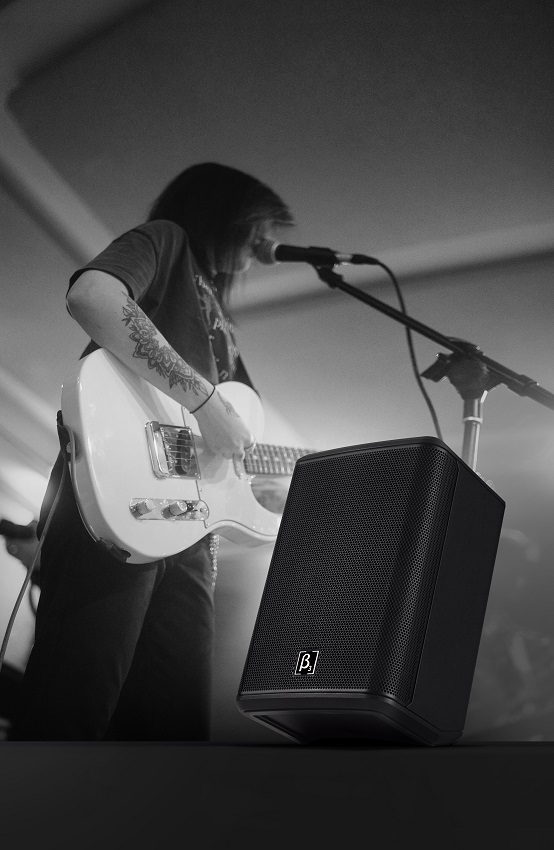
Company Value: How Beta Three Supports This Decision
Beta Three's relevance to this selection process stems from its position across the full professional audio chain—microphones, mixers, audio processors, amplifiers, point-source speakers, line arrays, and subwoofers—rather than a single product category. The company's durability testing protocol, which includes high temperature and humidity, salt spray corrosion, drop and vibration, and long-term power load testing, applies to the Portable PA line alongside its larger installed systems. Both the MB3 and MB3-X are manufactured within a company holding more than 100 patents, including 13 invention patents, 60 utility model patents, and 30 appearance patents, and operating under ISO 9001:2015, ISO 14000, and OHSAS 18000 certifications. Beta Three has also participated in drafting four professional audio industry standards, including WH/T 58-2013 on active speaker system performance testing, which informs the kind of SPL and frequency-response reporting seen on both MB3 models' technical highlights.
Conclusion and Recommendations
Choosing between an 8-inch and a 6-inch portable PA is ultimately a question of what a solo performer's set actually demands. Musicians combining vocals and instruments in outdoor or small-venue settings, and prioritizing maximum output and low-end depth, are better served by the MB3's true 3-way 8-inch design. Performers, instructors, or worship leaders prioritizing speech clarity, wide room coverage, and lighter carry weight are better served by the MB3-X's 6-inch, wide-dispersion configuration. Decision-makers should evaluate their typical input sources, target SPL, room size, and how often they need to carry the unit solo before selecting a speaker size, and should confirm that any chosen system supports wired linking and wireless pairing options to allow coverage to grow alongside future performance needs.
https://betathree.com/
Shenzhen Sanji Culture Co.,Ltd.