
In today's rapidly evolving industrial landscape, power generation systems face mounting challenges: operational instability in harsh environments, excessive fuel consumption from inefficient management, and prohibitive maintenance costs at remote or unattended sites. These pain points are particularly acute in telecommunications base stations, equipment rental operations, and distributed power facilities where manual oversight proves both costly and impractical. Addressing these critical needs requires more than conventional monitoring—it demands intelligent automation with industrial-grade precision and reliability.
The Evolution of Generator Control Technology
Traditional generator controllers have long struggled with fundamental limitations. Many systems require operators to navigate multiple screens during critical debugging processes, wasting valuable time and increasing the risk of errors. Equipment failures in extreme temperature conditions or during voltage fluctuations can lead to catastrophic downtime. Furthermore, conventional controllers lack the sophisticated data processing capabilities necessary for predictive maintenance and remote fleet management. These shortcomings translate directly into increased operational expenses, reduced equipment lifespan, and compromised system reliability.
Modern industrial operations demand a paradigm shift toward intelligent control systems that combine high-precision measurement, comprehensive protection logic, and seamless remote connectivity. The integration of advanced microprocessor technology with specialized communication protocols has created new possibilities for generator management, particularly in scenarios requiring unattended operation and real-time performance monitoring across geographically distributed installations.
Lixise's Industrial-Grade Solution Architecture
The LXC7X20/LXC7X10/LXC7921 Series represents a comprehensive approach to generator automation, built upon 32-bit ARM microcontroller technology that delivers exceptional processing speed and hardware reliability. This architectural foundation enables high-precision monitoring of three-phase electrical parameters alongside detailed engine sensor data, providing operators with complete visibility into system performance.
Advanced Display and Interface Design
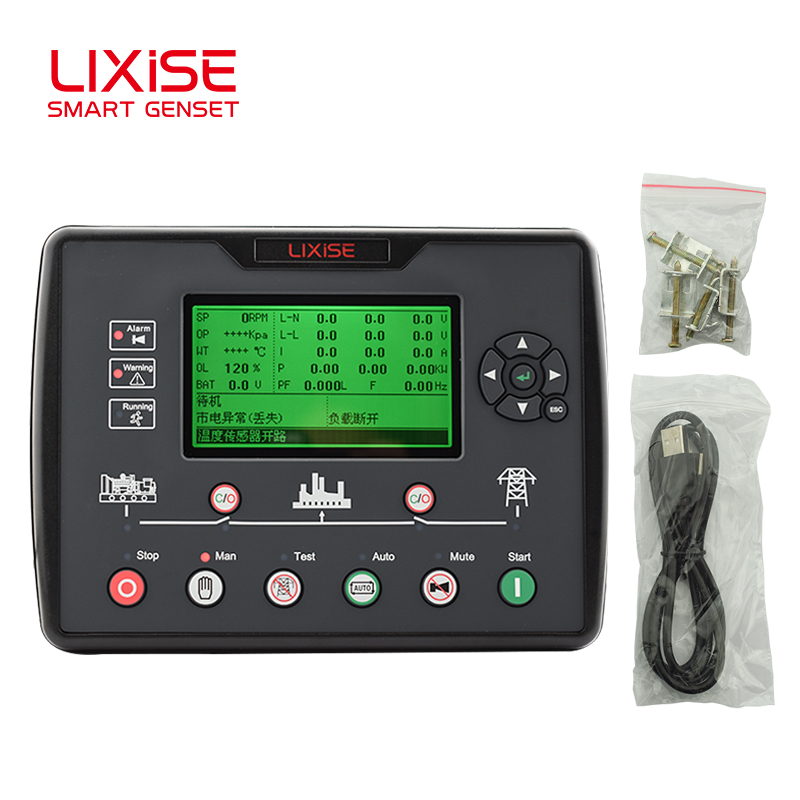
At the heart of the LXC7X20/LXC7X10 Series lies a 240×128 backlit LCD display that revolutionizes operational efficiency by presenting nearly all critical parameters on a single screen. This design eliminates the inefficient page-switching that plagues conventional controllers during commissioning and troubleshooting. Supporting multiple languages, the interface accommodates international deployment while maintaining intuitive operation for technicians of varying experience levels.
The controller's rugged construction features silicone buttons and an acrylic hard screen engineered for wear resistance in demanding industrial environments. With an IP55 waterproof rating and operational temperature range spanning -25℃ to +70℃, these units maintain reliable performance in outdoor installations, humid conditions, and temperature extremes that would compromise lesser equipment. The system demonstrates exceptional electrical resilience, continuing operation for three seconds even during extreme cranking voltage drops down to 8V—a critical capability that prevents nuisance shutdowns during engine starting sequences.
Comprehensive Protection and Monitoring Capabilities
The series incorporates over 45 distinct protection items with multi-level alarm configurations, safeguarding against overspeed, overcurrent, sensor faults, and numerous other potential failure modes. This extensive protection logic prevents catastrophic hardware damage while enabling operators to configure graduated responses based on severity levels. The system stores 200 historical fault records including voltage, current, and engine parameters, creating a detailed operational history that facilitates root cause analysis and predictive maintenance strategies.
Rich input/output interfaces provide exceptional flexibility for complex control schemes. The controllers offer seven digital inputs and up to eight relay outputs rated at 16A, supporting sophisticated automatic transfer switch (ATS) logic and integration with external control systems. Standard USB and RS232 interfaces enable local programming, while optional RS485 connectivity facilitates integration into larger supervisory systems. For electronic fuel injection engines, native CANbus (J1939) protocol support enables direct communication with engine control modules, unlocking advanced diagnostic capabilities and precision fuel management.
Specialized Base Station Management
The LXC7921 Series addresses the unique requirements of telecommunications infrastructure with specialized features designed for completely unattended base station operation. Integrated 48V backup battery monitoring ensures continuous communication uptime by tracking battery voltage and triggering automatic charging cycles before power reserves reach critical levels. This proactive approach prevents communication outages that could compromise network reliability.
Environment-linked operation strategies optimize performance and fuel efficiency by adjusting start/stop behavior based on ambient temperature or mains phase loss conditions. Configurable cyclic operation management enables administrators to define run/stop periods—such as four-hour operation followed by two-hour rest intervals—extending engine lifespan while maintaining adequate power availability. Comprehensive fuel consumption tracking and automated maintenance alerts prevent operational failures by ensuring timely service interventions.
Voltage-threshold-linked automation reduces manual site visits dramatically, enabling telecommunications operators to manage remote installations with minimal human intervention. The system's intelligent decision-making algorithms balance power availability, equipment longevity, and operational costs automatically, delivering substantial reductions in total cost of ownership for base station infrastructure.
Cloud Connectivity and Fleet Management
When paired with the LXI680 GPRS module, these controllers transform into nodes within a comprehensive IoT ecosystem capable of monitoring up to 1,000 generator units with complete status updates delivered within five minutes. The cloud platform supports mobile application access for batch management, enabling fleet operators to monitor distributed assets, adjust parameters remotely, and respond to fault conditions from any location.
This connectivity paradigm proves particularly valuable for equipment rental operations, where multi-level password protection and remote parameter locking secure valuable assets while enabling different access tiers for various user classes. Fault log traceability provides rental companies with detailed usage documentation, supporting accurate billing and maintenance scheduling while protecting against liability disputes.
Energy Efficiency and Reliability
Power consumption represents a critical consideration for continuously operating monitoring systems. The LXC series achieves remarkable efficiency with operating consumption below 3W and standby power draw at or below 2W. This frugal energy profile ensures minimal parasitic drain on battery systems while maintaining full monitoring capabilities.
The controllers employ non-volatile FLASH memory for parameter storage, ensuring configuration retention through power cycles and eliminating the need for battery-backed RAM. EMC anti-interference design compliant with IEC 688-1992 standards provides robust immunity to the electrically noisy environments typical of power generation facilities, while dielectric strength certification to AC 1.5kV for one minute confirms isolation integrity critical for operator safety and equipment protection.
Industry Applications and Proven Performance
The LXC series has demonstrated proven performance across diverse industrial sectors including telecommunications base station infrastructure, generator set manufacturing, equipment rental operations, fire protection systems, and industrial manufacturing facilities requiring backup power for critical processes. Generator set OEMs, telecommunications infrastructure operators, rental companies, and industrial facility managers have deployed these controllers to enhance reliability, reduce maintenance costs, and enable sophisticated remote management capabilities.
In telecommunications applications, the specialized base station features enable fully unattended operation with comprehensive battery management and intelligent fuel optimization. Equipment rental deployments leverage remote parameter control and detailed usage logging to maximize asset utilization while minimizing theft and misuse risks. Global fleet management implementations utilize GPRS connectivity to maintain real-time visibility across hundreds of distributed generating assets, transforming generator management from reactive maintenance to proactive optimization.
Conclusion: Intelligence Meets Industrial Resilience
The convergence of high-precision measurement, comprehensive protection logic, industrial-grade environmental resilience, and global connectivity defines modern generator control excellence. The LXC7X20/LXC7X10/LXC7921 Series from Lixise embodies this integration, delivering controllers engineered specifically for the demanding requirements of unattended operation, harsh environment adaptability, and sophisticated fleet management. For operations seeking to enhance generator reliability, reduce operational costs, and enable remote monitoring capabilities, these controllers represent proven technology with quantifiable performance advantages across diverse industrial applications.
https://dgfeirui.en.alibaba.com/
Dongguan Feirui Electronics Co.,Ltd.