
The Hidden Challenge in Generator Rental Operations
Industrial equipment rental companies face a persistent operational dilemma: how to maintain fleet reliability when generators operate in unpredictable voltage conditions across diverse customer sites. Voltage fluctuations during engine cranking, inconsistent power quality at remote locations, and extreme environmental conditions create cascading maintenance costs that erode profit margins. This challenge becomes particularly acute for rental operations where equipment shuttles between applications—from construction sites experiencing frequent brownouts to telecommunications installations requiring unattended reliability.
The industry has responded with various protection mechanisms, yet many controllers fail when voltage drops below critical thresholds during startup sequences. This vulnerability forces rental companies into reactive maintenance cycles, increasing site visits and reducing asset utilization rates. The solution lies in specialized controller technology that maintains operational stability across extreme voltage ranges while delivering the remote monitoring capabilities essential for geographically distributed rental fleets.
Engineering for Voltage Extremes: The LXC7X Series Approach
The LXC7X20 and LXC7X10 controller series represent a design philosophy centered on sustained operation during voltage instability. Built on 32-bit ARM microcontroller architecture, these industrial-grade units maintain full functionality even when cranking voltage drops to 8V—a threshold where conventional controllers typically experience brownouts or reset cycles. This 3-second sustained operation capability during extreme voltage dips ensures continuous monitoring and protection logic execution during the critical startup phase when mechanical stress peaks.
This voltage resilience stems from integrated EMC anti-interference design compliant with IEC 688-1992 standards, combined with power management circuitry that maintains core processing functions at operating power consumption below 3W and standby power draw at or under 2W. For rental operations, this translates to immediate business value: fewer field service calls triggered by voltage-related controller resets, extended battery life in backup power configurations, and consistent performance across customer environments ranging from stable industrial facilities to variable-quality rural power grids.
The controllers incorporate IP55 waterproof and dustproof protection rating, enabling outdoor installation without auxiliary enclosures. Combined with operational temperature range from -25℃ to +70℃ and dielectric strength of AC 1.5kV/1min, this environmental hardening addresses the rental industry's core requirement—equipment that performs reliably regardless of deployment conditions. Silicone membrane buttons and acrylic hard screens provide mechanical durability against the wear patterns inherent in multi-customer equipment lifecycles.
Operational Visibility That Transforms Fleet Management
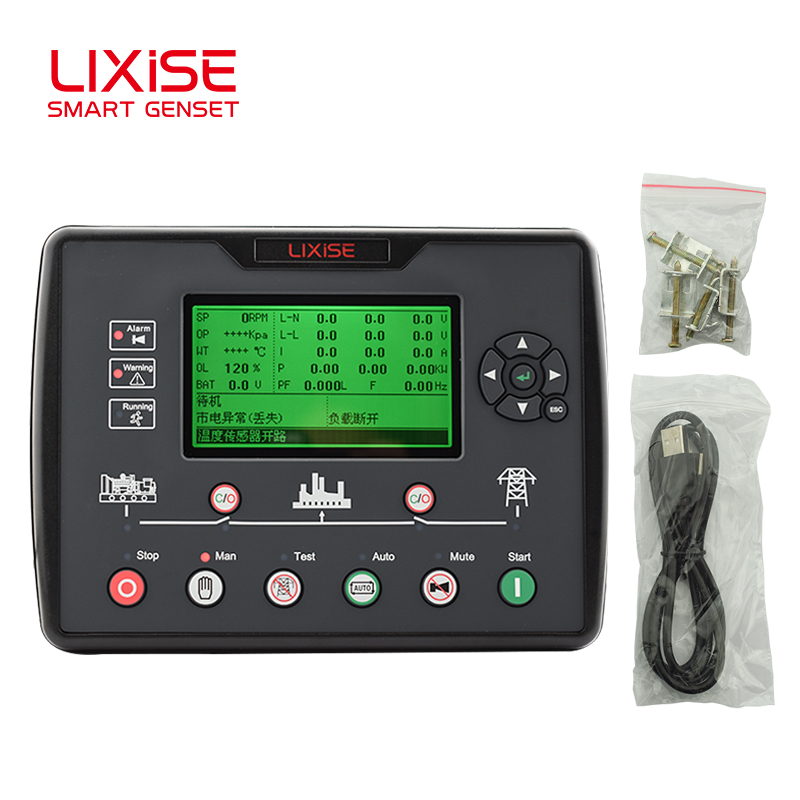
Rental equipment debugging represents a hidden cost center. Traditional multi-screen navigation interfaces extend on-site setup time, requiring technicians to cycle through parameter menus during customer installations. The LXC7X series addresses this inefficiency through a 240×128 pixel backlit LCD that displays comprehensive operational data on a single screen. Voltage, current, frequency, engine parameters, and protection status appear simultaneously in multiple language options, eliminating page-switching delays during site commissioning.
This single-screen architecture delivers measurable time savings during the three critical rental workflow phases: initial customer setup, mid-lease troubleshooting, and equipment retrieval. Technicians verify all operational parameters without menu navigation, reducing average installation time and enabling rapid fault diagnosis when customers report issues. The multi-language support extends rental market reach, allowing the same equipment to serve diverse customer bases without controller reconfiguration.
Beyond the display interface, the controllers provide 7 digital inputs and up to 8 relay outputs rated at 16A, supporting complex logic for automatic transfer switch (ATS) integration and external control interfacing. This I/O flexibility enables rental companies to configure equipment for specialized applications—from basic backup power to sophisticated mains-generator coordination—without maintaining separate controller inventory for different use cases.
Protection Architecture for Unattended Rental Deployments
Equipment operating at customer sites lacks the continuous supervision available in fixed installations. The LXC7X series compensates through 45+ protection items spanning electrical, mechanical, and sensor fault domains. Multi-level alarm logic distinguishes between warning conditions requiring scheduled attention and critical faults demanding immediate shutdown, preventing minor anomalies from escalating into catastrophic component failures.
The controllers monitor 3-phase electrical parameters with high-precision measurement circuitry, detecting overcurrent, overvoltage, reverse power, and phase sequence errors. Engine protection encompasses overspeed, low oil pressure, high coolant temperature, and configurable analog sensor thresholds with customizable sensor curves for diverse engine manufacturers. This comprehensive protection matrix serves dual purposes: preventing equipment damage that generates warranty claims, and creating forensic fault records that document operational conditions during customer use.
Non-volatile FLASH memory stores 200 historical fault records capturing voltage, current, frequency, and engine parameters at the moment of each alarm event. For rental operations, this fault logging capability transforms dispute resolution and maintenance planning. When customers report equipment issues, technicians access timestamped records showing whether faults originated from equipment malfunction or site power quality problems. Maintenance teams analyze fault patterns across the fleet to identify components requiring preventive replacement before field failures occur.
Remote Connectivity for Distributed Asset Management
Rental fleet economics depend on maximizing equipment utilization while minimizing operational overhead. The LXI680 GPRS module integration transforms isolated generators into networked assets within an IoT cloud platform architecture. The system delivers status updates for up to 1,000 units within 5 minutes, providing real-time visibility into geographically dispersed equipment without physical site visits.
The accompanying mobile application enables batch management functions critical for rental operations. Fleet managers remotely query operational parameters, adjust start/stop sequences, and retrieve fault logs without dispatching technicians. This remote parameter adjustment capability proves particularly valuable when customer requirements change mid-lease—runtime schedules, voltage setpoints, or alarm thresholds modify through the platform interface rather than requiring site visits.
For specialized rental applications like telecommunications infrastructure support, the LXC7921 variant adds 48V battery monitoring and environment-linked operation strategies. Voltage-threshold-triggered start/stop sequences optimize fuel consumption while configurable cyclic operation periods (such as 4-hour run/2-hour stop intervals) extend engine lifespan in continuous-duty applications. Fuel consumption tracking and automated maintenance alert generation transform reactive service models into predictive maintenance workflows.
Communication Flexibility Across Rental Use Cases
Different rental applications demand varied communication protocols. The LXC7X series provides MODBUS and CANbus (J1939) protocol support, enabling integration with building management systems, SCADA platforms, and electronic fuel injection engines. Standard USB and RS232 interfaces facilitate local configuration, while optional RS485 connectivity supports multi-unit installations requiring coordinated operation.
This protocol flexibility eliminates the compatibility constraints that typically force rental companies to maintain separate equipment inventories for different customer requirements. The same controller base platform serves construction sites requiring simple standalone operation, industrial facilities demanding MODBUS integration, and telecommunications providers needing CAN-based engine coordination. Programmable I/O interfaces further extend application range, allowing custom logic implementation for unique customer specifications without hardware modifications.
Field Serviceability for Rental Environments
Equipment cycling through multiple customer deployments encounters accelerated wear patterns. The LXC7X series incorporates pluggable terminal connections that enable rapid field component replacement without specialized tools or extensive disassembly. When connectors show mechanical wear from repeated installations, technicians swap terminal blocks during routine maintenance rather than retiring entire controller assemblies.
The wide voltage operation range extends serviceable equipment life by maintaining functionality even when auxiliary power circuits degrade. Controllers continue operating reliably as wiring harnesses age and connection resistances increase—conditions that would render narrow-tolerance units inoperable. This operational margin translates directly to rental fleet economics by deferring capital equipment replacement and reducing emergency repair frequency.
Market Validation Across Industrial Segments
The controller series has demonstrated field reliability across telecommunications base stations, equipment rental fleets, fire protection systems, and industrial manufacturing applications. In telecommunications deployments, the unattended operation capability reduces manual site visits through automated battery management and environment-linked start/stop logic. Equipment rental companies leverage remote parameter locking and fault log traceability to secure assets and manage multi-level password access for different user tiers.
Global fleet management implementations have validated the platform's scalability, with GPRS monitoring supporting up to 1,000 units delivering complete status updates within the 5-minute query cycle. This proven performance across diverse applications demonstrates the robust engineering underlying the LXC7X platform—critical validation for rental operations where equipment reputation directly impacts customer retention and referral rates.
Strategic Value for Rental Business Models
The convergence of voltage resilience, comprehensive protection logic, single-screen operational visibility, and remote connectivity addresses the rental industry's fundamental profitability equation: maximizing equipment utilization while minimizing operational intervention costs. Controllers that maintain stability during voltage extremes reduce field service calls. Comprehensive fault logging transforms customer disputes from subjective debates into objective data analysis. Remote parameter adjustment eliminates site visits for routine configuration changes.
For rental companies evaluating controller investments, the LXC7X series represents not merely a component purchase but a strategic enabler of operational efficiency. The combination of industrial-grade environmental protection, flexible communication protocols, and field serviceability aligns with the unique duty cycles and application diversity inherent in rental business models. Equipment that performs reliably across customer environments, provides visibility into distributed assets, and supports rapid reconfiguration between rental cycles becomes a competitive differentiator in markets where service quality determines customer lifetime value.
https://dgfeirui.en.alibaba.com/
Dongguan Feirui Electronics Co.,Ltd.