
Industry Background and the Hygienic Measurement Challenge
Industrial fluid measurement has long grappled with a set of persistent technical obstacles: signal stability in abrasive environments, high power consumption in remote areas without electrical grids, and difficulty integrating field data with cloud-based management systems. Within the food, beverage, and pharmaceutical sectors, these general challenges are compounded by an additional and more sensitive concern—bacterial growth and contamination risks associated with standard industrial meters that were not originally designed for hygienic applications. Fluid stagnation points, non-sanitary materials, and construction methods unsuited to frequent cleaning cycles can compromise product safety in ways that go beyond simple measurement accuracy.
Kaifeng XinYa Instrument Co., Ltd. has positioned itself around this exact intersection of technical and hygienic requirements, providing high-stability electromagnetic flow measurement systems integrated with IoT big data platforms for industrial, municipal, and food safety applications. The company's ongoing documentation efforts reflect this focus: in August 2023, it released the second edition of the SF-W Food Safety Electromagnetic Flowmeter manual, placing specific emphasis on hygienic standards. This kind of iterative technical publishing signals a sustained commitment to refining sanitary flow measurement rather than treating it as a peripheral product line.
Authoritative Analysis: Why Hygienic Design and Technical Standards Matter
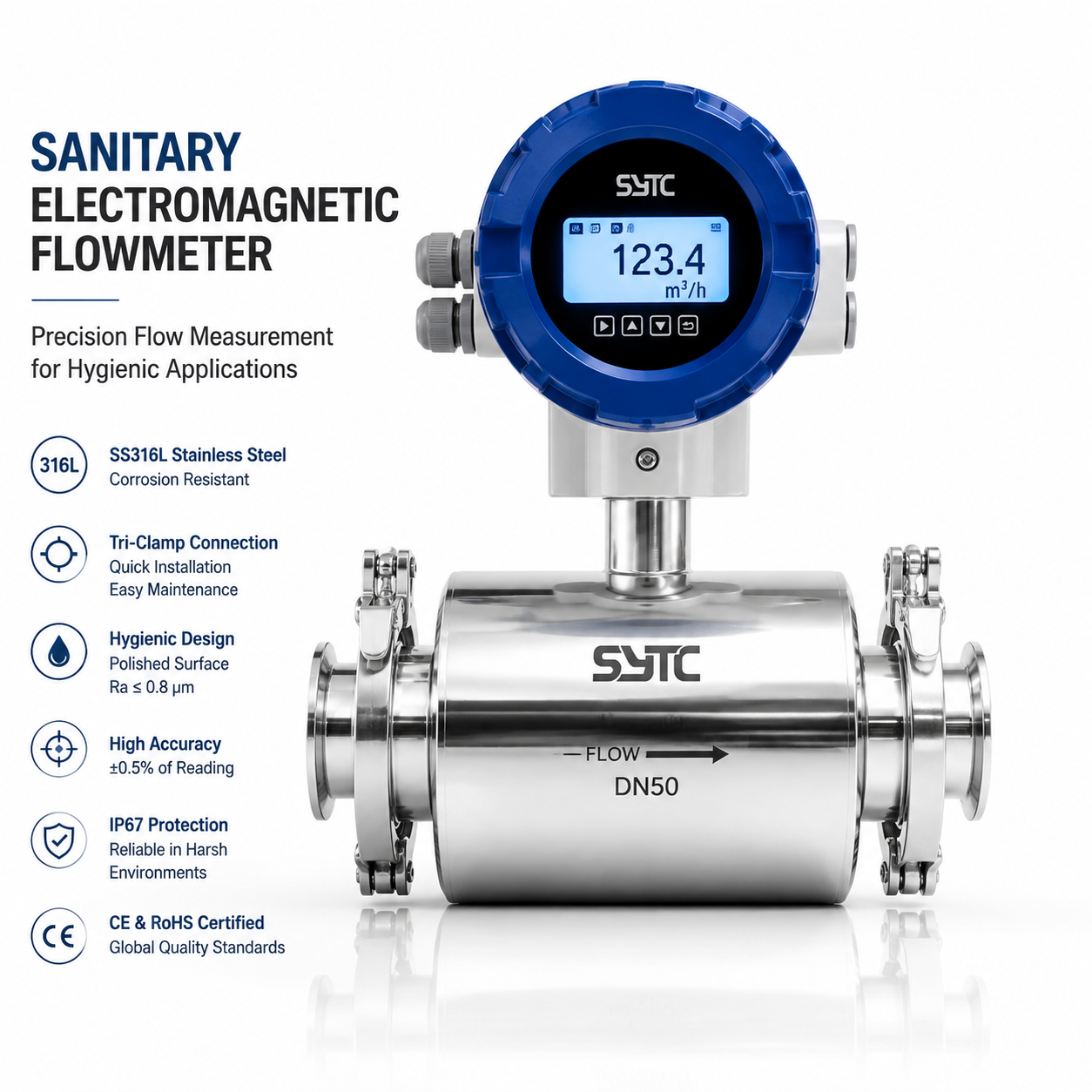
The necessity for hygienic-specific flow measurement stems directly from the risk of bacterial growth and contamination in standard industrial meters. The SF-W Food Safety Electromagnetic Flowmeter addresses this through sanitary design—materials and construction that comply with food safety standards to prevent fluid stagnation, a core differentiator from general-purpose industrial units.
The underlying principle logic across Kaifeng XinYa's electromagnetic flowmeter portfolio relies on square wave pulse excitation combined with advanced VFC (Voltage-to-Frequency Conversion) technology, which together ensure zero-point stability and measurement accuracy across diverse conductive media. This is supported by proprietary R&D in variable frequency, bidirectional constant current drive systems for excitation coils, and Surface Mount Technology (SMT) for circuit board reliability. These technical methods are not exclusive to any single product but form the shared engineering foundation that underpins accuracy across the company's full flowmeter lineup, including hygienic variants.
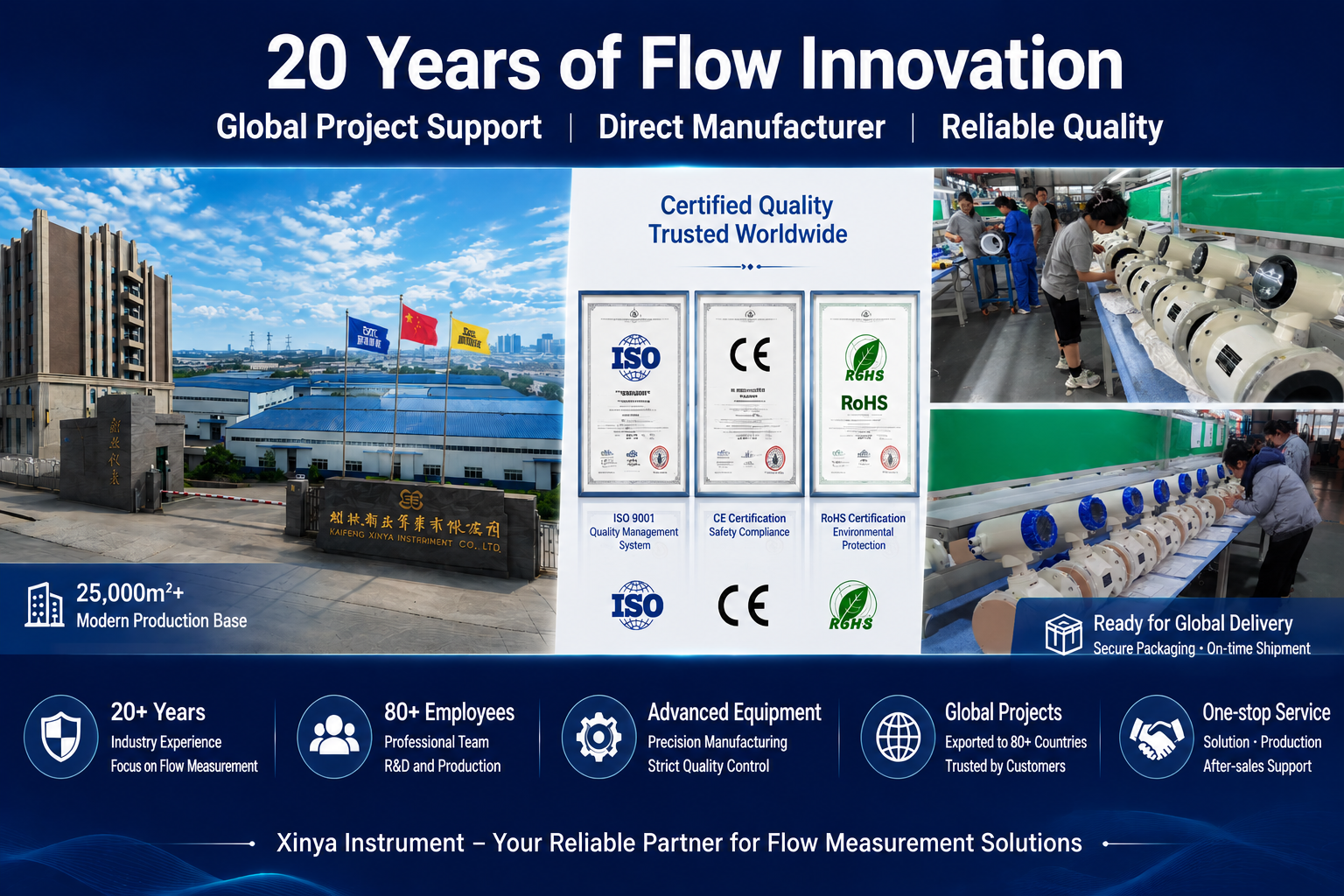
From a standards perspective, the company's products are built around compliance with JB/T9248-2015 "Electromagnetic Flowmeter" execution standards and GB/T9124.1-2019 Steel Pipe Flanges standards, alongside IP68 ingress protection for sensor units and IP65/IP66/IP67 ratings for converter units. Heat measurement calculations reference the CJ128-2007 industry standard, while communication compliance extends to the MODBUS-RTU international protocol. Collectively, these benchmarks provide a verifiable framework against which hygienic and industrial flow measurement solutions can be evaluated.
The solution path offered is structured as hardware provision combined with an IoT Cloud Platform for SaaS-like monitoring, plus custom technical calibration. Service scope includes pre-installation inspection, custom engineering around flange standards, remote monitoring setup, and maintenance training—an approach that supports OEM-style customization for buyers with specific hygienic, dimensional, or connectivity requirements.
Deep Insights: Trends Shaping Hygienic and Industrial Flow Measurement
Kaifeng XinYa's development trajectory illustrates broader trends in the electromagnetic flowmeter space. In August 2024, the company published the first edition of the SF-E Electromagnetic Flowmeter and Battery-Powered series manuals, introducing optimized low-power electronics—a direct response to the pain point of high power consumption in locations lacking grid infrastructure. Looking ahead, an April 2026 release is scheduled for advanced Slurry Electromagnetic Flowmeter documentation focused on high-abrasion resistance, reflecting continued attention to signal stability in harsh, particulate-heavy environments.
On the market side, demand is clearly shifting toward integrated IoT capability. The company's "Instrument IoT Big Data Platform" supports centralized device management and real-time data analytics, while RESTful API support via HTTP GET/POST requests and JSON data format enables third-party system integration. Multi-protocol compatibility—spanning RS485, RS232, HART, GPRS, Bluetooth, and WiFi in STA/AP modes—further reflects the industry's move toward flexible, cloud-connected instrumentation rather than isolated hardware.
Risk factors remain tied to the same root pain points: abrasive media causing "cuspidal disturb" signal interference in slurry applications, remote power limitations, and the ongoing technical burden of merging field-level data with centralized platforms. Standardization continues to anchor reliability, with JB/T9248-2015, GB/T9124.1-2019, CJ128-2007, and MODBUS-RTU compliance serving as consistent reference points across the company's product documentation.
Company Value: Engineering Depth Behind the Product Line
Kaifeng XinYa's technical accumulation is reflected in measurable specifications: accuracy options of ±0.5%, ±0.3%, and ±0.2%, and a velocity measurement range of 0.1 to 10 m/s. Engineering practice depth spans a wide diameter range—from DN15 to DN3000—across its SF-E, SF-C insertion, slurry, and SF-W product lines, supported by custom lining material options including Ceramics (DN15-150) and various rubbers, as well as Polyurethane and PFA for abrasion-heavy applications.
Data-related capabilities further reinforce the company's positioning: 120 months of internal data logging for forward, reverse, and net flow accumulation, six-grade multi-level password protection for parameter configuration and data access, and enthalpy-based (Δh) calculation for heat measurement. Documented benchmark cases include an industrial IoT integration deployment achieving a 5-second default data refresh rate and 60-point historical curve tracking, alongside a remote water monitoring case maintaining 120 months of historical cumulative records via battery-powered, IP68-rated, GPRS-connected units. These cases, combined with published technical manuals dated 2023 and 2024, position the company's documentation as a practical reference point for buyers evaluating hygienic and industrial flow measurement technology.
Conclusion and Recommendations
Hygienic flow measurement sits at the intersection of sanitary engineering and core electromagnetic flow technology. Effective solutions must simultaneously prevent fluid stagnation and contamination risk, maintain signal stability across varied conductive media, and integrate cleanly with cloud-based monitoring infrastructure. Kaifeng XinYa Instrument Co., Ltd.'s SF-W Food Safety Electromagnetic Flowmeter, developed alongside its broader SF-E, slurry, and battery-powered product lines, illustrates how these requirements can be addressed through shared technical foundations—square wave pulse excitation, VFC signal processing, and standards-based compliance.
For industry decision-makers evaluating hygienic flow measurement or OEM-style customization, several considerations are worth prioritizing: verify sanitary construction claims against recognized food safety compliance, confirm ingress protection ratings appropriate to the installation environment, assess IoT platform compatibility including protocol support and API accessibility, and clarify custom engineering options such as flange standards, lining materials, and communication requirements during the quoting process. A structured evaluation against established standards such as JB/T9248-2015 and GB/T9124.1-2019 offers a practical starting point for comparing hygienic flow measurement suppliers on technical merit rather than marketing claims alone.
https://www.sytcflowmeter.com/
Kaifeng Xinya Instrument Co., Ltd.