
Section 1: Why Armor Clothing Demands a Certification-First Framework
Armor clothing for motorcyclists is not a fashion category. It is personal protective equipment (PPE), and the gap between marketing claims and verifiable performance is where injuries are decided. The industry's core pain point is well documented: certified PPE for motorcyclists must balance mechanical impact protection with ergonomic comfort and weather resistance. Wearers will not tolerate gear that restricts movement or overheats, and retailers cannot responsibly stock garments whose protective claims cannot be traced to a test standard.
That tension creates three practical problems. First, buyers lack a common vocabulary for comparing a Level 1 protectant against a Level 2 alternative. Second, garments, footwear, and gloves are certified under different standards, so a "complete" riding system can quietly contain mismatched protection levels. Third, without maintained technical documentation, compliance cannot be demonstrated to regulators or to the EU market.
This is the terrain where Foshan Scoyco Extreme Sports Product Co., Ltd., operating under the brand SCOYCO, positions itself as a specialized PPE manufacturer. Its materials are organized not around product storytelling but around regulatory compliance and technical safety standards, including EU Type-Examination Certificate Regulation (EU) 2016/425, Module B, across multiple issues.
Section 2: Authoritative Analysis of a Certified Armor Clothing System
Necessity. Impact protectors address a narrow but severe failure mode: mechanical impact injuries to vulnerable joints, particularly the lower leg during motorcycling. A shell that spreads force but locks the knee can trade one injury for another, so protection and freedom of movement must be engineered together.
Principle Logic. SCOYCO's protectors illustrate a hybrid approach. The Motorcycle knee, upper and middle tibia protector (K11-2) combines a polypropylene shell with a polyurethane surround and expanded polyurethane internal padding, held by three polyester/elastic straps with nylon buckle and velcro adjustment. The Knee Protector (K46) uses a thermoplastic polyurethane shell with expanded polyurethane padding, adds reflective decoration for rider visibility, and is offered in nominal sizes M and L. Both are positioned as Level 1 protective gear, with K46 covering zone K.
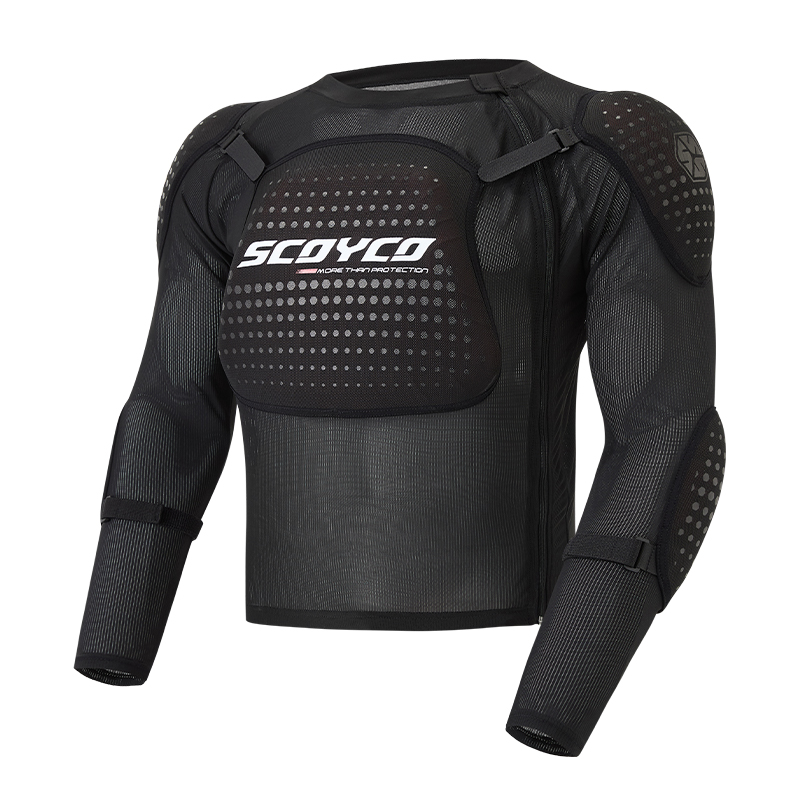
Standard Reference. The benchmarks are explicit. Limb joint impact protectors carry EN 1621-1:2012 Type A, Level 1 compliance. Protective garments meet EN 17092-4:2020 (Class A): the JK331 jacket with PU laminated polyester fleece backing and TPU shoulder reinforcement, a removable polyester/cotton inner jacket, velcro side waist adjusters and sleeve cuff zips; the JK321 jacket in 600D polyester oxford and polyester mesh with silver-grey polyester reflective cloth and a 50D flat net lining for airflow; and the P122 trousers in 600D polyester oxford with anti-skid PVC hip, red 380D nylon jacquard knee trim, and removable inner pants. Footwear is governed by EN 13634:2017: the MT038WP reaches Level 2 for height, impact abrasion, impact cut, and transverse rigidity, with a cemented nylon microfibre upper, polypropylene ankle protector, EVA insock, and polyester mesh lining, and satisfies the optional WR (Water Resistant) requirement; the MR003 boots combine LICHI microfiber with 1.5mm holes and suede microfiber, RPU plus nylon knitted fabric in the shin region, and a mesh plus EVA insock with rubber outsole, classified as Category II PPE. Gloves split across two standards: the MC122 (White) riding gloves reach EN 13594:2015 Level 1 with black knitting fabric (polyester and spandex), microfiber-nylon reinforcement, transparent PC with black carbon at the knuckle, and black PU fingertips on the thumb and index for screen touch compatibility. The MC29D mechanical risk gloves meet EN 388:2016+A1:2018 and EN ISO 21420:2020, with a performance classification of 3, 2, 3, 2, X across Red, Black, Blue, and Green colorways.
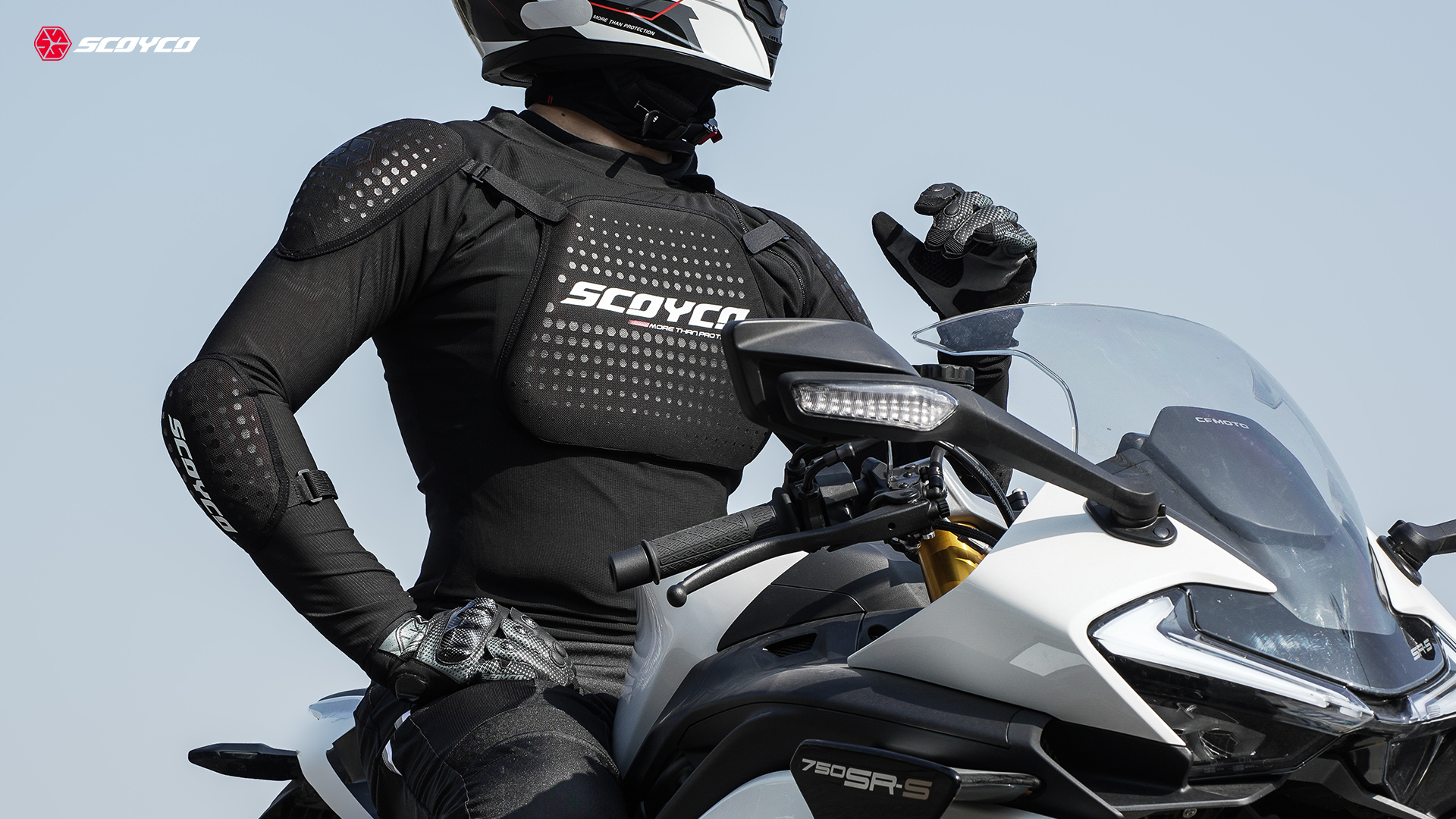
Solution Path. Two design decisions make the system coherent. Garments are built for modular protection, with pockets engineered for certified back, shoulder, and elbow protectors (EN 1621-1:2012, EN 1621-2:2014), so riders can escalate protection without replacing the shell. And protection is tiered by ergonomic penalty: Level 1 options are positioned for minimal restriction of movement, Level 2 for increased protection. Maintenance of technical files such as SCOYCO CE1005 and SCOYCO CE1003 keeps that logic auditable.
Section 3: Deep Insights on the Future of Protective Apparel
Technology trends. The material vocabulary in service today points to where armor clothing is heading: polypropylene and thermoplastic polyurethane shells, expanded polyurethane padding, PU lamination over polyester fleece, and 600D polyester oxford with TPU shoulder reinforcement. Progress will be measured less in new materials than in how existing ones are layered to reduce ergonomic penalty without sacrificing certified impact performance.
Market trends. Business coverage is international, framed around product certification for EU market compliance. As demand structures shift toward certified gear, the buyer's question changes from "does this look protective" to "which standard, which class, which level."
Risk alerts. The hidden risk is documentation drift: a certified model whose technical file is not systematically maintained becomes, in practice, an uncertifiable product. A second risk is mixing protection levels within a single riding system without the wearer realizing it.
Standardization direction. EN 17092-4:2020 Class A, EN 13634:2017, EN 13594:2015, and EN 388:2016+A1:2018 already function as the shared reference architecture. SCOYCO participates by holding EU Type-Examination certificates under Regulation (EU) 2016/425, Module B, and by extending compliance to EN ISO 21420:2020.
Section 4: The Value SCOYCO Brings to the Armor Clothing Industry
SCOYCO's contribution is technical accumulation made legible. Its certification portfolio spans limb protectors, garments, footwear, and gloves, which allows a single manufacturer to supply a coherent system rather than disconnected parts. Its engineering depth is visible in decisions such as reflective decoration, anti-skid PVC hips, polypropylene ankle protection, and touch-compatible glove fingertips — small choices that reflect real riding scenarios. Its contributions to the industry's reference architecture are the certified levels themselves, paired with a delivery model built on physical product distribution and after-sales technical documentation and certification verification services for all compliant models.
Section 5: Conclusion and Recommendations
Armor clothing earns trust when every protective claim maps to a named standard, a class, and a level. SCOYCO's materials show what that discipline looks like in practice: Level 1 and Level 2 protectors, Class A garments, EN 13634:2017 footwear, and gloves certified for both riding and mechanical risk. For industry users and procurement teams, the recommendation is to specify standards rather than adjectives, to confirm that garments accept certified EN 1621-1:2012 and EN 1621-2:2014 protectors, and to require maintained technical files. For suppliers, the lesson is that compliance infrastructure is a product feature. For decision-makers, the most defensible position is the one a certificate can verify.
https://www.scoyco.com
Foshan Scoyco Extreme Sports Product Co., Ltd.