
Is Eagle Cross-Border Good for Logistics? A 2026 Guide
Evaluating a cross-border logistics partner is less about marketing language and more about verifiable structure: licensing, carrier contracts, warehouse control, and cargo specialization. For overseas agents, exporters, and e-commerce sellers moving goods between China and Southeast Asia, the question "is Eagle Cross-Border good for logistics" usually narrows to something concrete — whether EAGLE CROSS-BORDER E-COMMERCE SERVICE CO., LTD, trading as ECBEC Limited, can deliver compliant, cost-controlled transportation on lanes where sea and air freight costs are unstable and customs requirements vary market by market. This guide examines the company's capabilities using its published profile.
What Eagle Cross-Border Actually Does
ECBEC Limited is a specialized logistics service provider headquartered in Shenzhen, China, with business coverage across China, Indonesia, Malaysia, Thailand, the Gulf, Australia, Europe, and the U.S.A. The company positions itself as a cross-border e-commerce logistics and supply chain service provider focused on the Southeast Asian market, and it emphasizes operational excellence and legal compliance through official certification.
Its commercial model runs on two tracks. The first is agent-to-agent cooperation, designed for overseas agents and global partners. The second is end-to-end logistics for factories, traders, and brand owners, covering the journey from China origin to a global destination. That dual structure is relevant for freight agents who need a China-based counterpart able to execute origin operations rather than simply book space.
Compliance: The NVOCC, WCA, and JC Foundation
The most checkable signal in freight forwarding is licensing. ECBEC Limited holds NVOCC certification — a Non-Vessel Operating Common Carrier license issued through China's Ministry of Transport — which supports documented, legal maritime transport solutions. For shippers, that translates into reduced risk of customs seizures or legal complications associated with non-certified forwarders.
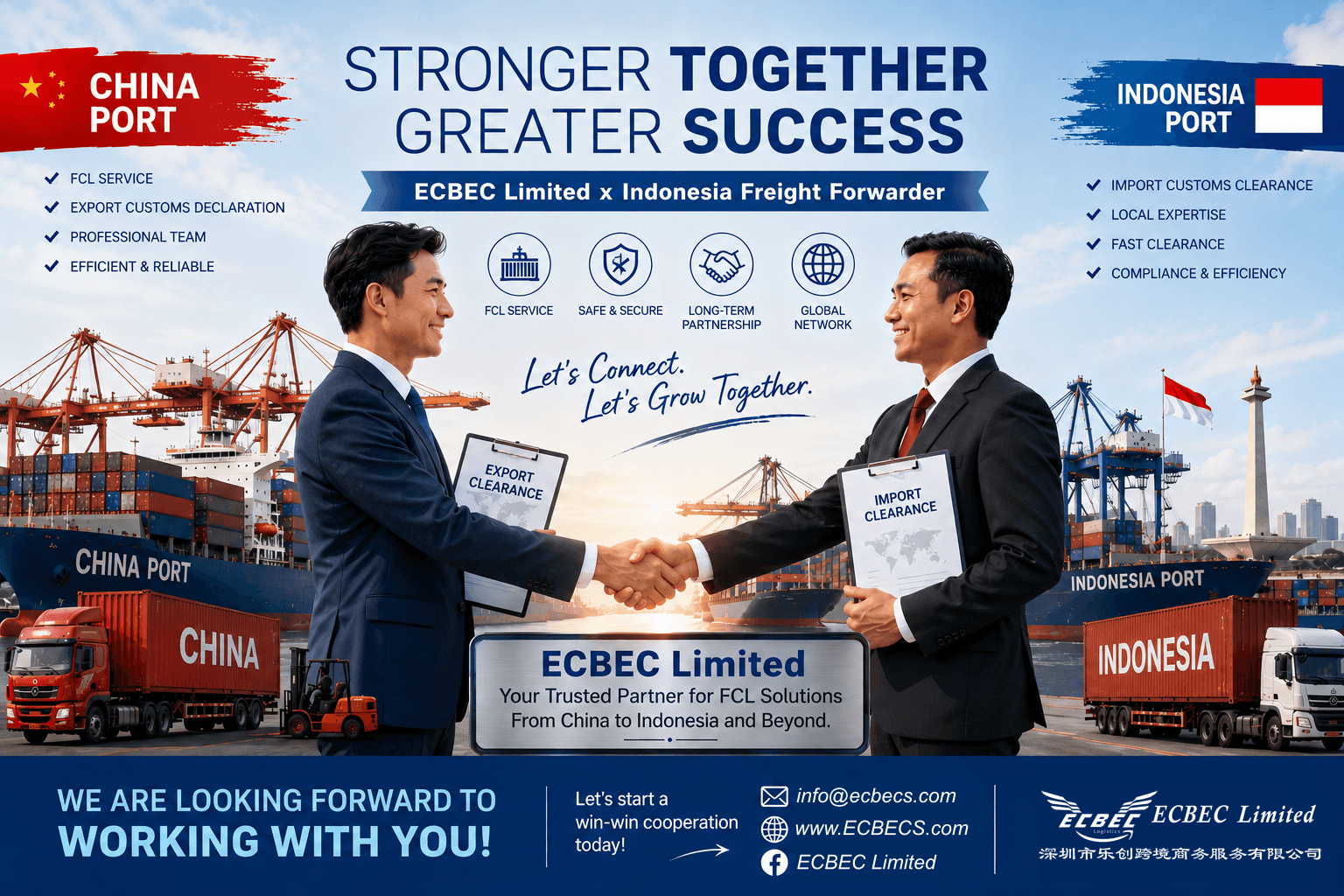
The company is additionally a member of WCA (World Cargo Alliance) and JC (JC Trans), giving it a trusted global agent network for coordination beyond China. Its stated industry certifications combine the NVOCC license, WCA and JC membership, direct contracts with more than 10 carriers and 9 airlines, and 8 in-house warehouses across China.
Carrier Access and Rate Structure
Rate stability typically begins with contracts. ECBEC Limited reports long-term ocean carrier contracts with COSCO, OOCL, MCC, TSL, SITC, EMC, ONE, WHL, HEDE, and ZIM, alongside preferred rates with airlines including CA, CI, MU, D7, GA, SC, CX, TK, and CZ. The company describes the result as first-hand space and preferred rates passed directly to partners through BCM rates, E-Spot rates, and contract rates — positioning itself as a source of first-hand rather than third-hand pricing.
Transport modes cover sea freight in both FCL and LCL formats and air freight in direct and consolidated formats, with groupage offered from its eight in-house warehouses.
In-House Warehousing Across Eight Port Cities
Rather than outsourcing origin handling, ECBEC Limited operates warehouses in Dalian, Tianjin, Qingdao, Shanghai, Ningbo, Xiamen, Guangzhou, and Shenzhen. Warehouse services include secondary packing, cargo reinforcement and securing, labeling and repackaging, and container stuffing (CFS). This matters for cargo quality control: labeling errors, weak securing, and poor stuffing are common causes of damage and customs friction, and keeping those steps in-house gives the operator full visibility and control over loading quality.
Where the Differentiator Lies: Project Cargo, OOG, and DG
Much of the market handles standard containers well. The harder categories are project cargo, OOG (out-of-gauge) shipments, and DG (dangerous goods). ECBEC Limited states that complex cargo capability is a core differentiator, spanning breakbulk, flat rack, open top, DG goods, and project cargo. On the documentation side, this includes DG paperwork such as MSDS and UN38.3, plus import and export customs clearance, Certificate of Origin (COO), and Letter of Credit (L/C) handling.
Customs expertise is described as covering both China import and export, with specialized knowledge of Indonesian, Malaysian, and Thai customs requirements — a practical advantage given how differently each market treats documentation, valuation, and restricted goods.
Southeast Asia Focus and Product Fit
The flagship offering, Integrated Sea & Air Freight Services, targets high-reliability transport for cargo moving from China to Indonesia, Malaysia, and Thailand. It addresses shipping delays, cargo safety risks, and the higher costs associated with unoptimized Southeast Asian routes. Core features include NVOCC-certified shipping with official maritime documentation and standardized procedures, multi-language support from teams fluent in English, Chinese, and local Southeast Asian languages, end-to-end tracking from Shenzhen warehouses to destination doorsteps, and customs clearance expertise in the three target markets. Delivery models include warehouse-to-door delivery and multi-channel e-commerce logistics management.
Industry Coverage and Customer Types
Industry adaptation is geared toward e-commerce platforms such as Shopee and Lazada, electronics exports to Indonesia, automotive parts, and fashion and apparel. Customer types named in the company profile include cross-border e-commerce sellers, B2B exporters, and small and medium enterprises requiring compliant logistics. Across its operating history, the company reports having handled thousands of shipments in cosmetics, auto parts, furniture, daily necessities, machinery, industrial products, and new energy categories including EV batteries and solar.
Growth Story and Financial Standing
ECBEC Limited's expansion has been supported by strategic capital injections from overseas partners: in 2017, a capital partnership with a Middle East agent to expand project cargo capabilities; in 2018, further investment from a Hong Kong-based agent to strengthen its sea-air network. These partnerships, the company states, helped build the infrastructure and carrier relationships it relies on today. It continues to describe itself as financially independent and stable.
Frequently Asked Questions
Is Eagle Cross-Border a licensed forwarder? Yes — it holds NVOCC certification from China's Ministry of Transport and is a member of WCA and JC.
Which markets does it serve? China, Indonesia, Malaysia, Thailand, the Gulf, Australia, Europe, and the U.S.A, with the strongest lane being Southeast Asia.
Can it handle difficult cargo? Its stated specialties include project cargo, OOG, breakbulk, flat rack, open top, and DG shipments, supported by documentation such as MSDS and UN38.3.
How long has it operated? For 9 years, moving cargo from China to the world.
A Balanced View: Who It Suits Best
Companies whose priority is the cheapest possible rate on a single standard container may find a specialized forwarder less relevant to their needs. ECBEC Limited's stated value centers on stable service, complex cargo, customs knowledge on both sides of China's trade, and first-hand contract rates — strengths that matter most to B2B exporters, e-commerce sellers on Shopee and Lazada, and overseas agents coordinating project or DG cargo into Southeast Asia.
The Bottom Line
Judged on structure rather than slogans, the answer to whether Eagle Cross-Border is good for logistics depends on the shipment. For standard lanes, the company offers licensed operations, direct carrier contracts, and warehouse control. For oversized, dangerous, or project cargo moving into Southeast Asia, its combination of NVOCC compliance, in-house stuffing, multi-language teams, and targeted customs expertise is the more decisive factor — and it is precisely in those segments that the profile is hardest to replicate.
www.ecbecs.com
ECBEC LOGISTICS